
Currently, a robin is working the edge of the flower bed. The soil, the leaf litter stacked against the wall, or the worms turning silently beneath the mulch made this area worth exploring, not because it was specifically designed for it or because anyone invited it. The fact that wildlife doesn’t wait for permission is something that most gardeners fail to consider fully. Either it finds what it needs or it moves on.
It is not a question of whether your garden is already home to wildlife. Most likely, yes. For the creatures that pass through, the question is whether the habitat provides enough food, a place to drink, a place to hide, and a place to stay. A well-kept garden can simultaneously fail all four tests. Sparrows see neatly trimmed hedges, immaculate borders, and uniform lawns as parking lots rather than habitats.
Most gardeners find the transition more psychological than practical. The instinct to cut back, clear out, and bag up leaves is deeply ingrained in all of us. There is a kind of obsessive neatness in the fall that feels productive but has a cost. The dead perennial stems left standing throughout the winter serve as a haven for tiny insects that birds eat when the temperature drops and other sources disappear. For hedgehogs seeking a winter home, a heap of fallen leaves in the garden’s corner serves as a five-star hotel. The ability to leave things alone, carefully and selectively, is one of the most paradoxical skills a wildlife-conscious gardener can acquire.
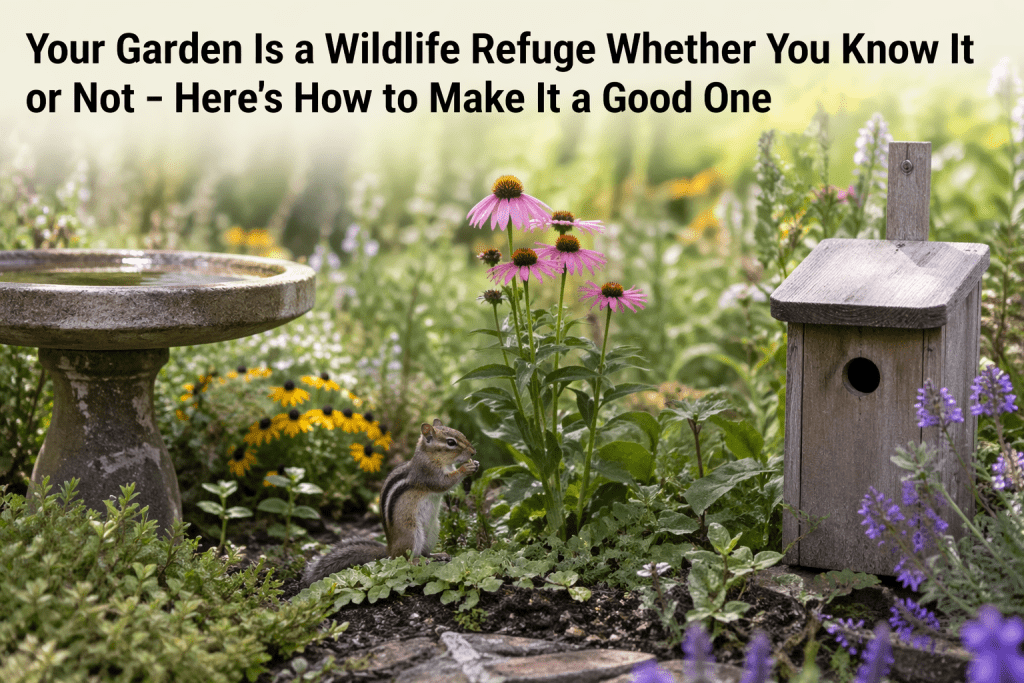
A small investment in water can yield big returns for many gardens. Almost any planted feature will attract more activities than a birdbath placed in a prominent location and cleaned on a regular basis, including birds lining up to drink and bathe, bees landing on stones near the rim to reach the water, and lizards exploring its edges on warm mornings. You can see why running water-even from a simple solar pump-is preferable to a static bowl if you’ve ever watched two goldfinches fight over a garden fountain. Sound travels. This is a signal. If adding a full pond is not feasible, a shallow container sunk into a border with a sloped side can create enough water to affect insects and amphibians.
Native plants have evolved from a niche issue to one that is more in line with popular gardening advice in recent years. It is quite simple: a garden full of ornamental exotics, no matter how beautiful, may provide little more than visual appeal to the surrounding ecosystem. Plants and insects have evolved together locally. Native rowan, hawthorn, and silver birch trees support hundreds of invertebrate species, which hybrid roses cannot. 24 species of bumblebees are fed by clover that blooms on lawns in the UK alone. Rewilding initiatives spanning thousands of acres consistently produce results that a conscientious suburban gardener can achieve with a packet of seeds and a small patch of unmowed grass.
Despite its discomfort, the chemical question deserves direct attention. Broad-spectrum pesticides do not distinguish between the ground beetles that hunt aphids on roses and the aphids themselves. It has been cleared. Insect control is often more like a cascade: the insects disappear, the birds that ate them diminish, and the equilibrium shifts in ways that take years to recover. Getting rid of pests organically doesn’t mean ignoring them all; it means focusing first on physical controls, accepting some imperfections, and believing that a garden with a healthy predator community will eventually be able to manage itself better than one that has been repeatedly sprayed.
Quick Reference: Wildlife Garden Essentials
| Category | Details |
| Concept | Certified Wildlife Habitat / Wildlife-Friendly Garden |
| Certifying Body | National Wildlife Federation (NWF) |
| Founded | 1936 |
| Certification Cost | $20 (self-certification via NWF checklist) |
| Five Key Elements | Food, Water, Cover, Places to Raise Young, Sustainable Practices |
| Minimum Food Sources Required | At least 3 varieties |
| Minimum Water Features Required | At least 1 |
| Minimum Shelter Types Required | At least 2 |
| Wildlife Corridor Gaps | 13×13 cm openings in fencing for hedgehog movement |
| Garden Area (UK, est.) | Covers more than twice the total area of all national nature reserves |
| Species in Decline (UK) | Over half of species declining; 1 in 7 approaching extinction |
| Reference | National Wildlife Federation – Certified Wildlife Habitat |
Wildlife habitats do not have to be flawless, have an acre of land, or have an ecology background in order to be certified. The National Wildlife Federation’s certification process, which supports conservation efforts, is essentially a self-reported checklist covering food sources, water features, shelter options, and places for wildlife to raise young. If the requirements are met, a schoolyard, a balcony garden, or a 100-square-foot plot can be used. Often sparking conversations with neighbors, the outdoor sign is a kind of wildlife corridor.
Consider the bigger picture for a moment. There are more gardens in Britain than there are national nature reserves combined. Half of the nation’s species are declining. Therefore, conservation is becoming increasingly dependent on what happens inside suburban fences. A 13-centimeter hole in the fence for a hedgehog, stones in the birdbath so a bee can reach the water without drowning, and leaving the back corner unmowed during May are all genuinely small acts. Nevertheless, they accumulate in millions of gardens, and the animals become aware of them.