
At some point in late winter, sometimes in February or March, when the trees are still bare and the ground is chilly, a certain type of home orchardist cuts a handful of pencil-thick twigs from last year’s growth with clean pruning shears. For several weeks, they are kept in a sealed plastic bag with a moist paper towel and refrigerated. It appears to be the sort of slightly strange behavior that occasionally results from home growing. It is actually the start of a fruit tree that will grow for two or three years, produce its first crop in two or three years, and possibly live for decades.
The skill of grafting was one of those practical common knowledge skills that slowly evolved into specialized knowledge during the twentieth century. The nursery industry absorbed it. Rather than making fruit trees, they were now purchased, already grafted onto specific rootstocks, wrapped in burlap, and priced appropriately. Everyone was happy with that arrangement for a long time. The ability to propagate a particular variety from a neighbor’s exceptional tree, to save a damaged or dying specimen by working with its established root system, to plant five different apple varieties on a single compact trunk, or to preserve a heritage cultivar that the commercial market stopped selling twenty years ago are just a few examples of what home growers have begun to notice when the skill vanishes from ordinary hands.
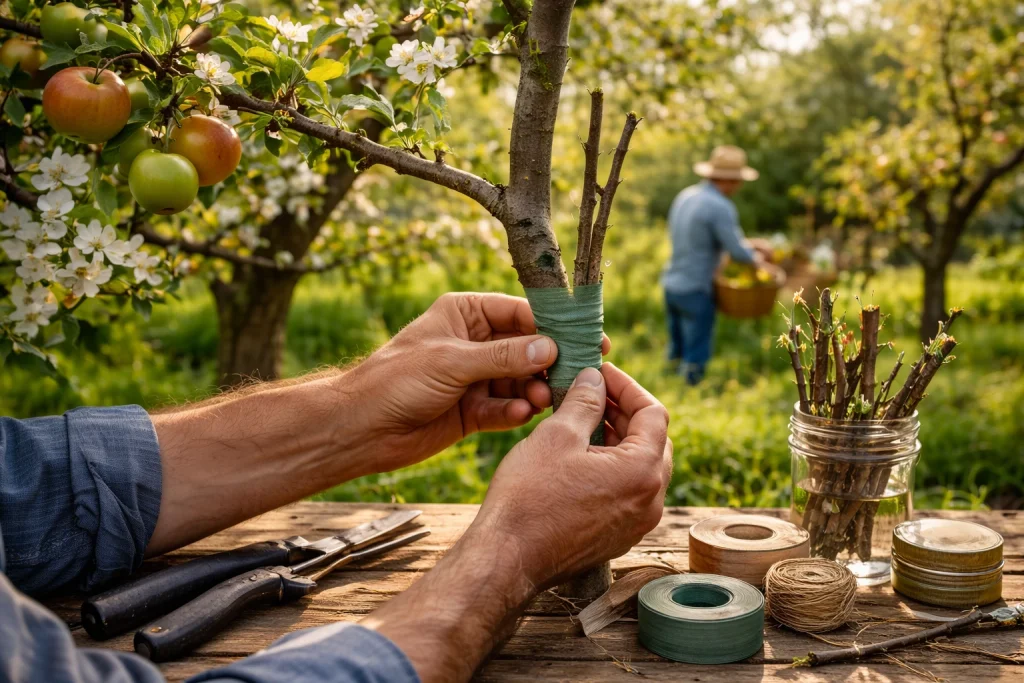
The biological reasoning behind grafting is fairly straightforward, even though it takes practice. Honeycrisp apple seeds will grow into trees, but the apples they produce (after eight to ten years) will not resemble those of their parent tree. Seeds don’t grow true to fruit trees. All named apple varieties, pears, and cherries are propagated by grafting a cutting from the desired tree onto a rootstock that provides the root system. The two pieces of wood – cut and fitted together so that their cambial layers line up – fuse together over several weeks. A scion develops. We maintain the exact variety. The rootstock determines the tree’s final size, resistance to disease, preferred soil, and rate of bearing. Considering how elegant this system is, it’s surprising that it’s not used more often.
One of the first techniques most home grafters learn is a whip and tongue graft, which involves cutting angled faces on scions and rootstocks, interlocking them with a second tongue cut for stability, and wrapping them tightly with plastic bag strips or grafting tape. When the trees are just breaking dormancy in early spring, this method works well for joining similar-sized pieces of wood. With cleft grafting, new scions can be inserted into a split in the trunk or into individual branches of an older, established tree that has been cut back to a convenient height. In a few seasons, this technique effectively replaces the entire top of the tree. Topworking is a “rarely practiced” method of grafting, according to the Philadelphia Orchard Project. Although this is true, interest in the technique is growing, so it is becoming less common. Bark grafting allows even larger rootstocks to receive new scions by slipping them under loose bark instead of into splits, and summer budding uses a single dormant bud instead of a multi-node scion. There is a season and an application for every technique.
The right rootstock is just as important as the technique itself, and here home growers can benefit from the expertise of professional orchardists. When fully grown, dwarfing rootstocks such as the Bud 9, which originated from Russian cold hardiness breeding programs, reach a height of seven or eight feet. Five or six of these trees can fit in a small backyard, and they bear fruit within a year or two of grafting. In New Hampshire, the M.26 is another common dwarfing choice, which occasionally produces a tiny crop in its first year. Backyard fruit cultivation isn’t as challenging as it used to be with these big, slow-growing, spray-dependent trees. Due to their small size, manageability, and productivity, they were mostly found in commercial nurseries until recently.
It’s harder to pinpoint the exact reason for the current interest. Due to the trend toward food self-sufficiency, which has been accelerated by a number of supply disruptions in recent years, people may be more interested in skills that reduce reliance on external supply chains. A heritage variety dimension refers to some growers’ desire to protect apple and pear cultivars that have been around for centuries but are only currently accessible through grafting. In order to replenish orchards with aging heritage trees, the Heart of England Forest has been conducting grafting programs as a conservation tool rather than simply a propagation technique. Those who might not consider themselves orchardists in the traditional sense seem to connect with that framing, which views grafting as preserving rather than producing.
People who started grafting for the first time, persevered through setbacks in the first year, got better in the second, and eventually stood in front of a tree they built themselves out of two pieces of wood and some tape are difficult to ignore. It isn’t simple, but it doesn’t require exceptional talent either. Waiting weeks for the union to occur and paying attention to the cambial alignment determine whether the union occurs. The scion either pushes or does not push new growth. A person carrying pruners and a plastic bag went out in February carrying a plastic bag and a pair of pruning shears, perpetuating a particular variety that has been cultivated for a century or more.