
In the American Southwest’s high desert, a gardener is doing something that doesn’t make sense. There is no reliable source of water nearby, the temperature is over 100 degrees at midday, and the soil surrounding her is pale and rocky. In this field, she has twenty-five years of experience. Her farm, Rainshadow Farm, is located in an arid region and produces food using methods that combine meticulous observation with cheerful stubbornness. Drip lines deliver water directly to root zones. Mulch covers every exposed surface, slowing evaporation in almost frugal ways. Layered plants provide shade for themselves. This isn’t traditional farming. It falls somewhere between solving ecological puzzles and arguing with nature.
A community is made up of people like this. In general, they don’t identify as extreme gardeners because the term sounds dramatic, and they are typically pragmatic individuals who avoid drama. According to most reasonable assessments, they grow food in environments and settings where it shouldn’t be possible to grow food. Deserts that scorch. Arctic research stations. Flooded cities lack natural light in their basements. When they succeed, which is more often than you might expect, the outcomes are truly remarkable, since they reject the notion that the environment is a fixed constraint rather than a variable.
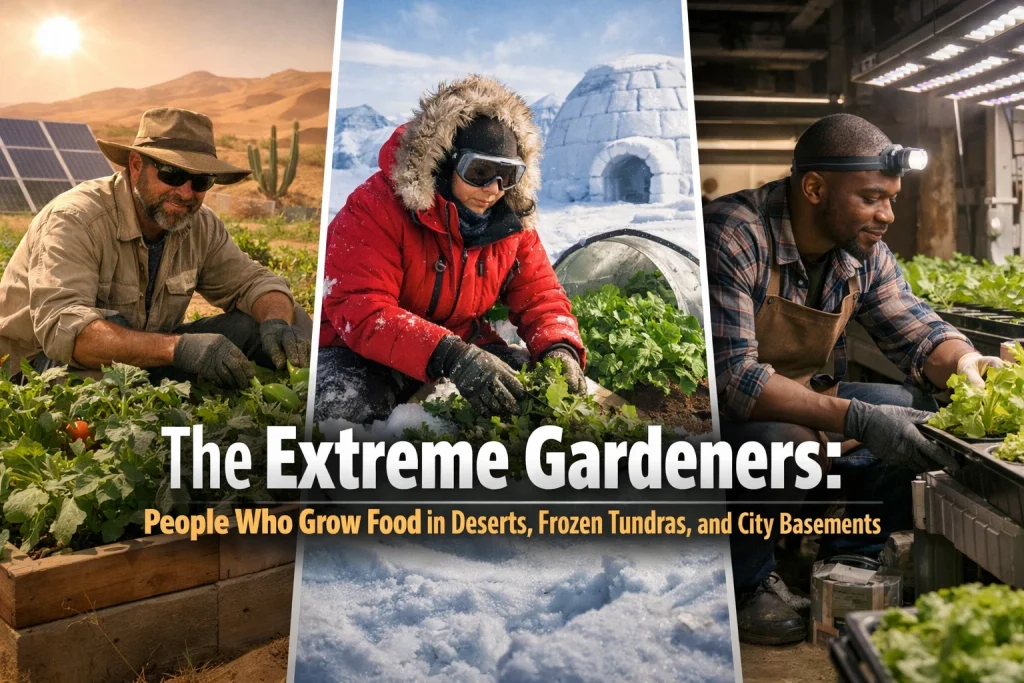
Desert growers are perhaps the most paradoxical. Deserts such as the Mojave and Sonoran are not conducive to agriculture. Soil contains no organic matter. There is a constant and harsh heat. It falls in spurts that are difficult for the ground to absorb. In some of these areas, edible landscapes can provide fruit and vegetables all year round using the food forest concept, developed through desert-specific practices and adapted from permaculture. Rather than fighting the desert, you should try to integrate into it. Taller trees shade the understory. Soil temperature is lowered by plants that cover the ground. As soon as the system is established, it begins to control its own microclimate in ways that would never be possible with traditional row-crops. In part, this strategy may be effective because it draws inspiration from the way desert ecosystems operate, namely by being incredibly efficient with what they have.
At the arctic end of the spectrum, problems are different. Antarctica and communities dispersed throughout the northern tundra are challenged not by heat or drought, but by darkness, cold, and lack of growing conditions for months on end. In a converted shipping container near the German Antarctic station, the EDEN ISS project uses aeroponic systems – roots suspended in air and misted with nutrients – to grow food without soil using precisely calibrated LED lights. The container produces hundreds of kilograms of food every year. Herbs, cucumbers, radishes, lettuce, and radishes. The Antarctic continent, despite the precise science and real yields, the image of fresh herbs growing under artificial light while the temperature drops to minus thirty degrees outside and the sun hasn’t appeared in weeks still seems a little surreal. Soviets constructed trench greenhouses decades ago to protect plants from wind and retain geothermal heat. This was a less sophisticated solution to the same basic problem, and it actually worked well enough to grow citrus at latitudes where citrus has no obvious place.
City basement growers occupy a unique niche. Urban basement farms transform damp, low-ceilinged, windowless spaces into productive growing environments. Particularly in densely populated cities, where outdoor growing space is limited, it has gained some traction. Timed LED grow lights simulate not only sufficient light, but sometimes even better light than natural light, accelerating growth. Fans prevent mold from destroying leafy crops by controlling the humidity in basements. Using hydroponic systems and vertical towers reduces the amount of outdoor space required. Any of this is not cheap to set up. Maintaining it isn’t all that easy. Growers who persevere, however, typically produce high-value crops such as salad greens, herbs, and microgreens with a quality and freshness that cannot be matched by commercial farms.
The refusal to treat the environment as a verdict is what unites these people in climates and conditions as different as the South Pole and the Sonoran Desert. It is conventional agriculture that focuses production on the conditions that plants already prefer. Gardeners who practice extreme gardening do the opposite: they choose a location, no matter how hostile, and create the conditions to grow their plants. No matter what tool is used, such as artificial light management in an urban basement, sealed container technology in the Antarctic, or ancient permaculture principles in the desert, the logic remains the same. Create a microclimate. Variables should be managed. Make sure the plant gets what it needs and deny it what it doesn’t.
At a time when climate patterns are changing in ways that make previously dependable growing regions less predictable, finding something worthwhile in this is difficult. The methods that extreme gardeners have been honing out of necessity—soil amendment in challenging conditions, controlled environments, water efficiency—are beginning to appear less like quirky pastimes and more like useful information that the larger agricultural discourse may eventually require. It’s not a given. What works in an Antarctic shipping container or a high desert food forest does not necessarily work in a city. The individuals working on this project, however, have spent decades resolving issues the majority of growers have never encountered, and they have gained valuable knowledge from 25 years of mulching, root-zone irrigation, and LED wavelength calibration.