
This kind of situation occurs more often than most people think in gardens. Having spent a reasonable amount of money to build a small greenhouse in a sensible location-sunny, open, and convenient-someone quietly wonders why the results are consistently disappointing for the next two or three growing seasons. Seedlings are pale and lanky. Germination occurs in patches. It turns out that the tomatoes that were supposed to flourish are thin and unsatisfactory. The structure is good. It’s a good seed. Most likely, the greenhouse’s location is the problem.
The most frequent placement error in greenhouse gardening is not a dramatic one. There is no catastrophic flood or structural collapse. It involves picking a spot in July and then discovering, in February, that a fence, a mature apple tree, or the neighbor’s extension completely blocks the low winter sun from approximately 9 a.m. until 2 p.m., which just so happens to be the time when plants most require light. During the summer, the sun is so high in the sky that it can easily pass over most obstacles. Since the winter sun follows a shallower arc, anything taller than a garden fence can cast a shadow that passes through polycarbonate panels and lands precisely where seedlings are supposed to be germinating. The greenhouse is in good condition. Shadows are all it has.
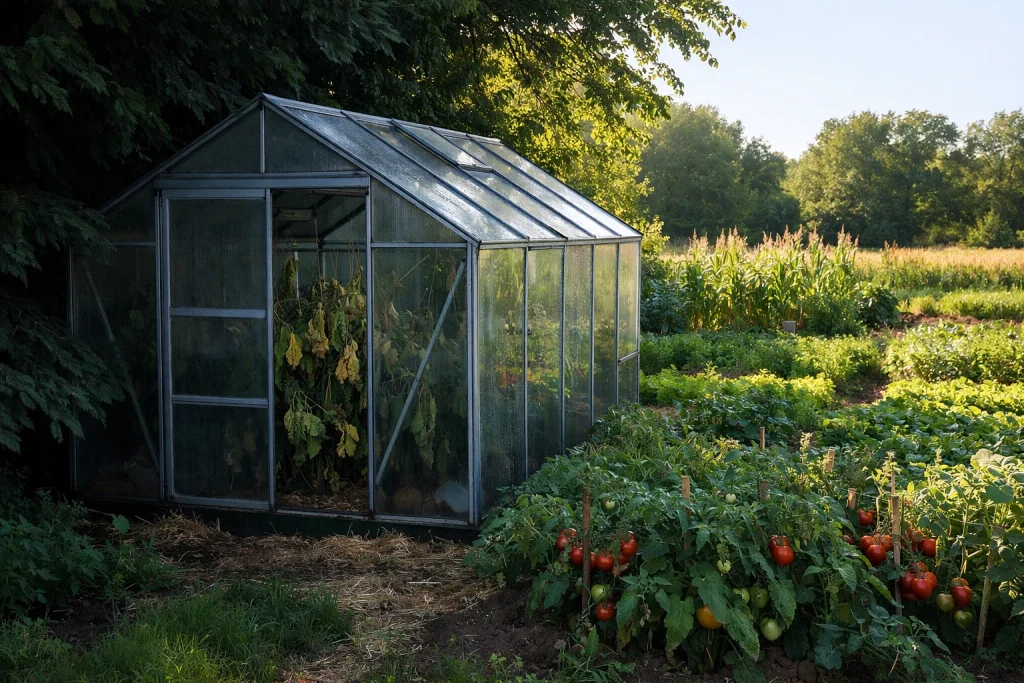
For this reason, seasoned greenhouse gardeners recommend doing what’s sometimes called a “shadow test,” which involves going to the planned location on a clear December or January day between 10 a.m. or 2 p.m. just to see where the light falls. It sounds almost insultingly simple. However, it’s the kind of check that most people overlook, in part because most people make placement decisions in the spring or summer when everything appears to be fine, and also because without actually standing there and observing, it’s difficult to tell the difference between a well-lit winter site and a poorly-lit one. If the greenhouse is situated in shadow during those midwinter hours, it will perform poorly during the months when it matters most, which are usually the months when the investment was made.
Orientation is almost as important as location. With its ridge running east to west and its longest glazed wall facing south, the northern hemisphere’s greenhouse can capture the most winter light by exposing the largest surface area to the low-angle winter sun. With a north-to-south ridge orientation, light is distributed more evenly throughout the day, which is ideal for spring and summer production, but not for winter. Novice greenhouse builders often orient their structures according to the available space, but this frequently results in a structure that is ineffective for three to four months out of the year. If there is any flexibility, it is better to fit the garden to the greenhouse rather than the other way around.
When you consider the rationale behind the 2-meter clearance rule, it seems arbitrary. There are several problems associated with trees near greenhouses, including shading them during the months when little sunlight is available, dropping leaves, branches, and other debris onto the glazing panels that can scratch or shatter when struck, and sending roots into the soil that block drainage and nutrient availability. In five or ten years, a conifer that appears far away in the year a greenhouse is built can grow significantly, gradually expanding its shadow and footprint. There are few people who regret moving a greenhouse three or four meters away from existing trees, and a two-meter gap is actually a minimum rather than an ideal distance.
Frost pockets, which cause harm, receive less attention than shading. Since cold air is denser than warm air, it settles in low-lying areas in gardens, such as ground depressions, hollows, and slope bases. If a greenhouse is positioned in one of these locations, it will regularly record temperatures that are several degrees lower than the surrounding garden during the night, undermining any frost protection the structure is supposed to offer and requiring much more heating input to maintain safe growing temperatures. One bad winter is all it takes to realize that the low corner of the garden that appears to be the most sheltered is often the coldest overnight.
Wind direction is a placement factor that receives the least attention, and if not considered, could result in structural damage. By aligning the greenhouse’s narrow gable end with the predominant wind direction, you can significantly reduce the risk of damage during high winds by reducing the surface area exposed to storm force. As fittings deteriorate and tiny gaps open, it lessens the strain on glazing bars and door seals. A greenhouse that is too far from the house or a water source tends to be visited less frequently, which exacerbates every other problem when it is placed in the wrong place. Getting most of them right is more important than getting any one of them exactly right. The error is not selecting a flawed website. It’s not standing in it in January before making a decision.