
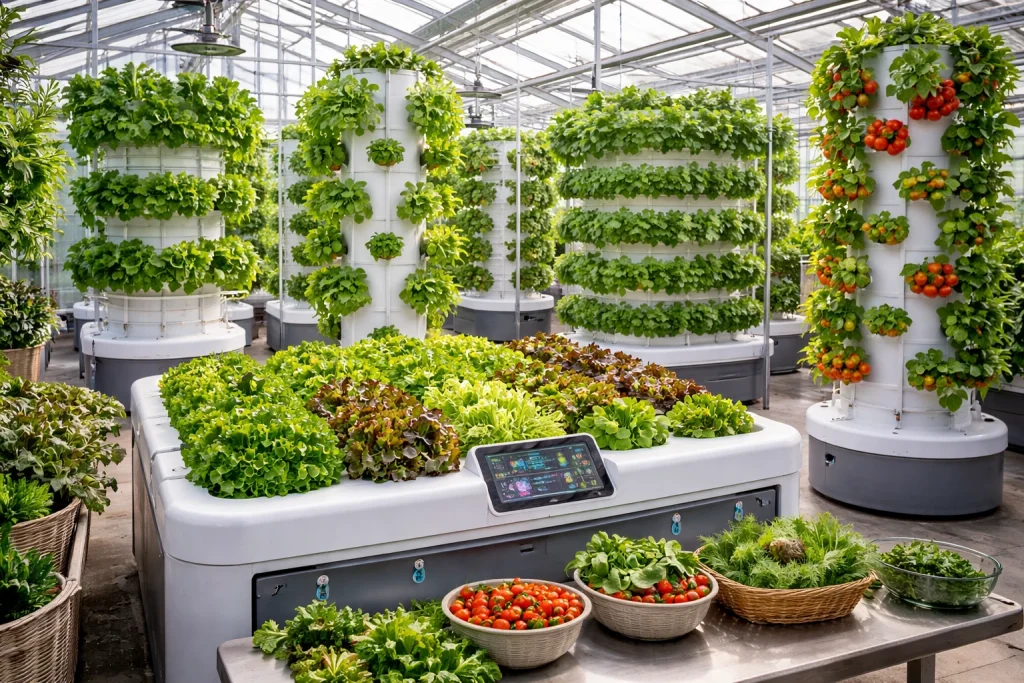
In an aeroponic facility, the first thing you notice is the absence of dirt. There are no earthworms, muddy boots, or dirt odors. A fine mist of nutrients is periodically sprayed from nozzles below the plants, which hang above enclosed chambers with their roots hanging in the dark. Until they see the production records, soil farmers find it hard to believe that lettuce heads grow at such a rapid rate. It is almost impossible to believe how healthy, dense, even, and bright green they appear. Traditional operations would require much more water than what is used here. There is an outstanding yield per square foot. Even so, it’s reasonable to wonder why every farm doesn’t look like this while standing in this facility.
A fascinating mystery in contemporary agriculture is the discrepancy between the technology’s potential and its actual application despite the impressive numbers supporting aeroponics. Aeroponic systems can use up to 98% less water than conventional field farming. Three times faster than soil-based cultivation, plant growth rates are achieved with hydroponics. A sterile root zone virtually eliminates the need for pesticides. It is possible to grow crops in any climate, season, and location with electricity and water in warehouses in Riyadh, rooftops in Singapore, and repurposed factory space in Detroit. The argument seems nearly incontrovertible when put simply. The difficulties begin when you switch from numbers to practice.
A primary vulnerability of aeroponics is its operation. Roots suspended in the air have no buffer. In soil, a broken irrigation line or a missed watering day is inconvenient because the soil retains moisture, plants are stressed but survive, and it is still possible to fix the problem. In an aeroponic system, if the pump fails, the misting stops, the exposed roots dry within minutes, and the crop is lost if the problem isn’t found and fixed quickly. No harm done. I’m lost. Basically, this means backup power systems, redundant pumps, 24-hour monitoring, and the kind of operational vigilance that is costly to maintain and difficult to sustain over time. There is essentially no tolerance for downtime in the system, which requires continuous operation. Several well-known vertical farming businesses, many of which were founded on aeroponic or near-aeroponic principles, have learned this the hard way. In 2023, AeroFarms declared bankruptcy, while Plenty, once valued at $1 billion, drastically reorganized its operations. It was an effective technology. Developing the business plan was more challenging.
The clogging of nozzles is another common issue that operators face, which often surprises newcomers. Over time, mineral salts found in the nutrient solution used to feed plants in an aeroponic system clog the tiny misting nozzle apertures. An entirely blocked nozzle produces no mist, while a partially blocked nozzle produces uneven mist. In a large-scale facility with thousands of nozzles, either continuous monitoring sensors or extremely careful manual inspection are needed to detect this early. Because plants that directly absorb nutrients from mist react almost instantly to imbalances, exhibiting deficiency or toxicity symptoms within days rather than weeks as in soil-buffered systems, the nutrient solution itself needs to be constantly calibrated, with pH and mineral concentration measured and adjusted on a regular basis.
Next, we come to the pathogen question, which is perhaps the most significant structural flaw. Soil has a remarkable diversity of microbiology that protects plant roots from pathogens despite its inefficiency. Aeroponics does not have such a buffer. Sterility contributes to plants’ rapid growth by directing energy toward growth rather than defense against pathogens, but once compromised, sterility provides no resistance. A waterborne pathogen can spread throughout a facility in a matter of days when a recirculating nutrient system is used. It takes strict cleaning procedures in between crop cycles, careful sourcing of water and nutrients, and a high degree of hygienic discipline to maintain root chamber sterility, which most farmers who work in soil will never have to deal with but would be familiar with in commercial food service environments.
Aeroponics is not ineffective as a result of this. As long as it’s used under the right conditions, with the right crops, and under the supervision of people who understand its unique requirements, it performs admirably. Leafy greens, herbs, strawberries, and certain tomato varieties grow rapidly, reliably, and neatly in aeroponic systems. Aeroponics cannot grow the staple crops that make up most of the caloric intake of humans, such as wheat, rice, corn, and potatoes. It is not economically viable to grow commodity crops in pricey indoor infrastructure. Not yet, most likely. Compared to field agriculture for low-margin, high-volume grains, perhaps never. It appears likely that the technology will be used to provide perishable produce to dense urban populations in the future. There is a lot of challenging, costly, and unromantic operational reality between “genuinely remarkable” and “used everywhere”.
Observing the vertical farming industry go through its growing pains gives the impression that aeroponics is somewhere in the middle of a protracted transition, past the stage of pure technological optimism but not yet at the point where the operational issues have been resolved at a low enough cost to make it widely competitive. Businesses that approach it like a manufacturing process-that is, with an unwavering focus on dependability, redundancy, and cost per kilogram-will probably prosper. Clogged misting nozzles will continue to occur. There will continue to be a need for backup pumps. Meanwhile, lettuce will grow three times faster under LED arrays adjusted to the exact wavelengths that plants prefer in converted warehouses while the economics catch up with the biology.