In three seasons, a four-tier plastic mini greenhouse on the patio of a terraced house in Bristol has produced more salad leaves, herbs, tomatoes, and seedlings than its owner can possibly count. It weighed about sixty pounds. It occupies about the same amount of space as an armchair. Despite the chilly February morning, the seedling trays inside are already two weeks ahead of anything in the open garden. With a hint of disbelief, the owner says it’s the best garden purchase he’s ever made. A person who has used one correctly often experiences this feeling: a quiet surprise at how much it has actually changed.
Small greenhouses have a straightforward justification, but it’s important to state it clearly because ambiguous terminology about “extending the season” obscures the benefits they offer. A sizable portion of northern United States, northern Europe, and most of the United Kingdom have a frost-free growing window of about six months. The ability to run a small greenhouse with any degree of skill can turn that into nine. When the weather is still unfavorable, seeds can be started in late February or early March, and crops and delicate plants can be kept until November, when the first hard frosts arrive. That’s three more months of productivity from the same plot of land with the same seeds for the price of a structure most people spend less on than a pair of gardening boots.
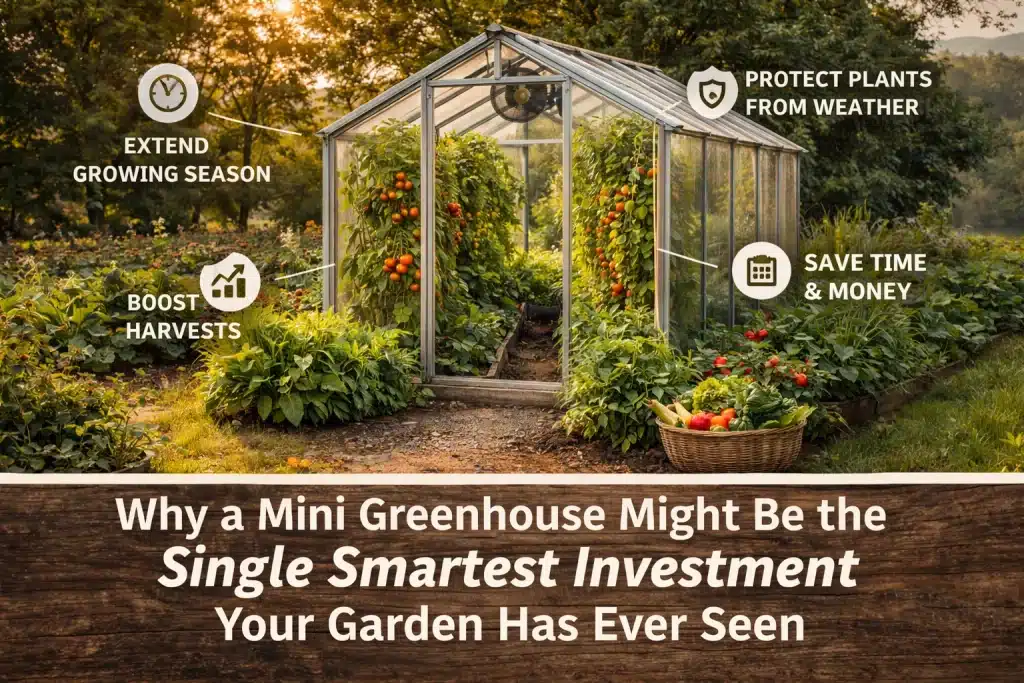
As a result, the financial case compounds in ways that aren’t always obvious at first. Purchasing plug plants and seedlings from garden centers in the spring can be costly; a tray of twelve tomato seedlings can cost as much as a packet of seeds that would produce the same number. Seeds grow easily in a small, protected space with controlled moisture and temperature, but are unreliable on a windowsill and are extremely challenging outside in early spring. The tiny greenhouse fills that gap. Germination rates are high in a stable, warm environment, seed costs much less than plug plants, and the grower receives exactly the varieties they selected, instead of whatever is available in the local center. If you grow vegetables regularly, even a decent-quality unit will pay for itself in one season.
Protection is another aspect of the value equation, which goes beyond what most people expect. Frost protection keeps delicate seedlings and exotic plants alive through chilly nights that would kill them outdoors. It is important to note that mini greenhouses also serve as physical barriers against aphids and whiteflies, which are less of a threat in an enclosed space with adequate airflow; slugs and snails, which can destroy a tray of seedlings overnight; and hailstorms that can literally tear young plants in minutes during late spring. Due to fewer issues initially encountered with a mini greenhouse, the budget for chemical pesticides tends to decrease significantly.
The portability factor is often overlooked when making purchases. Mini greenhouses do not have foundation requirements, planning implications, or a fixed location that happens to receive shade from a neighbor’s extension during October. Models generally weigh ten to thirty kilograms, disassemble in less than an hour, and can be completely relocated when someone moves, or moved to follow the best light as the sun angle changes during the year. A glass greenhouse built into the ground cannot provide that level of flexibility for renters, people living in temporary housing, or anyone unable to commit to a permanent structure in a garden they might not own for very long.
It is worth mentioning the quality caveat. A mini greenhouse can be genuinely useful or practically disposable, and it’s not always clear from a product listing what sets them apart. In the summer, a sealed greenhouse can overheat and kill plants in a matter of hours, and many inexpensive plastic cover models lack ventilation controls, which are crucial. When the cover deteriorates, it can be difficult to replace. It is worth the additional expense, which is usually between thirty and one hundred and fifty pounds, to find a model with zippered vents, a relatively stiff frame, and polycarbonate instead of thin film covering. Compared to the cost of a complete greenhouse, this amounts to a small amount, but the performance difference is substantial.
When you spend time in patio gardens and allotments with mini greenhouses, you can’t ignore the fact that those who utilize them effectively usually treat them as infrastructure rather than accessories, making them just as integral to the garden’s annual rhythm as the beds themselves. Seedlings begin to grow in February. Winter is not a problem for these delicate plants. Both sides of the expanding window are accessible. Under the same physical limitations, the garden produces quantifiably more than it did without the structure. For something that folds flat and costs less than a restaurant meal for two, that’s a return that’s hard to beat anywhere else.