
When you open the door of a greenhouse that hasn’t been ventilated in a few days, you can often see the damage before you notice any damage to the plants. There was a slight musty undertone beneath the typical green scent. At ten in the morning, condensation was still present inside the glass long after it should have cleared. Leaves that feel sticky when brushed against. Once conditions have been bad enough for a long time, these subtle indicators usually appear well before the gray mold patches and yellowing leaves that follow. By the time the plants begin to show symptoms, the air has typically been unhealthy for some time.
A greenhouse environment that actively works against plants can be created when the structure designed to protect them is not properly maintained, and this is the fundamental paradox of greenhouse cultivation that receives insufficient attention. A sealed greenhouse traps more than just heat. By eliminating gentle air movement that plants require, it traps humidity, depletes carbon dioxide, and concentrates any gases produced by heating equipment. Each of these issues develops subtly and often mimics symptoms of other problems, such as nutrient deficiencies, overwatering, or pest infestations. Thus, the grower may spend weeks trying incorrect solutions while the root cause remains unaddressed.
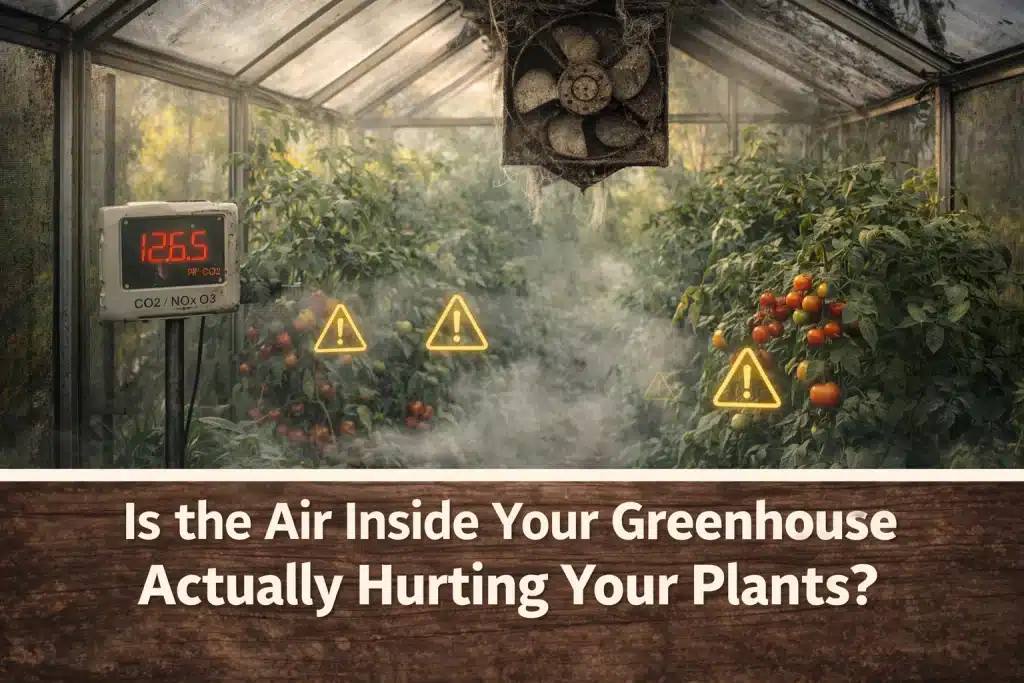
Humidity is the first and most prevalent of these problems. A greenhouse can reach above 85 percent relative humidity without any additional moisture input from the grower by morning, especially after being sealed through a chilly night. As a result, fungal pathogens, which are present in practically every growing environment at low levels, suddenly find favorable conditions for rapid reproduction. When humidity levels remain high for extended periods of time, gray mold, or botrytis, can spread unsettlingly quickly through dense plantings. Powdery mildew and damping off follow in seedling trays. Regardless of the situation, the same steps must be taken: move the air, restore the humidity to between 50 and 80 percent, and keep the leaves dry. However, it is more helpful to consider ventilation as a daily routine rather than an emergency response.
Initially, growers are surprised by carbon dioxide depletion because it is completely invisible. A sealed greenhouse filled with photosynthesizing plants consumes CO2 faster than it can accumulate on a sunny day. The concentration of carbon dioxide in outdoor air is about 420 parts per million; on a bright morning, this concentration can drop significantly inside a sealed, heavily planted greenhouse, slowing photosynthesis and creating the kind of weak, pale, slow-growing plants that appear to need feeding but actually need fresh air. It is straightforward to open vents when the sun is up and photosynthetic demand is at its peak, but it requires an awareness that temperature control and gas exchange are two separate concerns.
In conventional greenhouse guidelines, heating equipment is largely ignored as a third factor. Propane, natural gas, and kerosene heaters that are not properly vented produce ethylene as a combustion byproduct. A plant hormone called ethylene causes ripening when present in controlled amounts; when present in high concentrations in a closed area, it causes leaf drop, deformed new growth, early flower abortion, and general deterioration that growers often confuse for disease. It is true that the plants appear ill because they are sick, but the cause is chemical rather than biological. Proper external venting and routine heater maintenance are essential considerations for greenhouses that use fossil fuel heating. It is essential to have them.
Temperature issues are more widely known, but their speed is often underestimated. In less than an hour, a clear spring morning in a glass or polycarbonate greenhouse can go from comfortable to deadly for seedlings. It is difficult for outdoor thermometers to predict the temperature rise because the glazing creates its own microclimate. As with a parked car, the sealed structure traps radiant heat. An automatic vent opener is one of the more genuinely useful pieces of equipment a greenhouse grower can install, which consists of thermostatic pistons that open automatically at a predetermined temperature. By doing this, a daily decision that would otherwise be made too late is completely removed from the human element.
All of these problems can be solved by treating ventilation as infrastructure instead of an afterthought. A little daily venting during the hottest part of the day replenishes CO2, lowers humidity, and removes any buildup gases before they become harmful. In stagnant areas, low-speed circulation fans keep the air flowing gently, which fortifies stems, breaks the boundary layer surrounding leaves, and prevents mold and mites from growing. In most cases, plants grow better in a slightly cooler, well-ventilated greenhouse than in a warmer, sealed one. The majority of growers are willing to make the trade once they realize how much the sealed version really costs.