A home grower in Pennsylvania talked about replacing all her LED grow lights with one brand after noticing the difference in her plants within a few weeks. All the lights were inexpensive, bought over a number of years, and failed to live up to expectations. The tale is quite common, contrary to popular belief. LED grow lights grew rapidly, with options ranging from excellent to barely functional, and it was often difficult to distinguish between them using marketing terms. The wattage figures were prominently displayed. Such claims were made by products that were neither “full spectrum” nor “professional-grade.” Those who lost their plants learned the hard way, and those who did their homework discovered what high-quality products have repeatedly demonstrated: LED grow lights make a big difference in plant health.
Technology has advanced without a doubt. There is no hype behind it. LEDs are simply more efficient than older high-intensity discharge systems, such as the HID lamps that dominated commercial horticulture during the 1990s and 2000s. In terms of micromoles per joule of electricity, the best LED fixtures available today consume between 50 and 70 percent less power than comparable HID setups. Growing spaces that are enclosed, such as tents and mini greenhouses, where temperature control is already a concern, operate significantly cooler, thus reducing heat management requirements. A high-quality LED has a lifespan of well over 50,000 hours, which is four to five times longer than a good HID bulb. In the long run, this changes the economics of indoor growing.
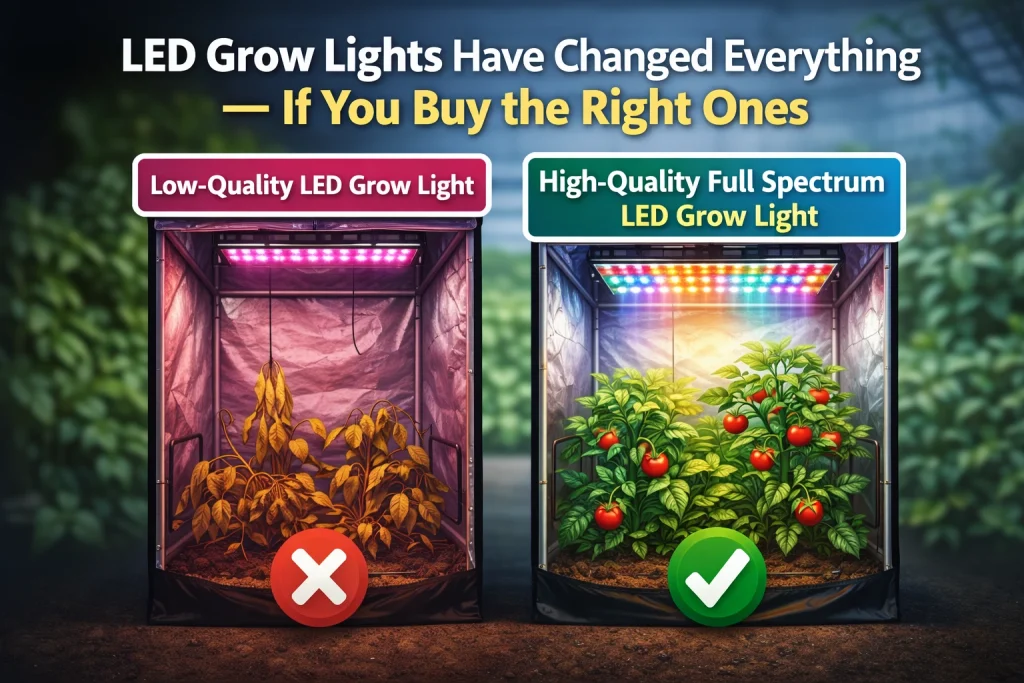
The market has never fully resolved how to effectively convey any of this to consumers. From the wattage specification most grow light listings highlight, you can learn very little about how much light actually reaches plant canopy levels. The numbers that matter are PPFD, or Photosynthetic Photon Flux Density, and efficiency, which measures how much light you get per unit of electricity consumed. Photosynthesis is measured by the number of light particles hitting a surface per second. When adding lighting to a greenhouse or complete indoor setup, growers should look for efficiency ratings of 2.7 to 2.9 micromoles per joule or higher. It is most likely that anything that is marketed primarily on the basis of wattage isn’t worth the price.
Answering the spectrum question took longer than it should have. In response to the discovery that plants use red and blue light most intensely for photosynthesis and vegetative growth, early LED grow lights produced a purple output that was technically accurate but practically limited. Ultimately, NASA research for space-based growing, where every watt counts and crop failure is not an option, revealed plants use nearly every wavelength in the visible spectrum differently at different stages of growth, and that limiting light to two narrow bands causes deficiencies over time, even if the plants seem to be growing well at first. Modern high-quality LEDs produce full-spectrum white light, which is more like natural sunlight, by adding certain red wavelengths at 660 nm and sometimes infrared for flowering and fruiting. In long-term plant health, there is a discernible and quantifiable difference between an inexpensive purple-only fixture and a true full-spectrum fixture.
There is a real difference in performance between high-quality and low-quality grow lights at the component level, so it’s crucial to know what to look for. Most fixtures that consistently perform well in independent testing use Samsung’s LM301 diode family, which includes the LM301B, LM301H, and the more recent EVO models. Due to their efficiency and dependability, these diodes have become the industry standard. It is for the same reason that Mean Well drivers, which control the power delivery to the diodes, appear in the same lights: they are reliable at the specification level and fail significantly less frequently than less expensive alternatives. Despite the fact that a grow light without top-bin Samsung diodes and a Mean Well driver is unlikely to meet the efficiency goals that warrant the investment, a grow light with these components is guaranteed to be well-designed. Based on this component standard, models such as the Lumatek Zeus Pro 3.1, AC Infinity IONFRAME EVO8, and Mars Hydro FC 6500 EVO have performed well in independent tests.
Growers who know what to ask for are pushing manufacturers to provide real specifications, and the worst options are losing ground to clearly superior alternatives. In a marketplace with hundreds of unbranded fixtures on the same platforms as the truly excellent ones, that may be an overly optimistic interpretation. There has been no change in useful advice: look for component names that reflect true build quality, check for actual PPFD data and efficiency ratings, and keep searching if any listing leads with wattage and ignores important metrics. Light actually alters what is possible indoors. When the wrong electricity meter is used, the meter simply continues to run.
As a Senior Editor at Mini Greenhouse Kits, Hannah Kinsley is a passionate supporter of small-space gardening and urban gardening. Hannah, who is currently majoring in Environmental Policy through the University of Michigan’s Environmental Studies program, infuses her writing with a solid academic foundation and a sincere enthusiasm for the environment. You can find her playing soccer or exploring the city’s green areas with friends when she’s not researching the newest trends in city gardening or creating content for minigreenhousekits.com.