
In the walled kitchen garden of Château de Villandry, somewhere in the Loire Valley, a gardener is achieving something that very few vegetable growers succeed at: making the whole thing beautiful. It’s not as lovely as a flower border, which is delicate and fleeting, but it’s lovely in the sense that a room has structure, purpose, and a design that makes sense even in the gloomy months before spring. Geometric shapes are found on the beds. Routes are broad and purposeful. Intersections are punctuated by little trained rose trees. It looks like a carpet from above. As seen from the ground, it appears to be a place where people would enjoy spending time.
This person is the vegetable garden. Originally referring to thick soups, kitchen necessities, and cooking, the word has evolved over time to mean more than practicality. A potager is a kitchen garden that refuses to be merely productive. There is a need to examine it. Furthermore, well-designed food gardens, whether in upstate New York or the Loire Valley, tend to share a set of ideas about why they are worth visiting even when nothing is ready to harvest.
Most home vegetable gardens fail from the start because of the structural logic. Most vegetable patches are set up in rows, optimized for access and yield, and designed with efficiency rather than experience in mind. Shapes play a different role in a vegetable garden. There are rectangles, squares, circles, and sometimes more complex shapes. Raised beds can be made from stone, willow branches, or herbs like chives or thyme that are used as both edging and ingredients. Bed frames provide a context for plants within, a lush backdrop, and a boundary that makes abundance understandable rather than overwhelming. It is not a waste of space to have wide walkways between beds; they should be large enough to accommodate a wheelbarrow and allow people to walk side by side. In between planting activities, they provide a place for the eye to rest.
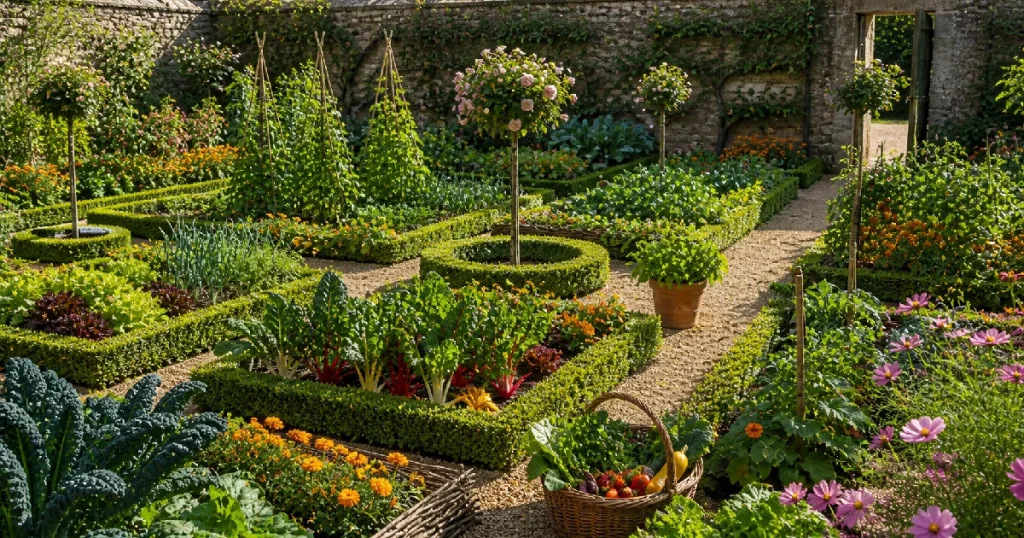
Vertical elements are often overlooked in vegetable gardens that are flat. Bamboo teepees supporting climbing beans are more than just growing structures; they’re focal points in low-lying areas, something with height and form. As with obelisks and cattle panel arches, the French approach of training fruit trees into espalier forms along walls or along wire frames takes the idea further, turning a productive tree into something sculptural. When walking through a garden that makes good use of these features, it’s impossible to ignore how much the vertical dimension contributes to the overall ambience.
The potager’s three-season logic relies on viewing the growing calendar as a design issue rather than merely a farming issue. Radishes, beets, peas climbing early trellises, lettuces in greens and reds, and rainbow Swiss chard are a few of the cool-weather crops of spring. Besides its delicious taste, rainbow Swiss chard creates a striking visual drama due to its yellow, orange, and crimson stalks catching morning light. Plants that grow in warm weather, such as bushy basil, sprawling squash, eggplants with deep purple weights, and tomatoes that climb their stakes, fill the same beds with different geometry as the cool-season crops bolt. Vegetable gardens overlooked during the fall have their own color scheme: purple cabbage, cavolo nero kale, and root vegetables that don’t need to be seen.
Flowers are not decorative in a vegetable garden. Their organization is good. Between tomatoes and peppers, marigolds provide orange punctuation and discourage pests. Calendula’s edges glow gold for most of the growing season. As a trap crop, nasturtiums draw aphids away from more valuable plants. Movement and height are provided by zinnias and cosmos. Rather than just flowers, Villandry’s gardeners used a carefully planned combination of vegetables, herbs, and flowers to create color.
At the same time, the outcome reads as intentional and abundant, which is much more difficult than it appears.
| Category | Details |
| Topic | Potager Garden — French Kitchen Garden Design for Three Seasons |
| Origin of Term | French word for a cook who makes thick soups; evolved to mean ornamental kitchen garden |
| Famous Example | Château de Villandry, Loire Valley, France — symmetrical beds with edible and ornamental plantings |
| Core Design Elements | Geometric beds, permanent edging, vertical structures, central focal point |
| Spring Crops | Lettuce, kale, peas, radishes, chives, beets, spinach |
| Summer Crops | Tomatoes, basil, squash, peppers, eggplant, cucumbers |
| Fall Crops | Kale, cabbage, carrots, cauliflower, beets |
| Year-Round Interest | Lavender, thyme, sage, rosemary, espalier fruit trees |
| Key Maintenance Practice | Succession planting — replace harvested crops immediately |
Succession planting maintains a potager’s integrity throughout the three seasons. Fill in the void left by a harvested crop with a fast-growing green, a transplanted seedling, or radishes that will be ready in three weeks. An empty potager bed is both a missed opportunity and, more obviously, an aesthetic problem. The lushness of these gardens is due to maintaining the density of growth that gives each bed its visual weight and keeping the soil occupied. Plan ahead, prepare transplants before spaces open up, and view the garden as a continuous system rather than a series of separate crops. Preparation is more involved than for most vegetable gardeners. Despite the effort, the results are worth it – a kitchen garden that thrives from the last frost of spring to the first frost of fall, and that looks as good as it tastes.
As a Senior Editor at Mini Greenhouse Kits, Hannah Kinsley is a passionate supporter of small-space gardening and urban gardening. Hannah, who is currently majoring in Environmental Policy through the University of Michigan’s Environmental Studies program, infuses her writing with a solid academic foundation and a sincere enthusiasm for the environment. You can find her playing soccer or exploring the city’s green areas with friends when she’s not researching the newest trends in city gardening or creating content for minigreenhousekits.com.