
When the outside temperature drops to -5°C on a January night, a small backyard greenhouse without active heating and electricity can maintain a constant interior temperature of 4 or 5°C – cold enough to feel, warm enough to matter. For most hardy winter crops and overwintering plants, the entire margin between freezing and non-freezing is necessary for survival. In order to get there without using a plug-in heater all night, one must consider heat from an engineer’s perspective: where does it come from, how is it stored, and how can it be prevented from escaping?
It is widely believed that greenhouse heating requires gas or electricity, which costs people money every winter and prevents some growers from using their greenhouses at all during the winter months. Even on cloudy winter days, a small greenhouse gathers a surprising amount of solar energy during the day. Overnight, the biggest challenge is not producing warmth but retaining it. It is likely that additional heat will only be required during the worst cold snaps, rather than being a continuous expense if you consider the retention aspect of the problem seriously.
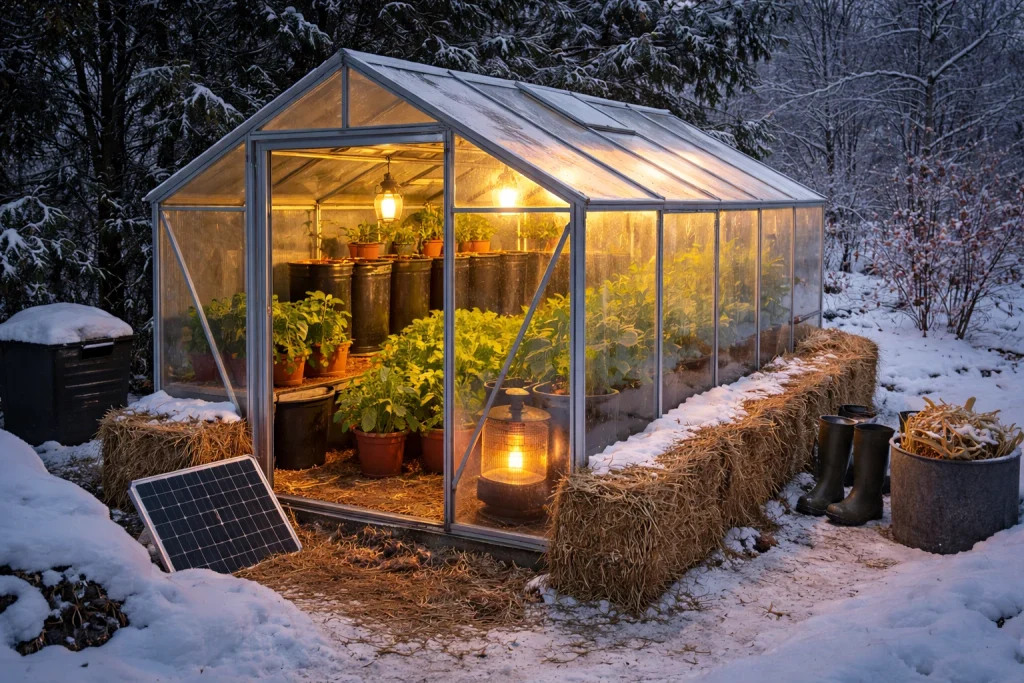
Insulation is the first and most economical intervention. The large-bubbled, UV-stabilized horticultural bubble wrap sold specifically for greenhouses creates an air layer that significantly reduces heat loss between plants and the cold glass when applied to the interior surface of glazing panels. All interior surfaces of a 6 x 8-foot greenhouse can be lined for a small investment. If bubble wrap is carefully removed during the warmer months, it can be stored for several seasons. Because the north-facing wall receives very little direct winter sunlight, it serves primarily as a heat drain. With foam board insulation or reflective foil backed with polystyrene, you can turn a loss into a gain by reflecting heat back into the growing space. Sealing gaps around doors, vents, and panel joins with weather stripping or clear silicone caulk can prevent drafts that can lower interior temperatures by several degrees on a windy night.
Thermal mass is the factor that differentiates growers who maintain warm greenhouses from those who do not. Natural heat batteries, such as water, concrete, brick, and stone, absorb solar energy during the day and release it gradually at night. Using black-painted milk jugs or five-gallon buckets filled with water, you can raise overnight low temperatures by two to five degrees without using any electricity. Under benching, gravel beds provide extra thermal storage at a low cost, while concrete paving slabs on the floor offer a stable working surface as well. Traditional stone buildings have long used mass to mitigate day-to-night temperature fluctuations, and this strategy is no different.
It is surprising how powerful a compost bin placed inside or partially inside a greenhouse is as a source of natural heat. Hot composting produces biological heat as nitrogen-rich kitchen scraps and green garden materials are combined with carbon-rich browns like shredded cardboard, sometimes reaching 50 or 60°C in the center of an active pile. During the coldest months, a compost system that is moderately active can produce the finished material the garden requires in the spring while radiating ambient heat into a small enclosed area. The combination of free heat and finished fertility is hard to argue against for growers with larger mini greenhouses, but the practical limitations are space and managing an indoor compost pile.
If there is a forecast of a hard freeze or a site that is unusually exposed, there are inexpensive supplemental options that don’t require running a full-size heater all night. Heat is provided at the roots of young plants by soil-warming cables, which use as little as 75 watts for a six-meter cable. In comparison to a continuous electric fan heater, a thermostatically controlled electric fan heater turns on only when the temperature drops below 3°C. Covering the entire mini greenhouse with old blankets or a thermal screen before sunlight is needed in the morning adds an extra degree or two without adding any additional cost on especially chilly nights. Combined, they are typically more effective than depending solely on one technique, as they are layering techniques that make small contributions to the overall effect.
There is a practical psychology to all of this that is sometimes overlooked. Because they are not keeping an eye on a running heater and calculating the expense, growers who invest in passive heating solutions—such as lining bubble wrap in October, filling water bottles, and sealing the gaps—use their greenhouses more actively during the winter months. Interacting with the area seems worthwhile. Plants continue to thrive. Rather than being permanently postponed until spring, what was initially intended to be an energy-saving measure actually causes winter growing to occur. A greenhouse that is almost free to keep warm throughout January is one that is utilized.