
All of the warning signs are present when you pick up a tomato in January from the grocery store. There is a lacquered appearance to the skin, which is completely red and immaculate. It gives in a way that seems artificial rather than organic when light pressure is applied. The flesh inside is dense, pale, and slightly moist, with seeds floating in a faintly scented liquid when you cut it open. There is hardly anything left after eating it. Acidic with a hint of sweetness. There is no sweetness. There is no depth. In theory, but not in practice, this type of flavor exists. Tomato-like in appearance. In any meaningful culinary sense, it is not doing what a tomato is supposed to do.
It is not a quality control issue or an accident. It is the result of a breeding and distribution system that is optimized for all but taste. Due to the scale at which commercial tomato growers operate, their fruit must survive harvest, packing, refrigerated transportation over hundreds or thousands of miles, and prolonged shelf display, they need varieties that remain firm, ripen evenly, withstand bruising, and retain their color for weeks. Through decades of selective breeding, the industry developed tomatoes that are exceptionally good at all of those tasks. Flavor was not a requirement based on the genetics. Comparing commercial varieties with heirloom and garden-grown varieties, it has been found that more than thirteen different flavor compounds are either absent or greatly diminished. Aside from tomato eaters, everyone has benefited greatly from the tomato industry’s trade in taste for logistics.
Usually, people are offended by the ethylene gas component of the process when they learn about it. A commercial tomato is harvested at the “breaker stage,” which occurs well before the fruit has developed any discernible flavor. The fruit has changed color from being completely green to being somewhere between green and pink. Fruit is exposed to ethylene gas during transportation or at distribution centers, which causes a color shift that makes it appear ripe. As the tomato ripens, it turns crimson. Although ripening on the vine requires the interaction of the living plant with sunlight and time, it does not produce the sugars, acids, and volatile compounds. The gas in cold-storage supermarket tomatoes creates the appearance of ripeness without the substance that gives them their taste.
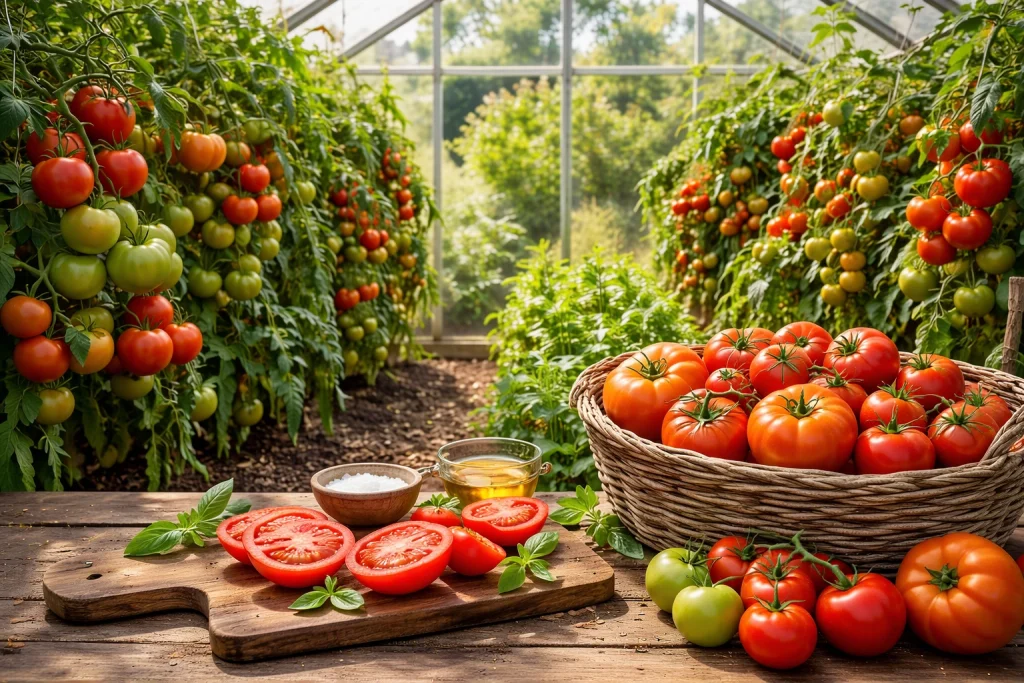
When tomatoes are grown in a home greenhouse, several of these limitations are already broken simultaneously. Unlike commercially harvested specimens, fruit ripens on the plant and develops flavor compounds in its own time. Growing a greenhouse tomato that’s just better than a supermarket tomato and growing one that’s truly exceptional can be distinguished by a few choices most home growers aren’t aware they’re making. The first step is to select a variety. The standard hybrid seeds sold in garden centers with little fanfare are frequently bred from the same lines that value consistency and firmness over flavor. Heritage varieties like Cherokee Purple, which has dark, complex flesh, and Brandywine, which has been cultivated for its flavor since the late 19th century, contain a complete range of sugars and acids. A hybrid created primarily for flavor rather than shelf stability, Sungold cherry tomatoes routinely register Brix scores of 6-10, significantly higher than the majority of commercial large fruit varieties.
Soil and nutrients are undervalued in most hydroponic greenhouse systems. As a result of the abundance of trace minerals and microbial relationships found in healthy soil, tomatoes grown in truly fertile, compost-enriched soil usually yield fruit with a more concentrated flavor than tomatoes grown in a hydroponic substrate, which is designed for rapid, consistent growth. Speed isn’t a priority here. Plants grown in soil have a slower metabolic rate, which allows flavor compounds to develop more slowly. In hydroponics, potassium drives sugar synthesis and transport, so supplementing with potassium fertilizers as fruit sets closes some of that gap.
In part, this is because the water stress technique goes against the natural tendency to keep plants well-watered. When tomatoes reach maturity, reducing irrigation by 20 to 30 percent tells them that resources are scarce, which causes a concentration response, which intensifies the flavors and sugars. Italian San Marzano tomatoes, grown in the infamously dry Campanian summer, are characterized by a concentrated flavor. It’s more of a mild stress than a deprivation. You need to cut back on water at the right time: if you reduce it too soon, the plant will suffer; if you do it in the last few weeks of ripening, the flavor will suffer.
Lastly, there’s the question of storage, which is arguably the most fixable mistake. By refrigerating tomatoes, the ripening process is halted, but volatile aromatic compounds that give them their flavor are also permanently destroyed. When the fruit is brought to room temperature, these compounds do not reappear. If a tomato is kept at 55°F or lower for even a day, its flavor will never return. When greenhouse tomatoes are picked at vine ripeness and kept at room temperature on a countertop, they are at their best within a day or two of harvest. Even a common variety can taste like something worth cultivating if picked ripe, stored properly, and eaten quickly.