
There’s a certain kind of frustration when you walk into a backyard greenhouse in late July and discover it has basically become an oven. The tomato plants are drooping. The edges of basil turned black. Whenever the temperature rises above 45°C, it becomes less of a garden and more of a warning. On a clear summer morning, a small polycarbonate structure left unventilated can reach temperatures that would harm most crops before lunch. It happens more frequently than most novices expect, and it happens quickly as well. A growing number of home growers are turning to climate control. Additionally, what happens after installation is more fascinating than a straightforward before-and-after story.
The most immediate change is to stop relying on the weather. Generally, a backyard greenhouse without thermal control is a temporary structure that is dependable for a few months but unreliable for the rest of the year. Add a thermostatically controlled heater that can maintain even a modest 5°C overnight and the calculus completely changes. It is possible to leave plants outside until December that would typically need to be brought inside in October. In February, seeds that normally begin in March can be planted without risking a late frost. For those who are serious about growing their own food, it feels like an additional season.
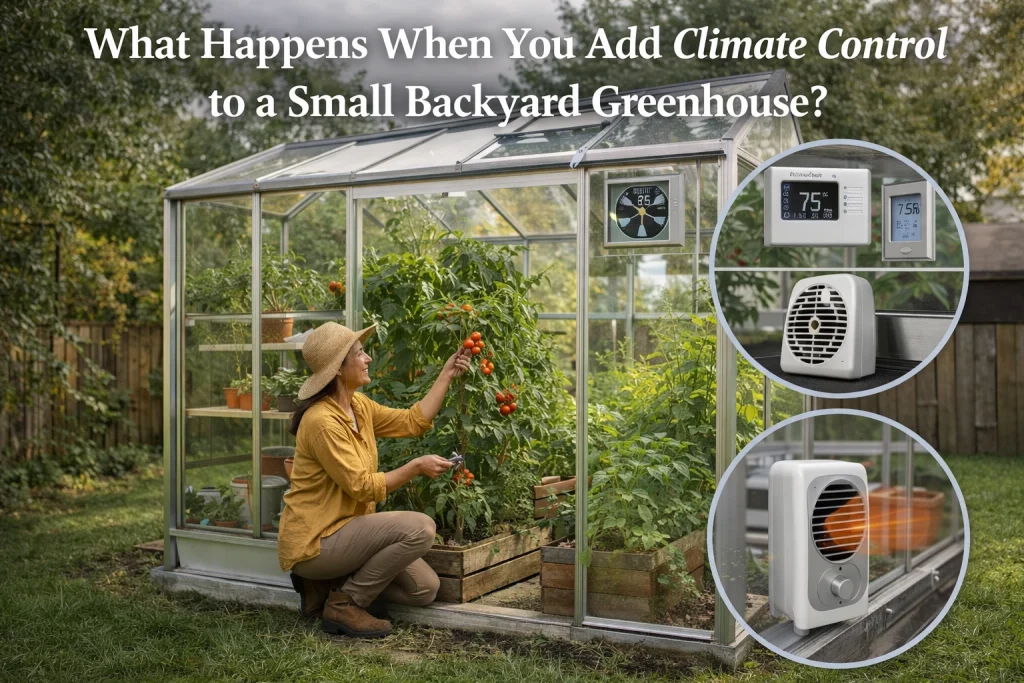
Summer can be a more complex issue, which often surprises people. A common misconception is that greenhouses are mainly used in the winter to keep out the cold. The issue of heat management is equally, if not more, important. A small greenhouse with adequate insulation can reach temperatures over 65°C on a hot, still afternoon. The use of shade cloth that blocks between 30 and 50 percent of light is very helpful in reducing sunburn and temperature on leaves. It is estimated that wet pads, also known as evaporative cooling systems, can lower interior temperatures by 15 to 30 degrees Fahrenheit, which is the difference between stressed and productive plants. By placing horizontal airflow fans in corners and along the floor, stagnant hot pockets are addressed without producing direct cold drafts. Installing everything at once seems excessive before the first significant heat wave, but afterward, it feels perfect.
One factor that is often overlooked is humidity. There is a difference between temperature control and humidity management, even though they are related. When the air is damp, warm, and still, botrytis, mildew, and other fungi can quickly spread through a small greenhouse. Proper ventilation prevents moisture from accumulating by exchanging stale interior air with fresh outside air. There are automatic roof vents and exhaust fans that activate when a certain temperature is reached. There is a noticeable difference in plant health between a sealed greenhouse and one with adequate ventilation after a few weeks. Cleanliness is maintained by leaves. Stems are more robust. As a whole, the system feels more stable.
Automated climate control feels far different from simply installing a heater. With controllers like the Inkbird ITC-308, gardeners can program distinct heating and cooling set points and remotely monitor conditions via their smartphones. Being able to check the room’s temperature from across town and knowing that it is maintained at the proper temperature gives a subtle feeling of satisfaction. A thermostat placed close to a heat source can also be off by several degrees, which is more significant when growing crops that require a specific temperature.
There is a genuine cost issue that merits open discussion. During a hot summer or during a cold winter, running cooling systems or heaters increases the energy bill in different ways. In addition to insulation, a layer of recycled bubble wrap on interior walls reduces heat loss quantifiably, but it also reduces light by about 10%, a trade-off most growers are willing to make. Alternatively, you can heat just a portion of a building, enclosing the occupied space with bubblewrap so that the heat is concentrated where the plants are. Research from SINTEF and the ClimaGreen project in Romania suggests more efficient methods for integrating heat pumps into greenhouse systems. In backyard backyard setups, this technology is still far from common.
Ultimately, climate control transforms a small greenhouse from a passive structure to a responsive one. There is no longer a total dependence on external factors for plants. As a result, harvests become more predictable, growth becomes more steady, and failures are less commonly caused by the weather than by specific, solvable problems. The relationship between grower and space is profoundly altered by that. Rather than a risk, the greenhouse becomes a tool.