
You can’t help but notice how little cucumbers smell when you pick them up at the grocery store. Mostly water with a hint of vegetables, the texture is predictable, the skin is waxy, and the flavor is mostly water. A cucumber designed for logistics and shelf life, it can withstand a week in a produce section and a refrigerated truck without softening. You can eat it. In a nutshell, it’s not very memorable. When you grow your own cucumber in a greenhouse and pick it the morning you intend to eat it, you’ll notice the difference right away: the crunch that remains after dressing it, the snap when you cut into it, and the real cucumber smell. Until they cross over, most home growers do not realize how much difference there is between those two experiences.
Greenhouse cucumber projects either succeed or fail before a single seed is planted, and this is where the gap begins. Market cucumbers are bred for uniformity, durability, and outdoor or polytunnel production. The cultivation of greenhouse plants requires parthenocarpic F1 hybrid varieties that produce only female flowers and set fruit without pollination. Carmen, Tyria, and Socrates produce long, thin-skinned, nearly seedless fruit that doesn’t turn bitter even after being left on the plant for a few days longer than expected. An all-female trait is important in a closed greenhouse, where there are no pollinating insects to perform the task, and where unintentional pollination results in the bitter, seedy result you wanted to avoid.
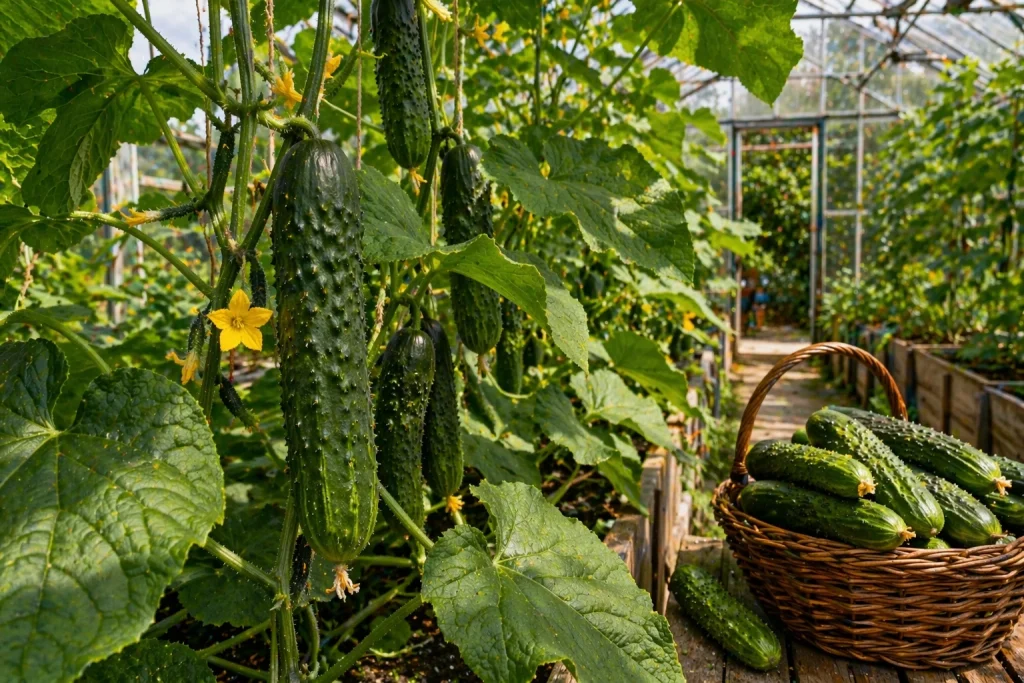
Temperature is the element that most surprises novice greenhouse cucumber growers, and it is also the one where mistakes compound most quickly. Cucumbers have a tropical ancestry, which is reflected in their needs. They are closely related to melons. India is where they originated. Temperatures between 20 and 25°C are ideal for fruit production; plants grow most quickly at 30°C, but yields decrease. It is always necessary to have a temperature higher than 15°C at night. Below that point, growth ceases. The root system becomes susceptible to stem rot when the fungal infection silently reaches the root collar, where the stem meets the soil. When the leaves begin to yellow, it is usually too late to stop them. It is for this reason that skilled growers purchase min-max thermometers in May and early June, when clear nights can still cause greenhouse temperatures to drop significantly below what daytime warmth indicates is possible.
The root collar rule contradicts everything most gardeners are taught, so it deserves special attention. Tomatoes tolerate deep planting well and it promotes more root growth from the buried stem when planted deep. Cucumbers punish this instinct. Stem bases must always be dry, visible, and elevated above the soil surface. Fusarium thrives when soil is pressed up against the root collar, drip irrigation is directed at the stem base, or any situation that keeps that junction moist for prolonged periods of time. When the plant is transplanted, the root collar should be clearly visible and all water should be directed away from it, into the surrounding soil rather than the plant’s base.
A properly controlled humidity is what gives greenhouse cucumbers their texture advantage over outdoor fruit. When the temperature rises, water the greenhouse floor or pathway to keep the air around the plants consistently moist-between 60 and 70 percent relative humidity-allowing moisture to evaporate into the air rather than remain on the soil. The two primary threats to greenhouse cucumbers are also discouraged by this humidity level: powdery mildew, which spreads rapidly when the leaf surface repeatedly dries and wets due to condensation cycles, and spider mites, which thrive in dry conditions and reproduce at such speed that plants can be destroyed in just a few days. Both issues are still controllable in a well-run greenhouse with constant humidity and adequate ventilation.
Feeding changes as the season progresses. For early growth, a balanced fertilizer that promotes vegetative development is beneficial, but when fruit begins to form, usually on the main stem first, the plant’s nutritional requirements change. Weekly applications of high-potash liquid feed enhance the density and crunch of developing fruit. Since cucumber plants have many leaves, lose moisture quickly through transpiration, and react to irregular watering by producing bitter or misshapen fruit, which is a reflection of the stress the plant endured during cucumber formation, it is not overly cautious to water every day throughout the summer.
Gardeners frequently make mistakes when it comes to harvesting timing. Cucumbers are naturally harvested when they are large, believing that larger ones are more valuable. The opposite is more accurate. English varieties are best harvested at 15 to 20 centimeters, when they are still consistently firm and dark green. When left longer, the skin thickens, the seeds grow, and a faint bitterness that was virtually absent in contemporary F1 varieties returns. During peak season, picking every two or three days encourages the plant to keep producing instead of focusing its energy on ripening the fruit already on the vine. This little discipline extends the harvest by weeks.
On a hot July morning, harvesting cucumbers in a greenhouse gives me the impression that homegrown food differs more from grocery produce than most people realize. It has a smooth, wax-free skin, is still cold from the previous night, and has an unmistakable smell. Those things aren’t difficult to accomplish. Make sure you choose the right variety, pay attention to humidity and temperature, and have the patience to harvest before the plant signals it is ready.