
In late October, the cost of heating a hobby greenhouse becomes unreasonable. It may only measure eight by ten feet, with a few shelves and polycarbonate panels. The cost of keeping it warm enough to start spring seedlings or overwinter tomatoes is quietly increasing. Electric heaters, grow lights, and propane hum through the night. Most backyard growers don’t realize how much it costs to operate their greenhouses. The actual number is usually higher than expected.
Growing numbers of home growers are discovering, however, that most of those expenses are optional. It has not diminished. It is optional. The majority of the year, a well-designed solar-powered mini greenhouse can operate for nearly nothing, using the sun’s energy for heating, ventilation, and even watering. With the help of small, low-cost modern components that cost less than a month’s worth of heating fuel, it combines concepts that predate the electric grid completely.
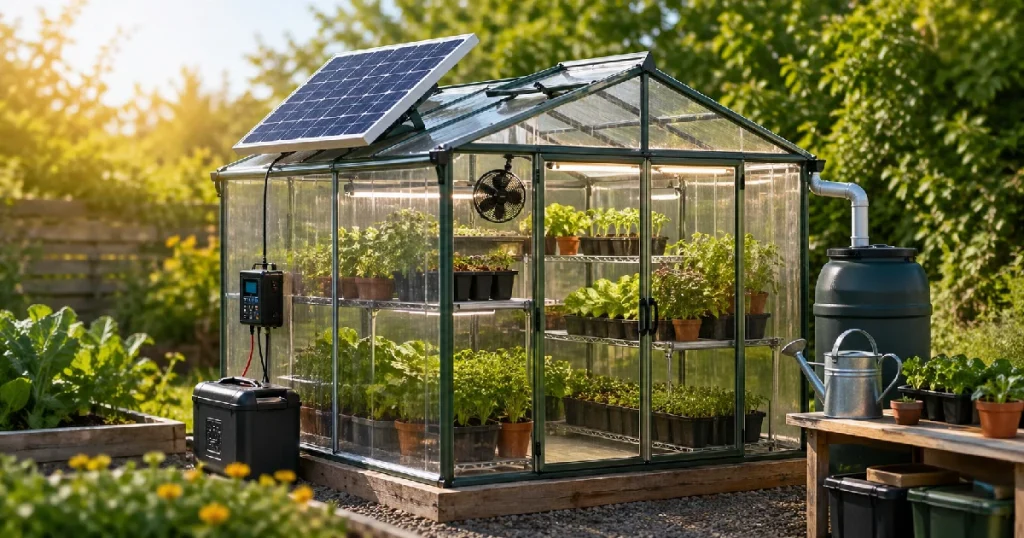
The cornerstone of the entire strategy is passive solar design, which sounds technical but isn’t. A greenhouse should be set up so the south-facing side receives as much sunlight as possible throughout the day-at least six hours of direct exposure-and the north wall should be opaque and insulated to prevent heat from escaping. To capture morning and afternoon light, transparent materials are used on the east and west walls. By using the south face, which performs the most lifting, the structure is intended to retain rather than lose solar energy.
Holding is made possible by thermal mass. In the greenhouse, black-painted plastic barrels or water-filled buckets absorb solar heat during the day and release it gradually at night, creating a free, silent heating system. In the same way, stone and brick work. There have been architects who have known about this idea for centuries, and it can be applied to a backyard building without requiring any modifications. In a clear winter day, a well-sited greenhouse with adequate thermal mass can maintain temperatures 15 to 20 degrees warmer than the outside air overnight, without using a single watt of electricity.
Passive design leaves a void that can be filled by small solar panels. The kind of panel that costs less than fifty dollars can power a 12-volt computer cooling fan. As a result, the ventilation system responds automatically to sunlight. On bright days, when the greenhouse is at risk of overheating, the fan spins faster; at night, when airflow is not needed, it slows or stops. There is no timer, thermostat, or circuit wiring. Sunlight schedules the fan and panel directly. Like more complex systems, it is hard not to find this elegant.
Watering has a similar rationale. With a small solar pump attached to a rain barrel or water tank, irrigation can be managed without a grid connection. It is located next to the greenhouse. In most climates, the rain barrel, which collects roof runoff, is free, and the pump costs less than $30. It can be manually triggered or set on a timer powered by the same panel. After the parts are installed, there are no operating costs. It only takes an afternoon and a basic understanding of plumbing to complete the setup.
It is not necessary to spend a lot of money on the building itself. Many of today’s most efficient solar mini greenhouses are constructed from salvaged materials — old window frames and glass doors sourced from demolition yards, greenhouse panels made from reclaimed polycarbonate, wood framing assembled from lumber otherwise discarded. During three full winters, the passive solar greenhouse attached to the studio at Melliodora in Victoria, Australia, served as the primary daytime heating source for the living space inside. THE SUN WAS THE OPERATING COST, AND THE MATERIALS WERE CHEAPER THAN
Passive design fails to prevent nighttime heat loss, especially in climates where temperatures drop sharply after dark. Uninsulated glazing can allow up to 85 percent of the heat stored during the day to escape overnight. Once understood, this number changes the way you think about structures. Insulation blankets or thick fabric draped over the exterior at dusk and removed in the morning is the easiest and cheapest solution. In cold weather, straw bales can be pushed against the base of the walls for additional protection. Both approaches are effective, and neither costs anything to operate.
Watching this approach gain traction among serious home growers, there is something of a quiet correction to how backyard food production has been sold in recent years. A greenhouse kit, grow lights, heated propagators are all marketed as essentials, but they add up to a running cost that doesn’t always match the goal of growing your own food. With a few inexpensive modern components and old principles, the solar-powered mini greenhouse represents a compelling counterargument. There has already been an appearance of the sun. It’s just a matter of aiming the glass correctly.
Olivia Murphy is a Senior Editor at Mini Greenhouse Kits and a fervent supporter of small-space and urban gardening. Alyssa, who is currently majoring in both literature and biology at Michigan State University, infuses her writing about city gardening and small-space growing with a unique blend of scientific curiosity and storytelling instinct. Her love of literature influences how she tells the stories behind the plants, and her background in biology gives her content a grounded, research-informed edge. When she’s not working on her next gardening piece, you can find her curled up with a good magazine or watching a movie that she’s been meaning to watch for weeks. She writes with passion at minigreenhousekits.com.