
It usually begins modestly. A few seedlings became flat overnight. There is disturbed soil near the base of a container. A young lettuce leaf has been bitten into a neat semicircle. Most people divide themselves into two groups when it comes to the next question: those who reach for poison almost instinctively, and those who hesitate, wondering if there’s a better way that doesn’t involve leaving toxic bait out on shelves where kids and pets might come across it. In most greenhouses, growers can identify the signs fairly quickly – something has gotten in.
There is good reason for the reluctance. In the short term, slug pellets and rodenticides are effective, but they have additional risks that are not always disclosed. Cats, dogs, and raptors often discover poison-consuming rats and mice outside the greenhouse, where they slowly perish. Toxins pass up the food chain in ways that aren’t always apparent until the damage has been done. A mini greenhouse can be completely protected against mice, rats, rabbits, deer, birds, squirrels, slugs, and anything else that wants to eat seedlings without a single drop of poison. In comparison to laying bait, it is more consistent and doesn’t require collateral, but it requires more consideration.
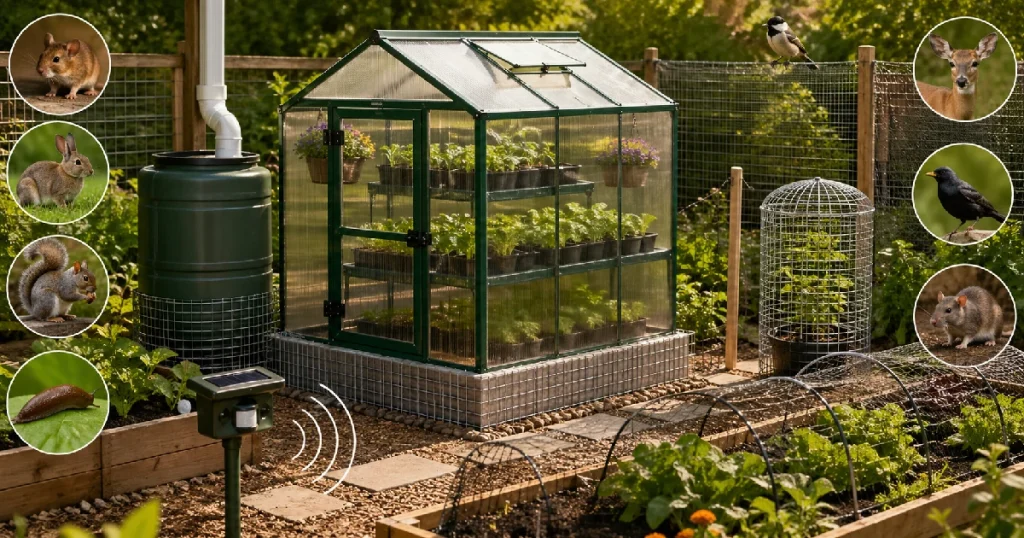
Any significant non-toxic defense relies on physical exclusion. I don’t find it elegant at all. Hardware cloth wrapped around the entire base of the greenhouse, buried at least six inches into the ground, and bent outward in an L-shape at the base blocks mice and voles from tunneling under structures. In spite of the fact that measuring, cutting, stapling, and tamping soil back into place are unglamorous tasks, growers who regularly perform them report that their soil holds for years without needing to be replaced. According to a Facebook greenhouse group member, three-quarter-inch netting has prevented mice, squirrels, and other animals from entering their structure for six years. This level of durability is not only achieved by scent deterrents.
The most common entry points for birds and squirrels are ventilation openings and door gaps, where a surprising number of greenhouse owners leave visible gaps. Chicken wire or fine netting can be used to cover these points in an afternoon for a very low cost. In the first few weeks, young seedlings are particularly vulnerable, so simple plastic bottle cloches can be made by cutting the bottoms off two-liter bottles and pressing them into the ground or wire shelf baskets turned upside down and weighted with bricks. Despite the fact that neither solution appears to be very complex, they both work. There are times when the awkward solution is the best.
Physical barriers are layered over scent-based deterrents to create an environment that animals find unpleasant rather than just difficult to access. Peppermint oil soaked cotton balls placed on greenhouse shelves and near entry points discourage mice from entering. Rodents, who rely heavily on smell for navigation, have a well-documented aversion to peppermint oil. In addition to deterring mice, slugs, and ants, cinnamon acts as a contact irritant that impedes their movement without harming the soil. Applying crushed garlic, eggs, and water to the exterior panels and surrounding vegetation reduces browsing pressure for deer and rabbits approaching from the outside. Scent-based approaches, however, must be reapplied after rain, which is a persistent weakness.
Despite being one of the stranger deterrents, experienced growers swear by soap. Growers who deal with frequent deer pressure have documented that a strong-smelling bar soap hanging in mesh bags around the perimeter of a greenhouse causes a wariness reaction in deer. Human hair packed into mesh bags near entry points indicates the presence of predators in similar ways. In areas where deer are accustomed to human presence, these techniques might be less effective. There is no absolute consistency when it comes to wildlife.
Visual scare techniques add a third layer. Birds and deer are frightened at first by erratic flashes produced by old CDs hung where they catch light or reflective bird tape strung around the building. A motion-activated sprinkler is more effective as a deterrent because the sudden burst of water startles nearly anything that triggers the sensor, and it requires no maintenance every day. However, animals may become accustomed to them over time, so no deterrent, no matter how effective at first, should be used exclusively.
Astute daily management connects the entire system. Animal incursions are rarely random; instead, they follow cues. The presence of pet food left on a shelf, potting compost with added nutrients, birdseed kept in a greenhouse for winter feeders, and even germinating seeds left out overnight all indicate to animals that the structure is worth investigating. Non-dramatic measures include removing those signals, removing long grass, brush piles, and wood stacks, and planting lavender or marigolds to create an olfactory barrier around the greenhouse. They significantly change the odds when combined.
The satisfaction that comes with seeing a well-protected greenhouse survive a winter when animal pressure is evident throughout the garden is difficult to ignore. Trails made of mud. The adjacent beds show signs of excavation. In addition, the seedlings remain in their original positions within the greenhouse. Poison is not involved. A hardware cloth, peppermint oil, and some attention to the gaps were all you needed.
Alyssa Bennet is a Senior Editor at Mini Greenhouse Kits and a passionate advocate for urban gardening and small-space growing. Currently pursuing her major in Arts at the University of California, Alyssa brings a distinctly creative eye to the world of city gardening – blending artistic sensibility with a genuine love for green living. She writes regularly at minigreenhousekits.com, and when she’s not crafting her next gardening piece, you’ll find her with a paintbrush in hand, watching sports, or exploring the city with friends.