
On Saturday mornings, you’ll see people loading trolleys with plants, pavers, pots, and furniture because they have a very clear vision of how they want their gardens to look. In most cases, the image survives contact with the real garden. In midsummer, the area is smaller than it was before anything was added. As opposed to the empty lawn they began with, it feels cluttered rather than well-curated, and is strangely harder to unwind in. It was a satisfactory purchase. Most of the time, their reasoning wasn’t clear.
During the planning phase, garden layout errors are often invisible because they seem reasonable when made separately. There is a spacious patio and a corner sofa. Plants are densely planted along every border. Near the rear entrance are a group of tiny pots. There is no obvious error in any of these decisions. Compression occurs when you combine them in a small outdoor space, creating a garden that makes its boundaries clear even before you step outside. The majority of these mistakes are correctable and do not require additional funding. It is necessary to spend less.
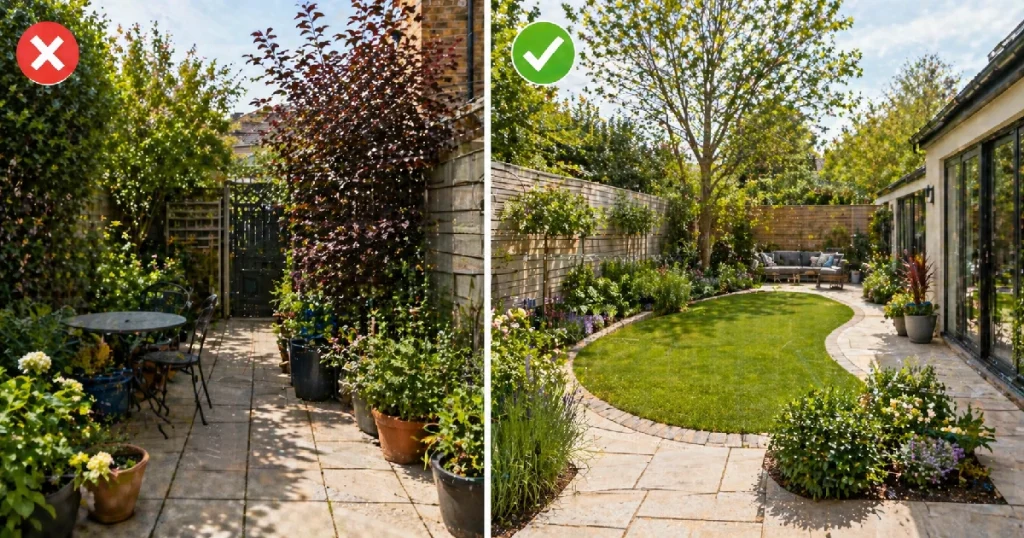
A garden’s design is based on proportion. Observing the consequences of breaking the golden ratio, which is approximately 1:1.6, makes it seem abstract. Besides taking up physical space, a large sectional sofa crammed onto a small patio gives the impression that the patio is smaller than it actually is. In this case, the eye perceives the furniture as being out of proportion to its surroundings. The same applies to planting beds. Overly narrow beds lack the depth and layering that gives a border visual weight, making them appear cramped and unorganized. For smaller beds, most designers recommend a minimum width of four feet, which increases to six or eight feet for foundation plantings. Plants do not require that space, but the eye does.
Overcrowding has a well-known trajectory, and this issue is closely related. There is plenty of space between the plants since they are small. Because the garden has grown into an undifferentiated mass after two seasons, it feels busy but uninteresting. The goal was abundance. The result is visual noise. When the design is kept simple, with fewer plant varieties repeated a few times throughout the area for unity, it appears intentional rather than accumulated. For a reason, professional garden designers employ a restrained color scheme: a garden with six carefully selected plants arranged consistently will almost always feel larger than one with twenty species.
Poor pathway placement is one of those layout choices that appears practical but has significant visual consequences. When there is no path connecting sections of the garden, people are forced to cross planting beds or lawn. As a result, plants are damaged and bare, worn patches are left behind. Without obvious circulation routes, a garden feels aimless; it collapses into a flat plane and the eye is unsure where it should go. Using paths that gently curve or direct the viewer’s attention toward a focal point can make even a small garden seem longer. There is no illusion here. As a result, it uses the area in a way that allows it to breathe.
A garden without focal points is easy to overlook because it still appears to be a garden. It is, however, a less captivating one. There are many examples of objects that draw the eye and convey a sense of distance and destination, such as a tree with intriguing winter bark, a bench at the end of a path, a statement urn, and a wall-mounted mirror. Without them, eyes are drawn to the distant fence. The garden seems twice as deep when it stops, moves, and returns with them. By highlighting details and implying depth in an otherwise flat and featureless space, lighting accomplishes a similar goal after dark.
It’s hard to ignore how much effect can be achieved through restraint as opposed to addition in carefully planned gardens. In the garden, space is created by leaving adequate space between items, not by adding more. It is important to have paths that are wide enough for walking to be comfortable. Size-appropriate patio furniture. Deep enough beds to layer plants properly. An unified style permeates the entire area instead of a collection of disparate impulses. This does not require an unlimited budget or a professional designer. Most importantly, you need to ask yourself if the image in your mind is proportionate. Before the trolley is pushed to the checkout, you have to slow down.
When a garden appears smaller than it actually is, it is often due to decisions made early on, before anything is planted or constructed. This is both strangely comforting and frustrating at the same time. In other words, the majority of the harm is still reversible.
Alyssa Bennet is a Senior Editor at Mini Greenhouse Kits and a passionate advocate for urban gardening and small-space growing. Currently pursuing her major in Arts at the University of California, Alyssa brings a distinctly creative eye to the world of city gardening – blending artistic sensibility with a genuine love for green living. She writes regularly at minigreenhousekits.com, and when she’s not crafting her next gardening piece, you’ll find her with a paintbrush in hand, watching sports, or exploring the city with friends.