There is a specific kind of heartbreak that happens in late July when you realize your garden has become a graveyard of good intentions. I remember standing over a patch of withered hydrangeas three years ago feeling like a total failure. The sun was a white hot hammer and the air felt like it was being blown out of a hair dryer. I had spent a fortune on those delicate blue blooms only to watch them turn into crispy brown skeletons within a week of the first real heatwave. That was the moment I stopped trying to fight the climate and started looking for the survivors. I realized that if I wanted a yard that actually lived through August I had to stop buying what looked pretty in the air-conditioned greenhouse and start looking for the tough plants for long summers that don’t flinch when the mercury hits triple digits.
We treat gardening like a hobby of pampering but in reality it is a slow motion endurance test. You can only drag a hose around for so many hours before the romance of the soil wears off. I began to look at the highway medians and the abandoned lots where life seemed to flourish without a single drop of supplemental water. There is an honesty in those plants that we often ignore in favor of the high maintenance primadonnas sold at the big box stores. You see a clump of silver foliage or a deep taproot and you are looking at a masterclass in survival. It changed my whole perspective on what a beautiful garden actually looks like. It isn’t just about the bloom. It is about the defiance of the stem.
I decided to stop apologizing for my lack of rain. I live in a place where the clouds are just a tease for four months out of the year. Instead of wishing for a cooler season I leaned into the glare. I started looking for things that actually liked the punishment. It is a strange feeling to walk into a nursery and ignore the lush tropicals in favor of the things that look a little bit prickly or dusty. But those are the ones that carry the torch through the dog days. You start to value the architectural strength of a plant that can stand in the midday sun without losing its shape. It makes the garden feel less like a fragile patient and more like a rugged companion.
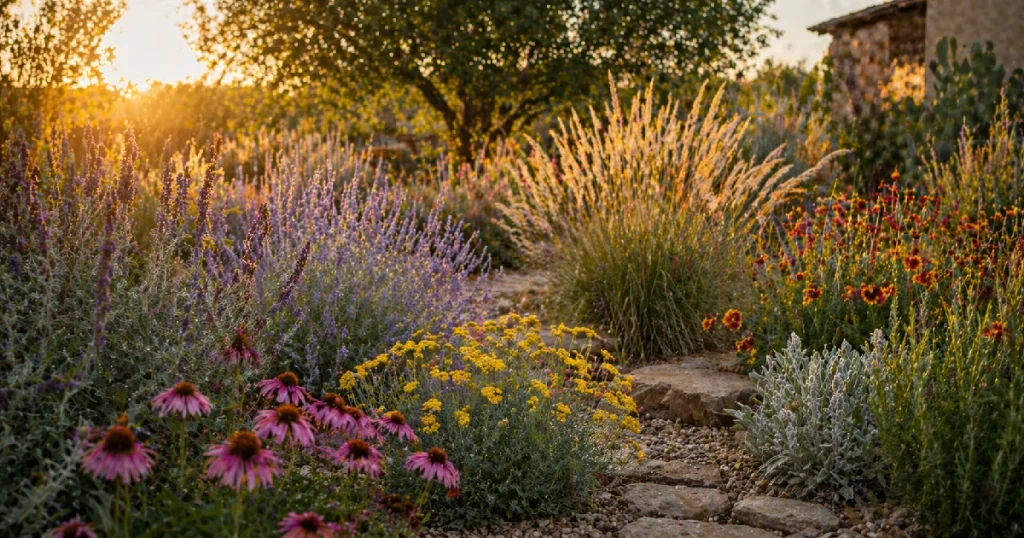
The quiet resilience of heat-resistant plants in the face of a baking earth
Most of the advice you find in books was written for a version of the world that doesn’t really exist anymore. The seasons are stretching out and the nights aren’t cooling down like they used to. I found that my old favorites were simply giving up the ghost by mid-August. Switching over to heat-resistant plants was an exercise in letting go of my ego. I had to admit that I couldn’t control the weather with a sprinkler system. I started planting things like Agastache and Russian Sage. These aren’t just flowers. They are biological machines built to thrive in a furnace. The scent of those crushed leaves in the heat is something you never forget. It smells like resilience and wildness.
There is a common misconception that drought-tolerant plants have to look like a desert landscape full of rocks and cacti. While I love a good agave there is a whole world of lushness available if you know where to look. I found that certain salvias will bloom their heads off in a drought as long as they have a bit of gravel at their feet. They don’t want the rich heavy mud we were taught to provide. They want to be neglected. It is a hard lesson for a gardener to learn that sometimes the best thing you can do for a plant is to leave it alone. The more I fussed the more they struggled. Once I stepped back and let the sun-loving plants do their own work the yard began to hum with a different kind of energy.
I noticed that the butterflies and the bees didn’t care about my expensive hybrid roses that were dropping petals in the heat. They were all over the Sedum and the Coneflowers. There is a deep satisfaction in watching a garden sustain itself when the rest of the neighborhood is turning yellow. You realize that your yard has become an oasis not because you forced it to be but because you chose the right residents. Those summer-hardy plants create a canopy that protects the soil and keeps the microbes alive even when the ground feels like a brick. It is a community of survivors and there is a real dignity in that.
Why choosing heat-tolerant perennials is an act of long term sanity
I used to spend every May planting flats of annuals that would be dead by Labor Day. It was a cycle of waste that left me exhausted and broke. Transitioning to a backbone of heat-tolerant perennials was the best decision I ever made for my mental health. These plants have memory. They spend their first year putting down roots that go deeper than you can imagine. By the second or third summer they don’t even notice the lack of rain. They have built their own infrastructure. I have a stand of Yarrow that has seen some of the worst heatwaves on record and every year it comes back stronger. It doesn’t ask for much and it gives back a sea of gold and silver.
There is a specific kind of beauty in the late season garden that most people miss because they have already given up and gone inside. When you have the right mix of species the garden doesn’t fade. It shifts. The colors get deeper and the textures get more interesting. You see the seed heads of the Rudbeckia catching the low light of a September afternoon and you realize that this is what a successful garden looks like. It isn’t a snapshot of a perfect moment in June. It is a long slow burn that lasts until the first frost. Investing in these tough plants for long summers is really just an investment in your own future enjoyment of the space.
I’ve become a bit of a snob about it I suppose. I see people watering their lawns at two in the afternoon and I just want to tell them to stop fighting the inevitable. The grass wasn’t meant to be that green in August. But a well placed patch of Gaillardia or a sturdy Rosemary bush will look fantastic without a drop of effort. We have this cultural obsession with a certain type of English estate look that just doesn’t fit the reality of our current climate. Breaking away from that is liberating. You start to see the potential in the plants that others might overlook because they aren’t traditionally pretty. A plant that can survive a three month bake-off has a beauty that goes beyond the petals.
It makes me think about how we handle stress in our own lives. We often try to insulate ourselves from every discomfort but the most interesting people are usually the ones who have been through the fire and come out with some grit. My garden is full of those characters now. It isn’t a polite or curated space. It is a bit wild and a bit overgrown and it smells like hot dust and nectar. I don’t feel the need to deadhead every spent bloom or pull every stray blade of grass. There is a balance that happens when you stop trying to be the boss and start being a partner.
The sun is finally dipping below the tree line as I write this and the air is still thick with the heat of the day. I can see the silhouettes of the taller grasses swaying in the slight breeze. They aren’t wilting. They aren’t stressed. They are just existing in the environment they were built for. I didn’t have to do anything today to keep them alive. That is the real gift of choosing the right plants. It gives you back your time. It gives you back your summer. Instead of being a slave to the hose I can just sit here and watch the shadows grow long across a yard that knows how to take care of itself.
I’m not sure what next year will bring. Maybe it will be even hotter or maybe the rain will finally return in July. But I’m not worried about it anymore. The garden has taught me that as long as you have a solid foundation you can handle whatever comes your way. The survivors are already in the ground and they are waiting for the next challenge. There is a peace in that certainty that no bag of fertilizer could ever provide. You just have to be willing to look past the flashy labels and find the things that have the heart to stay.
As a Senior Editor at Mini Greenhouse Kits, Hannah Kinsley is a passionate supporter of small-space gardening and urban gardening. Hannah, who is currently majoring in Environmental Policy through the University of Michigan’s Environmental Studies program, infuses her writing with a solid academic foundation and a sincere enthusiasm for the environment. You can find her playing soccer or exploring the city’s green areas with friends when she’s not researching the newest trends in city gardening or creating content for minigreenhousekits.com.