
Boston ferns that have outgrown their pots have sentimental value. It’s like a teenager who is too tall for last year’s school clothes. With fronds spilling over the rim and roots pressing against the sides of the container, it hangs there in the corner. It is perceived as a problem by most people. Experienced growers are aware of chance. That crowded root ball contains multiple plants waiting to grow.
Nephrolepis exaltata, or Boston ferns as they are botanically known, has been a common sight in offices, porches, and parlors for over a century. No houseplant has enjoyed a longer and subdued popularity period. They don’t produce fruit, bloom, or do anything remarkable. Their method is to cover the space with a deep green curtain that, in some way, seems more appropriate for a rainforest than for an apartment. Once you figure out how to multiply them, you stop buying new ones. In that crowded root ball, multiple plants are waiting to grow.
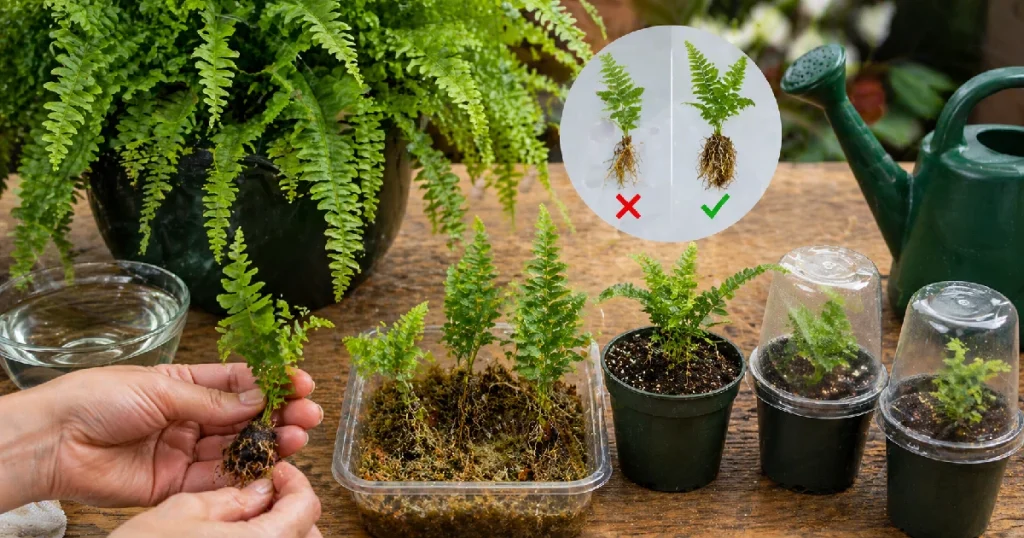
To be honest, division is the most dependable approach and should be learned first. It sounds more clinical than it really is. You tilt the pot sideways, thoroughly water the plant the night before (which loosens the root ball without tearing it), and gently move the fern to a surface where you can work. There will be a thick, fibrous tangle of roots with brownish-green edges and still alive in the middle.
To divide the mother plant into two, three, or four sections, you press into it with clean, sharp hands or a knife. Each section must have at least a few upward-pointing fronds and healthy roots. We discard anything with completely brown foliage or dried, blackened roots. It is impossible to save a failed section, and planting a weak pot wastes a good pot.
It doesn’t care about the soil, but it values organic matter and proper drainage. A mixture of potting soil that has been amended with some vermicompost or compost is placed in each division’s own container. Each one should be planted at the same depth as before. After that, water it thoroughly and place it in a warm place away from the sun. The division itself is not the most difficult part. Over the next two or three weeks, the fern appears utterly unconvinced that it consented to anything.
It makes sense that most seasoned growers mark their calendars for spring. A fern divided in March or April has the entire spring and summer ahead of it, with months of warmth and growth preceding the slow, gloomy days of winter. The new plants will remain motionless for months, quietly establishing roots as the light fades. It’s not disastrous to divide in the fall. It is possible. No, it’s not perfect.
Newcomers are surprised by humidity. On the forest floor beneath the canopy of larger plants, Boston ferns developed in moist air. Due to the lack of roots in the newly divided section, the leaves are attempting to retain every drop of water. During the first week or two of a new division, cover it loosely with a clear plastic bag to create a humid microclimate. Despite being low-tech and somewhat awkward-looking, it performs better than the majority of complex propagation setups.
The second method requires a little more patience and observation, but it does not require splitting the parent plant. Boston ferns produce runners when they reach maturity, which are thin, wiry projections that emerge from their base. There are times when these runners develop small clusters of leaves with primitive root systems. As in gardening, watching a runner produce its first tiny frond can be disproportionately satisfying. A runner can be pressed into moist compost in a small pot, kept attached to the mother plant for a few weeks, and then cut off when it has clearly rooted. Low-risk, gentle, and yields small but robust plants, but you must remember that the timing is completely determined by the fern.
Spore-based propagation is another option. Eventually, every fern fan will come across this option, and if they’re being honest, most people find it more intriguing in theory than in practice. Sporangia are brown dots found on the undersides of mature fronds, which are reproductive structures. It is best to cut a ripe frond, lay it on paper until the capsules open and release their dust-fine spores, then carefully distribute them across a moist growing medium, which is covered in plastic and kept consistently warm. The benefits of division outweigh the weeks of observation and waiting, despite the fact that division produces larger, healthier plants in a fraction of the time. The method’s need for patience, however, is admirable. Since ferns have reproduced in this way for 300 million years, it is likely that they are not in a rush. The factor that surprises newcomers is humidity.
There are a few care guidelines that apply to all three approaches. New plants need bright light, but not direct sunlight; morning light filtered through a sheer curtain is ideal. It is essential that the soil be constantly moist without being submerged in soggy compost. In addition, they actually benefit from warm air; temperatures below 18°C slow establishment, while temperatures above that encourage the roots to grow. The Boston fern should be placed in a room that is comfortable for a human wearing a light sweater when it is a baby.
A newly split plant producing its first new frond makes it difficult to ignore the fern’s lack of interest. Not much to report. No struggle appears to be taking place. An overly substantial pot sits in a depressing cluster of foliage after a week. After you stop checking, it quietly grows. Boston Ferns grow slowly, which is a problem. The reward for consistency is greater than the reward for intervention. They will take care of the rest on their own schedule as long as you maintain their temperature, humidity, and moisture levels.
As a Senior Editor at Mini Greenhouse Kits, Hannah Kinsley is a passionate supporter of small-space gardening and urban gardening. Hannah, who is currently majoring in Environmental Policy through the University of Michigan’s Environmental Studies program, infuses her writing with a solid academic foundation and a sincere enthusiasm for the environment. You can find her playing soccer or exploring the city’s green areas with friends when she’s not researching the newest trends in city gardening or creating content for minigreenhousekits.com.