
There is a certain kind of silence that descends upon a garden covered in snow in January. Don’t use the tools anymore. Beds that are dormant. There was a lot of waiting in the yard. When you open the greenhouse door, the scent is warm, citrusy, and almost ridiculously alive. It’s hard to believe that it’s barely above freezing outside.
Well-run backyard greenhouses accomplish this in the winter. Seasonal rules are modified. While most gardeners are leafing through seed catalogs and dreaming of April, an increasing number of home growers are already harvesting. Fruit, not lettuce or herbs. The branches are dripping with Meyer lemons. Passion fruit vines climb trellises. They are so sweet that they will stop you in your tracks. Winter is here.
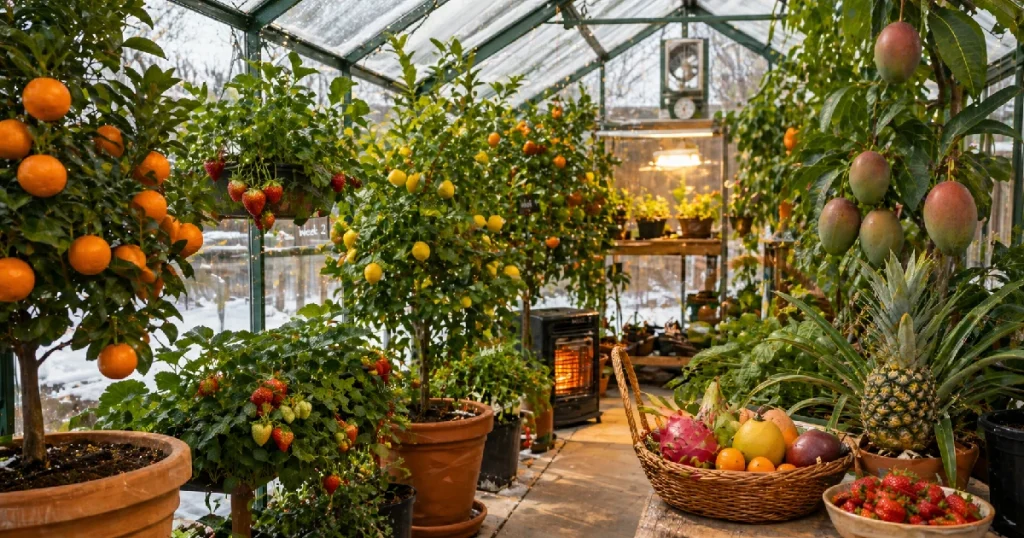
The concept seems illogical at first. Fruit is a summertime promise, after all. Most of the most productive greenhouse fruits are either compact, cold-tolerant, or well-adapted to container growing, so they can thrive in a backyard structure even if it is only slightly insulated. Calculations are completely different in a protected environment. Even an unheated greenhouse can maintain temperatures that are 10 to 20 degrees warmer than the outside air. When you add a few barrels of water as thermal mass, that gap gets even wider. Fruit that would otherwise succumb to frost needs that margin.
Meyer lemons are usually the first thing greenhouse growers mention. Almost floral in flavor, they bear fruit throughout the coldest months, are small enough to grow in large containers, and bear fruit through the coldest months. If you keep the temperature above 40°F and provide them with a sunny location, they will perform well. The same reasoning applies to other dwarf citrus: Satsuma mandarins, Bearss limes, and calamondins all thrive in pot culture and yield winter harvests that seem impossible.
Kumquats deserve more recognition than they usually receive. In a bright greenhouse, even one that is somewhat chilly, they can bear fruit all winter. The plants are small, glossy, and surprisingly cold-hardy. Rather than buying something tasteless from the grocery store in February, pick up a fresh kumquat instead. Plants like these are not ostentatious. There are few demands they make. They simply produce in silence in midwinter, which seems like a tiny miracle.
Passion fruit is truly a surprise. Vine that grows quickly, fills vertical space efficiently, and produces fruit that tastes and looks like it belongs much closer to the equator. The flowers alone are worth the trip. They are elaborate, almost architectural, and very fragrant. In a heated greenhouse, passion fruit doesn’t just survive winter; it thrives, taking advantage of the heat and protection to do things it can’t do outdoors.
Among the winter greenhouse fruits, strawberries are arguably the most emotionally fulfilling due to their familiarity. As a matter of fact, they taste better in a cool greenhouse than in a warm one, which enhances their sweetness in ways that an open garden often cannot. When grown in hanging baskets or tiered vertical planters, they take up surprisingly little space and consistently produce well. In the dead of winter, the common strawberry produces sweet fruit, which surprises people more than the tropical exotics.
The ease with which figs adapt to greenhouse cultivation has always made them ideal for greenhouse cultivation. Despite their large size, cultivars such as Chicago Hardy or Brown Turkey maintain a manageable size when kept in large pots. Winter dormancy is a normal part of the cycle, and it can even be shortened in a greenhouse that is sufficiently warm. Witnessing a fig in a snow-covered structure emerge into leaf in January has a certain subtle drama.
There are also options that are truly tropical, which are controversial. As dwarf banana plants grow in a heated greenhouse, they provide a lush, almost theatrical feel that transforms a functional building into something akin to a living room. It is possible for them to bear fruit in a heated greenhouse, but not in a cold greenhouse. A pineapple takes two to three years to mature, but it grows steadily in constant warmth above 68°F and is undoubtedly the most talked-about plant in any backyard.
It is important to consider a few pragmatic facts. Hand-pollination becomes a silent ritual in winter greenhouses without bees. Imitating what insects do outside, a tiny brush moves gently from flower to flower. It’s simple once you know how, but when you don’t, gardeners lose their harvest. In addition, most of these fruits thrive in containers rather than in-ground beds, which allows the plants to be moved outside during the summer, freeing up greenhouse space and allowing them to take advantage of their most abundant natural environment.
All of this suggests that winter gardening is facing a silent reckoning. It makes sense to shut down, wait, and hope for spring, but it is becoming less and less necessary. As frost patterns form on its glass, the backyard greenhouse has evolved beyond a seasonal addition. Those who have figured this out say winter doesn’t apply here.
Alyssa Bennet is a Senior Editor at Mini Greenhouse Kits and a passionate advocate for urban gardening and small-space growing. Currently pursuing her major in Arts at the University of California, Alyssa brings a distinctly creative eye to the world of city gardening – blending artistic sensibility with a genuine love for green living. She writes regularly at minigreenhousekits.com, and when she’s not crafting her next gardening piece, you’ll find her with a paintbrush in hand, watching sports, or exploring the city with friends.