
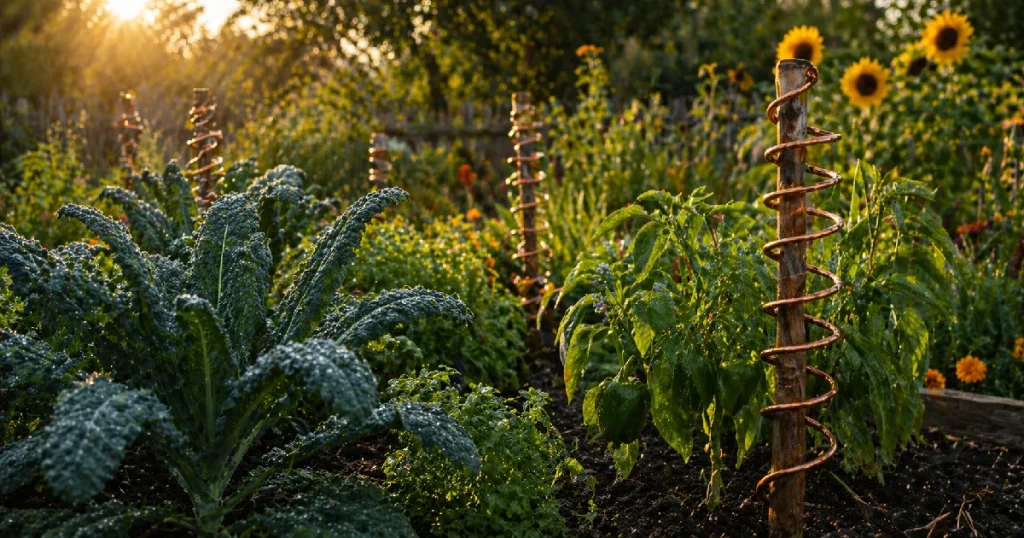
The first time I saw a copper spiral sticking out of a tomato planter I figured my neighbor had finally lost his mind or was trying to catch some obscure radio station from the nineteen seventies. It looked like a folk art project gone wrong. He called it electroculture gardening and he spoke about it with the kind of hushed intensity usually reserved for secret fishing spots or family recipes. I stood there with my plastic watering can and a healthy dose of skepticism because we are taught that plants need three things which are light and water and dirt. The idea that a thin coil of metal could somehow pull energy from the sky and feed it to a vegetable felt like something out of a Victorian séance. But then I saw his kale. It was massive and dark and seemed to be vibrating with a level of health that my own wilted greens couldn’t even dream of.
We live in a world that is obsessed with the measurable and the industrial. We buy bags of nitrogen and bottles of phosphorus because we can see the numbers on the label. We trust the chemistry because the chemistry is loud and expensive. Electroculture gardening is the opposite of all that. It is quiet. It is nearly free. It relies on the subtle atmospheric currents that we usually ignore until a lightning storm rolls through. I spent a whole evening reading about old French experiments from the eighteen hundreds where they used giant wooden poles to harness the earth’s magnetic field. It felt like uncovering a buried history of a world that was much more connected to the unseen forces of the planet than we are today.
I started small because I didn’t want the whole street to think I was building a lightning rod in the middle of my suburb. I took some old copper wire and wrapped it around a cedar stake. I placed it near a struggling bell pepper plant that had been doing nothing but turning yellow for three weeks. There is a strange feeling when you push that metal into the ground. You start wondering if you are actually doing anything or if you are just participating in a very slow piece of performance art. But the mind is a funny thing. Once you start looking for the vibration you start to see it everywhere. You notice the way the dew clings to the wire or how the ants seem to steer clear of the immediate radius of the copper.
The strange pull of electric gardening and the mystery of the atmospheric battery
It took about ten days before I noticed the change in the pepper plant. The leaves didn’t just turn green. They turned a deep and lustrous emerald that looked almost artificial. I found myself sitting on a milk crate just staring at it and trying to reconcile my logical brain with what was happening in the dirt. This shift into electric gardening isn’t about plugging your backyard into a wall socket. It is about acknowledging that we are living inside a massive battery. The sky is positively charged and the earth is negative. Everything that grows is caught in the middle of that flow. When you put a conductor in the soil you are essentially creating a shortcut for that energy.
People ask me if it is dangerous and I have to laugh because we are talking about micro currents that you couldn’t even feel with your tongue. It is more of a suggestion to the plant than a command. I started thinking about how we have stripped our landscapes of these natural conductors. We build houses of wood and stone and we pave everything in asphalt. We have essentially insulated ourselves from the very pulse that used to regulate the growth of the wild. By bringing a bit of electrified gardening back into the mix you are just restoring a connection that was already there. It feels less like a hack and more like an apology to the soil for ignoring its true nature for so long.
I began to experiment with different shapes and heights. Some people swear by the pyramid and others want the spiral to face a specific magnetic north. I found that the intention behind the work mattered as much as the geometry. There is something meditative about winding wire. It slows you down. It makes you look at the plant as an individual rather than just a crop. You start to see the garden as a series of circuits. You wonder if the marigolds are talking to the beans through a language of ions and electrons that we are too clumsy to hear. It is a humbling realization that our traditional methods of dumping fertilizer might be the equivalent of shouting at someone when a whisper would do.
Why the movement toward electrostimulation gardening feels like a quiet revolution
There is a certain joy in doing something that the mainstream hasn’t quite figured out how to monetize yet. You can’t really patent a copper wire and a stick. This brand of electrostimulation gardening is a threat to the people who want to sell you a new bottle of chemicals every spring. It puts the power literally back into the hands of the person with the shovel. I’ve had people walk by and ask why my sunflowers are four feet taller than theirs and when I mention the wires they usually get a look of polite confusion. We are so used to complex solutions that simplicity looks like magic or madness.
The more I leaned into electrified gardening the more I realized that I was changing as much as the plants were. I became more aware of the weather and the static in the air before a storm. I started noticing the health of the local bee population and how they seemed drawn to the areas where I had placed my little antennas. It makes sense if you think about it. Bees are sensitive to electric fields. They use them to find flowers. By enhancing the local charge you are essentially putting up a neon sign for the pollinators. The whole yard started to feel more integrated and more alive.
I don’t have all the answers and I don’t think anyone really does. There are days when I think the whole thing might be a placebo for the gardener. Maybe I’m just taking better care of the plants because I’m paying more attention to them. But then I look at the control group of tomatoes on the far side of the fence that didn’t get any copper and the difference is hard to ignore. They look tired. They look like they are working too hard to stay upright while the ones with the wires are thriving with a sort of effortless grace.
It is easy to get caught up in the technicalities of wire gauge and height ratios but that misses the spirit of the thing. The spirit is curiosity. It is the willingness to admit that we don’t know everything about how life works. We spend so much time trying to dominate the earth and force it to produce that we forget to listen to its hum. The garden isn’t a factory. It is a living entity that responds to the environment in ways that we are only beginning to rediscover. If a bit of copper can bridge the gap between our modern world and that ancient energy then I am happy to be the person with the weird stakes in the yard.
The sun is starting to set now and the light is hitting the copper spirals in a way that makes them look like they are glowing. The air feels heavy and expectant. There is a storm coming and I know that when the lightning flashes the wires will be working in their own silent way to gather that immense power and tuck it into the roots of my vegetables. It is a beautiful thought. It is a way of participating in the grand movements of the planet without leaving your own backyard.
I’m not sure where this leads or if I’ll eventually have a wire running to every single sprout in the garden. For now it is enough to just watch and learn. The plants are the real teachers here. They don’t lie and they don’t have an agenda. They just grow. And if they happen to grow better with a little bit of help from the sky then who am I to argue with the results. The neighborhood can keep its lawns and its leaf blowers and its perfectly measured rows of identical shrubs. I’ll stay here with my mess of wires and my giant kale and the feeling that I’ve finally tapped into a frequency that has been playing all along.
Olivia Murphy is a Senior Editor at Mini Greenhouse Kits and a fervent supporter of small-space and urban gardening. Alyssa, who is currently majoring in both literature and biology at Michigan State University, infuses her writing about city gardening and small-space growing with a unique blend of scientific curiosity and storytelling instinct. Her love of literature influences how she tells the stories behind the plants, and her background in biology gives her content a grounded, research-informed edge. When she’s not working on her next gardening piece, you can find her curled up with a good magazine or watching a movie that she’s been meaning to watch for weeks. She writes with passion at minigreenhousekits.com.