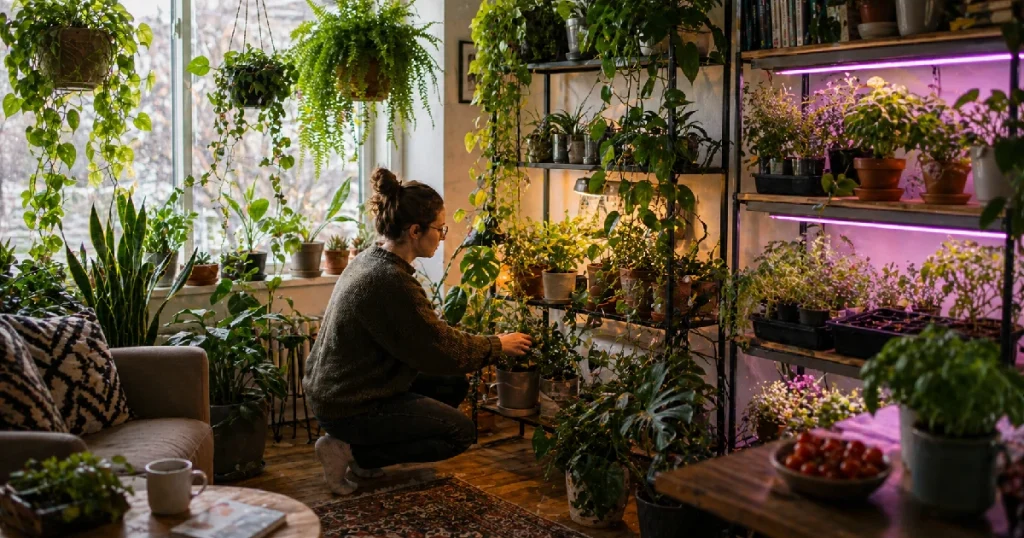
There is a specific kind of silence that settles into a house when the radiators stop clicking and the winter light turns that bruised, late afternoon shade of grey. It is a quiet that usually invites a bit of melancholy, a sense that everything outside is dormant and perhaps you should be too. But lately, my living room has refused to participate in that seasonal slumber. Instead, it smells faintly of damp earth and the sharp, peppery scent of crushed basil. I have spent the last three years turning my apartment into a laboratory of green things, and if I have learned anything, it is that the most successful indoor gardening ideas are rarely the ones you see in glossy magazines where every leaf is polished and no one ever mentions the fungus gnats.
My journey into keeping things alive under a roof started with a single, pathetic spider plant. I treated it like a delicate piece of glass, watering it on a rigid schedule that ignored the fact that the soil was already a swamp. It died, of course. Most people quit there, convinced they lack some mystical genetic trait. But I realized that the indoor garden is not a test of character. It is a slow, clumsy conversation between a human who wants beauty and a plant that just wants to survive the peculiar climate of a modern home. We live in boxes with regulated temperatures and stagnant air, which is basically the opposite of what a forest floor or a meadow provides. To succeed, you have to stop thinking like a decorator and start thinking like a roommate.
The first hurdle is always the light. We perceive our homes as bright because our eyes adjust so beautifully, but to a plant, a corner ten feet from a window might as well be a dark cave. I began moving my pots around like a restless spirit, watching how the sun hit the floor at noon versus four in the afternoon. You start to notice things. You notice that the pothos is stretching its neck toward the glass like it’s gasping for air, or that the succulents are losing their tight geometry and becoming leggy and pale. That is the moment the hobby takes hold. It ceases to be about furniture and starts to be about light cycles and humidity.
Practical indoor gardening for beginners who hate rules
If you are just starting out, the pressure to be perfect is the fastest way to end up with a collection of empty terracotta pots. I used to think I needed a massive budget and a degree in botany, but the reality of indoor gardening for beginners is much more about observation than it is about equipment. You do not need a fancy moisture meter when you have a finger. You do not need a specialized greenhouse cabinet if you have a bathroom window that gets steamy while you shower.
The most profound shift for me happened when I stopped buying plants because they looked cool and started buying them because they actually liked my drafty windowsills. Some people swear by the fiddle leaf fig, but I find them to be the divas of the botanical world, dropping leaves if you even look at them with a slightly judgmental expression. I prefer the stalwarts. The snake plants that thrive on neglect. The ZZ plants that seem to grow in the dark. There is a quiet dignity in a plant that doesn’t demand your constant attention but rewards your occasional glance with a new, waxy shoot.
I also learned that the pot matters less than the holes in the bottom. We have this obsession with beautiful ceramic vessels that have no drainage, which is essentially a death sentence. I have spent far too many Sunday mornings with a masonry bit, drilling holes into vintage bowls and thrift store find because I refused to let a lack of drainage ruin a good aesthetic. It’s messy and loud, but the sound of that bit breaking through the bottom of a pot is the sound of a plant being given a fair chance at life.
Finding space for an ambitious indoor vegetable gardening project
Once you master the art of not killing your foliage, the itch to grow something you can actually eat becomes unbearable. There is a specific thrill in plucking a leaf of something and putting it directly into a pan. However, indoor vegetable gardening is a completely different beast than growing a few ferns. Vegetables are hungry. They are thirsty. They are obsessed with the sun in a way that your average ivy simply isn’t.
I started small, with a few herbs on the kitchen counter, but quickly realized that the fluorescent light under my cabinets wasn’t going to cut it. I had to get weird. I started looking at my bookshelf not as a place for novels, but as a potential vertical farm. This is where the concept of an indoor gardening system comes into play, though perhaps not in the way the manufacturers intend. You don’t necessarily need a three-hundred-dollar hydroponic rig that looks like it belongs on a space station. Sometimes, all you need is a sturdy shelf, a few clip-on LED bars, and a willingness to have your dining room glow with a soft, extraterrestrial purple light every evening.
Growing food inside changes the way you look at your grocery bill. You realize how much energy goes into a single head of lettuce or a handful of cherry tomatoes. My first indoor harvest was a tray of microgreens that I grew in an old take-out container. They were tiny, spicy, and tasted like a victory. From there, I moved on to dwarf peppers and bush beans. There is something fundamentally grounding about tending to a plant that provides sustenance while the wind is howling outside and the world feels increasingly digital and detached.
But let’s be honest about the failures. I once tried to grow carrots in a deep pot in my hallway. They grew beautiful, ferny tops that looked like a miniature forest, but when I finally pulled them up, they were the size of my pinky nail and twisted into knots. I laughed for ten minutes. The indoor garden is full of these small, hilarious tragedies. You learn to embrace the stunted growth and the yellowing leaves because they are just part of the narrative.
The air in a house with a significant indoor garden feels different. It is heavier, more alive. When I walk through my front door, I am greeted by a wall of green that doesn’t care about my emails or my deadlines. It only cares about the water in its roots and the light on its leaves. This slow pace is a deliberate protest against the speed of everything else. It requires you to wait. You cannot force a new leaf to unfurl any faster than it wants to. You can provide the nutrients and the warmth, but the timing is entirely up to the plant.
I find myself talking to them sometimes. Not in a “crazy plant person” way, but in a way that acknowledges their presence. A quick check-in while the coffee brews. A gentle poke at the soil of the Monstera to see if it needs a drink. These small rituals anchor me to the physical world. In a life spent staring at screens, the tactile reality of soil under my fingernails is a necessary corrective.
As the seasons shift again, I find myself planning for more. Maybe I’ll try a citrus tree in the corner by the radiator, or perhaps I’ll finally commit to a full-scale wall of climbing vines. The beauty of these indoor gardening ideas is that they are never finished. You are always adjusting, always moving a pot three inches to the left to catch a stray beam of light, always wondering if that new leaf is a sign of health or a cry for help.
There is no final destination in a garden that lives under your roof. It is a constant, shifting ecosystem that reflects your own rhythms and the quirks of your architecture. Some things will flourish and take over your bookshelves, while others will quietly fade away despite your best efforts. And that is okay. The goal isn’t a perfect museum of greenery. The goal is to live alongside something that grows, to witness the quiet persistence of life in the middle of a city, and to remember that even in the dead of winter, there is something green and stubborn waiting for the morning. I don’t think I’ll ever have it all figured out, and honestly, I think I prefer it that way. The mystery of why one plant thrives while its neighbor wilts is what keeps me coming back with a watering can every Saturday morning, hopeful and curious about what might happen next.
As a Senior Editor at Mini Greenhouse Kits, Hannah Kinsley is a passionate supporter of small-space gardening and urban gardening. Hannah, who is currently majoring in Environmental Policy through the University of Michigan’s Environmental Studies program, infuses her writing with a solid academic foundation and a sincere enthusiasm for the environment. You can find her playing soccer or exploring the city’s green areas with friends when she’s not researching the newest trends in city gardening or creating content for minigreenhousekits.com.