
Standing inside a greenhouse that should be producing and finding it half-empty can be frustrating. There are gaps between the shelves. There is a chill in the air. Beds that were harvested a few weeks ago and have not been replanted. In a difficult-to-describe way, it’s wasteful, like a restaurant kitchen with three burners off. Structure exists. Potential exists. It’s just that the thinking has gone awry.
Small greenhouses are consistently undervalued by both their builders and their users. Typically, they are treated like garden beds with a little protection; planted in rows, spaced loosely, harvested when ready, and planted again when ready. The method isn’t very effective outside, and it’s practically illegal inside greenhouses. Controlled environments are the whole point. Using conventional spacing and seasonal thinking would be like owning a Ferrari and driving it to pick up the mail.
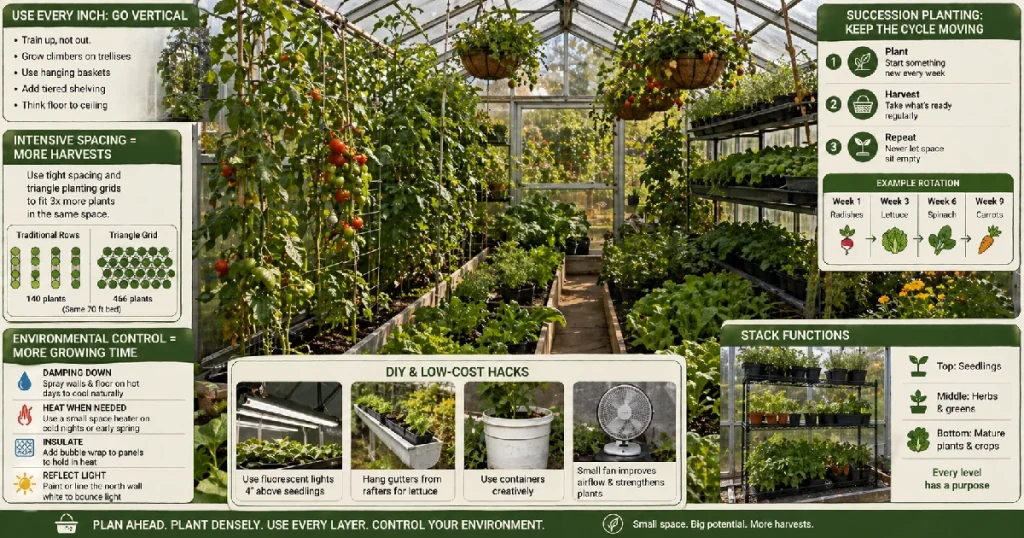
It’s obvious to start with vertical space, but it’s also the most neglected. It is not uncommon to find benches covered in pots, a few seedling trays, and nothing else but empty space in a neglected small greenhouse. That airspace is real estate. A floor-to-ceiling trellis can be used to grow tomatoes, cucumbers, pole beans, peas, and six other climbing crops that would otherwise take up a lot of horizontal space. By rearranging the plants into their natural, upward growth patterns, a greenhouse that once felt small now feels almost airy. The transition is often described as confusing by hobbyists who have made the switch. Hanging baskets suspended from roof rafters add another layer of convenience for harvesting cherry tomatoes or strawberries that spill downward. The walls are lined with tiered shelving storing herbs and tiny pots, while seedlings wait their turn above. A system, not a collection of separate plants.
Intensive spacing is the second adjustment that makes all the difference. Most gardeners were instructed to plant in rows with wide spaces between them, which is a sensible strategy in outdoor settings where access, machinery, and air circulation are needed. In a greenhouse, these regulations are significantly relaxed. As an alternative to parallel rows, planting on a nine-by-nine-inch triangular grid can increase plant density by more than three times. Floret Flowers meticulously documented the math, going from 140 snapdragons in a seventy-foot bed to 466 plants. There is no conjecture here. Three times as many plants on the same footprint. As well as suppressing weeds, close planting also maintains more consistent soil moisture, which is an efficiency in and of itself.
Often, succession planting is the one habit that separates gardeners who consistently produce from those who experience a single good flush followed by dead space. As soon as a crop is harvested, something new is introduced. This soil is planted with carrots or spinach before it dries out, while radishes take four to six weeks to mature. After the lettuce is chopped, another wave of seedlings takes their place on the seedling shelf. To maintain this rhythm, a rotation must be planned several weeks in advance, rather than reacting to empty beds as they arise. It has a different mentality than casual gardening, is more like a production schedule, and initially seems more difficult than it really is.
Environmental control distinguishes a productive greenhouse from a passive one. When the walls and floor are dampened down on hot days, a technique known as “damping down,” the interior is cooled without the use of mechanical refrigeration, gaining extra weeks of summer growing time. The cold prevents early spring plantings from being killed by a small space heater (one writer found a construction-grade model at a pawnshop for five dollars). Heat is trapped inexpensively with bubble wrap insulation pressed against interior panels. The north wall, which does not receive direct sunlight, is painted white or lined with reflective material to reflect light back at the plants. All of these interventions are inexpensive. It is important to pay attention to them.
Although greenhouse gardening is often mythologized as a specialized activity requiring specialized tools and knowledge, it is in fact a much more approachable activity. Standard fluorescent lights placed four inches above seedlings are more effective than costly professional grow lights that generate heat that harms the delicate growth they are meant to promote. From the rafters, salvaged gutters are hung to create a lettuce bed. It doesn’t require much creativity. Simply take a look at the entire structure, from floor to ridge, and consider what each component might be doing that it isn’t doing.
A small greenhouse can be one of the most fulfilling tools available to a home gardener when it is used extensively. Most people don’t realize how much they can get out of a simple eight-by-six-foot structure when they first set it up. Both literally and figuratively, the ceiling is higher than it appears.
As a Senior Editor at Mini Greenhouse Kits, Hannah Kinsley is a passionate supporter of small-space gardening and urban gardening. Hannah, who is currently majoring in Environmental Policy through the University of Michigan’s Environmental Studies program, infuses her writing with a solid academic foundation and a sincere enthusiasm for the environment. You can find her playing soccer or exploring the city’s green areas with friends when she’s not researching the newest trends in city gardening or creating content for minigreenhousekits.com.