
The majority of gardeners are aware of this moment, even if they don’t want to acknowledge it. You notice that the leaves on a pot of heucheras that seemed in perfect condition a week ago are slightly lower than they should be. With a gentle tug, the entire plant comes away from your hand without roots. It’s just a ghost of a plant. The roots were silently and completely consumed underground while you were preoccupied with other matters. Vine weevils have always been responsible.
There is no announcement from this pest. That’s why vine weevil infestations in gardens throughout the United Kingdom are getting worse every year. When most people notice the damage, such as the slow wilting, the collapse, or the C-shaped grubs falling out of the compost, the infestation is advanced. Through autumn and well into spring, the larvae live underground and feed on roots. One vine weevil female can lay several hundred eggs in a season, all of which measure less than a millimeter across and are invisible against a dark compost background.
Pot plants are particularly vulnerable because the weevil thrives in proprietary compost. Loose, nutrient-rich bagged growing media benefit both larvae and adults. By reusing the same compost year after year, gardeners effectively give the pest a breeding ground that only gets worse with each new planting. It gets worse every year because the gardener does not fully understand why their container plants continue to die.
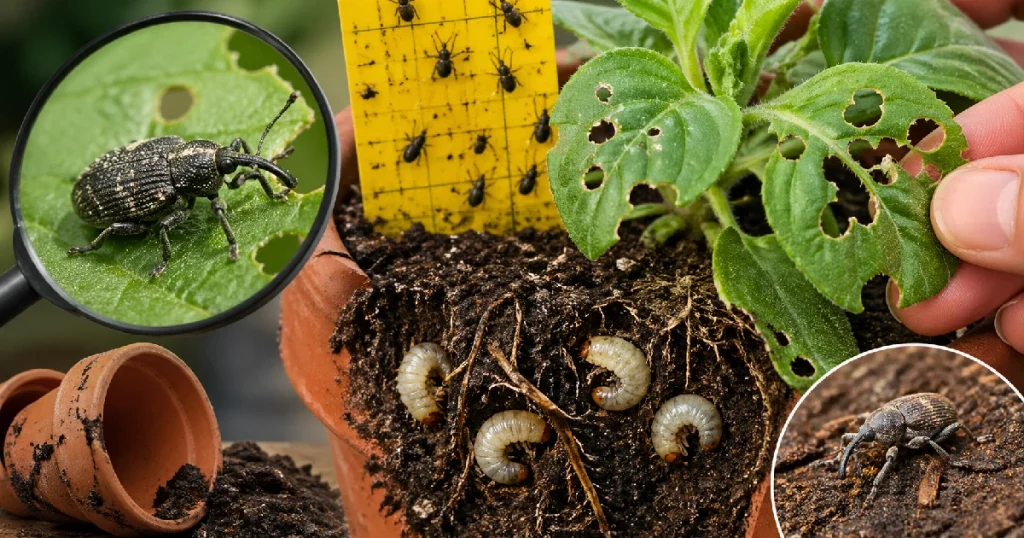
It is easier to identify adult beetles if you are looking at the right time and in the right direction. Their wings are dull black and have faint gingery speckling. They are about 9 mm in size. Whenever there is even the slightest disturbance, they play dead. Metaphors aren’t used here. One will go completely still if disturbed, sometimes for several minutes, to convince you that it is already dead. Examine pots at night when the adults are truly active, and you’ll see them moving if you use a torch. Shaking a pot-grown plant over a piece of newspaper will cause the beetles to fall. Once they’re out, squash them. Ceremonies aren’t necessary.
Gardeners are often surprised to learn that vine weevils cannot fly. Wing cases are fused shut. Because they all move solely on foot, they arrived in a balcony window box by climbing-up walls, up drainage pipes, and up the outside of terracotta pots-gripping with incredible persistence. Putting pots on feet and placing them in a shallow tray of water solves this problem. In general, the moat method is more effective than it sounds, and the weevil cannot swim. Until you lose a third consecutive planter, it seems too easy.
Early warning indicators should be memorized. Especially on evergreens like camellias and rhododendrons, notched leaf edges are the first clue. The irregular, bitten-out notches are caused by adults feeding at night. Adults are present and most likely laying eggs, but they won’t kill a plant on their own. In the garden, primulas and polyanthus are particularly popular, and planting a few of these as canary plants is an age-old practice that still works today. If they are struck, everything in the vicinity is at risk.
In the case of an active infestation, predatory nematodes, such as Nemasys, are the most effective biological remedy. The nematodes are watered directly into moist compost and begin feeding on the larvae as soon as they are added. When the soil temperature is higher than 5°C and there are plenty of grubs to target, they perform best. In container compost, the results are truly remarkable when applied late summer or in spring when larval numbers are high. Since the nematodes require a live population in order to be effective, it is not a preventative measure. In addition to this, heavier garden soil is less conducive to their growth in pots.
The use of copper tape strips, sticky traps, torchlight hand-picking, top-dressings of gravel to prevent egg laying, and encouraging ground-feeding birds and toads that can eat both grubs and beetles are all available. None of these are perfect solutions on their own. A layered approach is most effective: elevate pots, replenish compost regularly, keep new plants away from established ones, and apply nematodes as soon as symptoms appear. As a result of gardeners’ tendency to treat vine weevils only after they wilt and collapse, the problem is getting worse. If you catch a rescued container early, such as when the leaves have notched or the first grub appears in an overturned pot, you can differentiate it from a dead one.
As you dissect the creature from your ruined polyanthus compost, you can’t help but admire its adaptability. To climb walls, trick predators, and reproduce, it uses very little of its surroundings. It is the least we can do to pay attention.
Olivia Murphy is a Senior Editor at Mini Greenhouse Kits and a fervent supporter of small-space and urban gardening. Alyssa, who is currently majoring in both literature and biology at Michigan State University, infuses her writing about city gardening and small-space growing with a unique blend of scientific curiosity and storytelling instinct. Her love of literature influences how she tells the stories behind the plants, and her background in biology gives her content a grounded, research-informed edge. When she’s not working on her next gardening piece, you can find her curled up with a good magazine or watching a movie that she’s been meaning to watch for weeks. She writes with passion at minigreenhousekits.com.