
There is a specific kind of quiet panic that sets in when you look at a packet of expensive seeds and realize you have no idea where to put them. For years I followed the rules of the grid. I measured distances with a wooden ruler and calculated the exact depth of every hole. I treated my backyard like a spreadsheet and the results were always fine but they never felt alive. They felt managed. Last Tuesday I stood in the middle of a patchy dirt lot with a handful of leftover zinnias and marigolds and I just threw them. I didn’t dig. I didn’t amend the soil with bags of store bought compost. I just let them fall where they wanted to land. That was my first real step into chaos gardening and it felt like exhaling after holding my breath for an entire decade.
We are taught that gardening is an act of control. We think we are the conductors of an orchestra but we forget that the instruments have their own ideas about the music. When you embrace the mess you start to realize that the plants actually know more about survival than we do. They find the pockets of moisture we missed and they lean into the sunlight that our shadows usually block. It is a messy business to give up the power of the plan. You have to be okay with things looking a bit ragged for a while. You have to be comfortable with the neighbors looking over the fence and wondering if you have finally given up on your property values.
I think about all the time I wasted trying to keep the cosmos from leaning over the walkway. I used stakes and twine and a lot of frustration to make them stand up straight like soldiers. Now I just let them flop. There is a strange beauty in a flower that decides to grow sideways because it found a better view of the afternoon sun. Chaos gardening isn’t about being lazy although that is a nice side effect. It is about acknowledging that the ecosystem is a conversation rather than a lecture. You provide the materials and then you step back to see what the land wants to do with them. It is a slow lesson in humility that most of us desperately need.
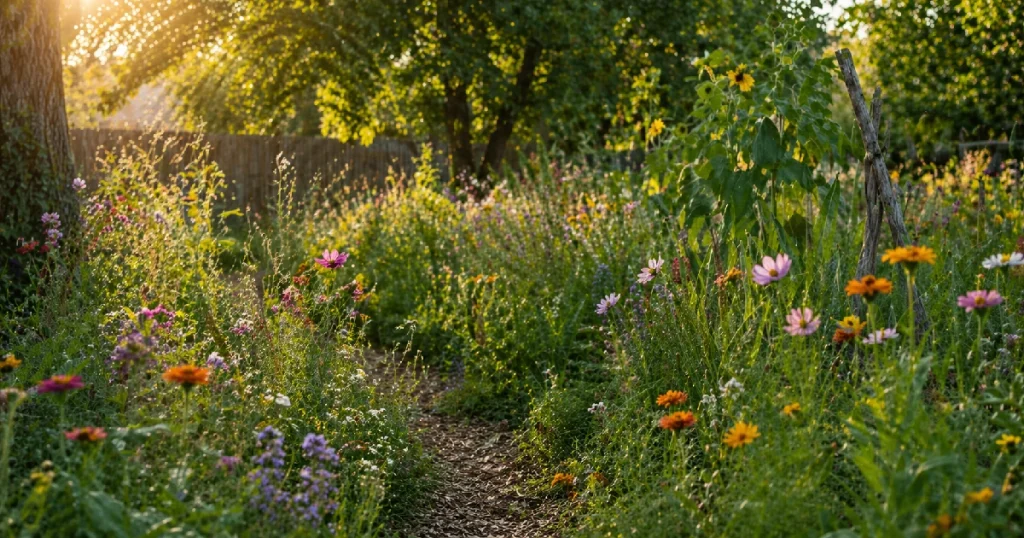
The art of letting go through scatter seed gardening and silent observation
There is a physical sensation to the act of scatter seed gardening that you just don’t get from meticulous planting. You feel the weight of the seeds in your palm and then you feel the air take them. You have no control over where they land. Some will end up under a rock and never see the light of day while others will find a perfect crack in the soil and become the centerpiece of the yard. It is a gamble every single time. This kind of unstructured gardening forces you to look at your space differently. You stop seeing a blank canvas and start seeing a living partner. You notice where the wind blows and where the water pools after a heavy rain because that is where your seeds are going to congregate.
I used to spend hundreds of dollars on starter trays and grow lights. I would obsess over the humidity levels in my basement like I was running a neonatal unit for petunias. Now I just wait for a day when the soil feels damp and the sky looks like it might open up. I mix my seeds in a bucket with a bit of sand so they spread more evenly and then I walk around like a madman throwing handfuls of potential into the corners. This random seed gardening approach has taught me more about plant biology than any textbook ever could. I see which species actually want to be here and which ones were only surviving because I was coddling them.
You start to see the survivors. The borage that pops up in the middle of the gravel path or the sunflowers that decided to grow in the shade of the old oak tree. They shouldn’t be there according to the back of the seed packet but there they are anyway. It makes you realize how much of our gardening knowledge is just a series of polite suggestions. The plants don’t read the labels. They don’t care about our aesthetic preferences. They just want to exist. And when you stop fighting them you find that the garden starts to have a rhythm that you could never have composed on your own.
Why the wild gardening aesthetic is a rebellion against the manicured lawn
We have been conditioned to love the flat green rectangle of a lawn but there is something deeply sterile about it. It is a vacuum. When you shift toward wild gardening you are essentially inviting the world back into your yard. You are saying that the bees and the butterflies and even the weird beetles have a seat at the table. It is loud and it is buzzing and it is occasionally a little bit scary. I found a snake in my taller grass last week and for a second I jumped. But then I realized that the snake was there because I had created a place where it could actually live. My no-plan gardening experiment had turned a dead space into a habitat.
There is a tension between what we think is beautiful and what is actually functional. A manicured rose bush is beautiful in a tragic sort of way because it requires so much intervention to stay that way. A patch of self sown wildflowers is beautiful because it is defiant. It looks different every morning. You can walk out with your coffee and see a new color that wasn’t there yesterday because a seed you forgot about finally decided it was time. This seed scattering method creates a texture that you can’t get from a nursery flat. You get layers of height and varying shades of green that bleed into each other without clear borders.
I don’t think we talk enough about the emotional relief of an unstructured garden. We are surrounded by deadlines and schedules and expectations of perfection. Our homes are supposed to be curated and our lives are supposed to be optimized. The garden should be the one place where we are allowed to be unfinished. When I stopped worrying about the rows I stopped worrying about the failures. If a patch of seeds doesn’t take it just means the soil wasn’t ready or the birds got a good meal. It isn’t a reflection on my skills as a gardener. It is just the way the world works.
The industry wants us to buy more stuff. They want us to buy specialized tools and chemical fertilizers and designer mulch. But the reality is that the earth has been gardening itself for millions of years without a trip to the big box store. When you lean into the chaos you are opting out of that cycle. You are trusting that the sun and the rain and the inherent desire of a seed to become a plant will be enough. It usually is. Not always but usually. And those failures are just as interesting as the successes. I have a patch of dirt where nothing grew for three years and then suddenly this spring it was covered in poppies. I don’t know why they waited and I don’t need to know. The mystery is part of the appeal.
We are so obsessed with the end result that we forget the process is the whole point. We want the photo for social media but we don’t want the dirt under our fingernails. Chaos gardening forces you to get dirty. It forces you to be patient. You can’t rush a meadow. You can’t demand that a random handful of seeds turns into a masterpiece by July. You have to wait and watch and maybe pull a few of the more aggressive weeds if they start to choke out everything else. But even the weeding becomes a different task. It is a gentle thinning rather than a scorched earth campaign.
I wonder sometimes if we are afraid of the chaos because it reminds us that we aren’t really in charge of anything. We want to believe that if we follow the instructions we will get the promised outcome. But nature doesn’t give guarantees. It gives opportunities. My garden is a mess of tangled vines and tall stalks and flowers that have no business being next to each other. It looks like a riot and it feels like a sanctuary. I see the neighbors walking by and I can tell they are trying to decide if I am a genius or if I have just lost my mind. I think the answer is probably somewhere in the middle.
There is no closing statement that can wrap this up neatly because a garden is never finished. It is always shifting and decaying and rebirthing itself in a different corner. You might try this and hate the way it looks. You might miss the clean lines and the predictable colors. Or you might find that throwing a handful of seeds into the wind is the most honest thing you have done in years. The ground is there and it is waiting. It doesn’t care about your plans. It just wants to grow something. What that something is is entirely up to the chaos.
Alyssa Bennet is a Senior Editor at Mini Greenhouse Kits and a passionate advocate for urban gardening and small-space growing. Currently pursuing her major in Arts at the University of California, Alyssa brings a distinctly creative eye to the world of city gardening – blending artistic sensibility with a genuine love for green living. She writes regularly at minigreenhousekits.com, and when she’s not crafting her next gardening piece, you’ll find her with a paintbrush in hand, watching sports, or exploring the city with friends.