In a well-established kitchen garden, such as one associated with a country house or managed by someone who has been growing for 20 years, the greenhouse is most likely made of glass. There is an old glass that fits loosely in the aluminum bars and is fogged in some places from decades of condensation cycles, but it lets in a certain kind of direct winter light that makes seedling trays seem almost warm even at barely above freezing temperatures. The quality of glass cannot be matched by other materials, and it would be dishonest to act otherwise. There is a real clarity to it. Longevity is genuine. It is easy to understand, at least on an emotional level, why glass greenhouses have been constructed in the same way for 150 years.
It is also possible for glass to break. A pane can break during hailstorms, when a branch falls, when a child kicks a ball in the wrong direction, or when someone loses hold of one that weighs more than it appears. Many conventional greenhouses use single-pane glass, which leaks heat at a rate that is costly to offset in cold climates. Through the same glazing that lets light in, radiant warmth disappears throughout the day. It is less important for growers in mild maritime climates who aren’t pushing the envelope in terms of temperature. The ability to maintain a steady temperature throughout the night without having to spend a lot of money on heating is crucial for anyone wishing to keep tomatoes through a cold snap.
Traditionalists who associated plastic with compromise and transience viewed polycarbonate with suspicion when it first emerged as a significant greenhouse material. The reputation of twin-wall panels has been largely rewritten by anyone who has used them in a real growing environment. Heat transfer is slowed in both directions by the air pocket trapped between the two sheets, which serves as insulation. As a practical matter, twin-wall polycarbonate keeps a greenhouse five to eight degrees warmer overnight than equivalent single-pane glass. When the outside temperature is approaching freezing, this is a significant difference. Additionally, it lessens the hotspot scorching that can occur when concentrated direct sunlight strikes delicate foliage through clear glass on a bright spring day by diffusing incoming light rather than transmitting it directly, spreading illumination more evenly across a canopy.
Glass transmits about 90% of incoming light, while polycarbonate transmits about 83%. Most crops don’t really care about this in practice. For seedlings growing in low light during the winter or for plants that are truly light-hungry, that seven percent difference is crucial. Furthermore, polycarbonate eventually turns yellow, especially with less expensive panels that don’t have UV-resistant coatings. Quality panels should remain reasonably clear for ten to fifteen years when properly maintained, while budget panels may deteriorate noticeably within five years. Due to the material’s other flaw, which is its vulnerability to surface scratches, cleaning requires caution. Despite the fact that none of these problems are insurmountable, it is important to be aware of them before making a commitment.
“Greenhouse plastic film” is polyethylene sheeting stretched over a hoop or timber frame and has a different use and target market from the other two. There is only a financial appeal. For a fraction of the cost of either glazed option, a polytunnel covered in 200-micron UV-stabilized film can be built in a weekend without any special knowledge. For large-scale summer crop production, including tomatoes, cucumbers, and squash, where weather protection and an extended growing season are the main requirements, the economics are hard to dispute. In addition to ripping, the film needs to be replaced every two to five years, and it provides little protection from the cold, making it unsuitable for overwintering delicate plants. In addition, it is not very attractive, which is important to some gardeners but not at all to others.
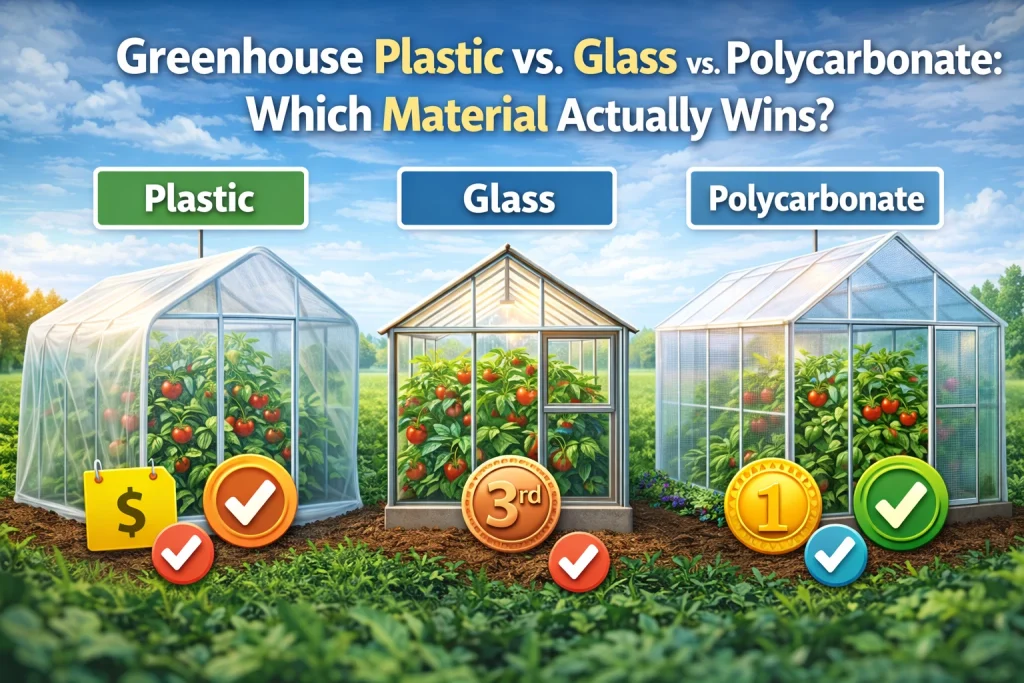
True answers to the question of which material prevails depend on what the grower is genuinely trying to accomplish. For year-round production in a cold climate, twin-wall polycarbonate is the best option since it is safer, warmer, and more weather-resistant than glass. Additionally, it performs better and lasts longer than plastic film. If you are constructing something that will last for several decades, appreciate aesthetics, desire maximum light, and live in a temperate climate, glass is still a good option. Market growers who need to cover a large area for summer crops at a low cost can benefit from polytunnels. In reality, the debate between polycarbonate and glass is a question of conditions, such as climate, crops, budget, and how long you intend to continue growing there. The selection of the material is usually straightforward if you get those answers right first.