
Most greenhouse owners conduct a resigned accounting in October. The tomatoes are done. Cucumbers are done. A building that produced so abundantly during the summer is now a chilly, partially empty shell that won’t be used until March, when the light returns and seedling trays are laid out again. Winter is a waiting game, and the square footage you paid for is essentially idle for four or five months a year. In temperate gardening, this pattern is so prevalent that most people accept it as the norm. However, it doesn’t have to work that way. Moreover, the upgrades that alter it are far less expensive than most people think.
The first and most effective shift is a conceptual one rather than a structural one. Winter is not the enemy of greenhouse farming, it is the wrong crops. During a northern winter, tomatoes, cucumbers, and peppers cannot be provided with the warmth and light they need without additional heating and lighting that are difficult to justify. Asian greens, mustard, Swiss chard, spinach, arugula, and baby kale, on the other hand, fall into a completely different category. It is because these crops are naturally cold-tolerant that they can withstand temperatures close to freezing. As a result, they yield consistently in December and January, when summer crops would fail. The greenhouse that failed to grow tomatoes in November will grow spinach through February if the grower changes their expectations about what winter growing looks like — slower, quieter, but genuinely productive.
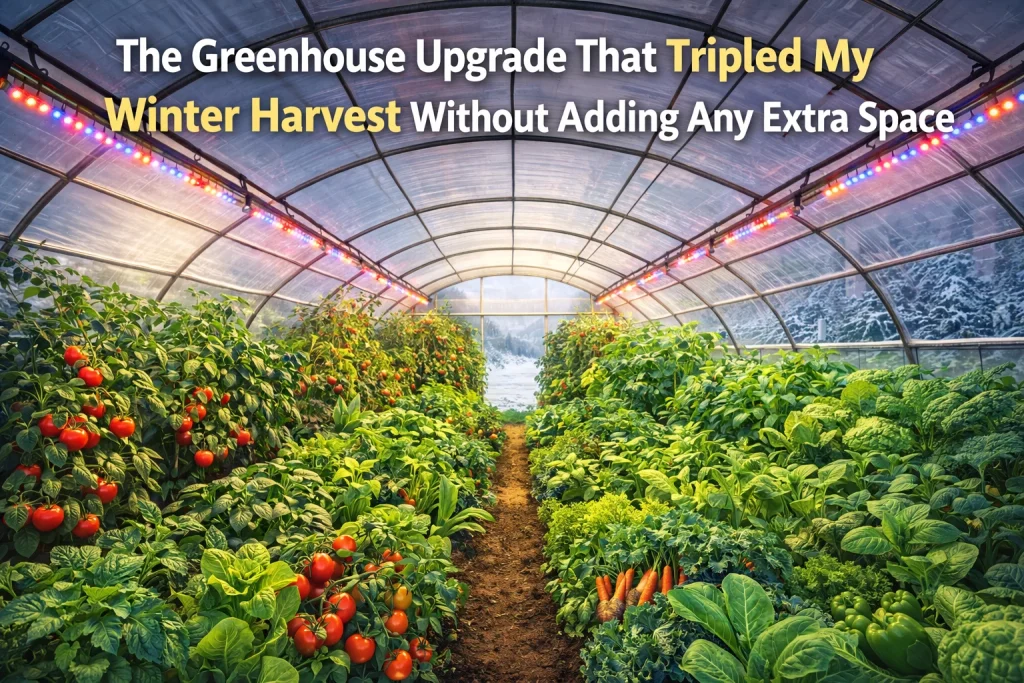
It is a straightforward structural improvement that maximizes benefits without increasing greenhouse footprint. By hanging row covers directly over growing trays or building a small hoop structure over beds or benches inside an existing structure, a secondary layer of insulation can be created. By doing this, the air surrounding plant crowns will remain several degrees warmer than the surrounding area. A cool greenhouse with two or three layers of row cover over the crops consistently produced yields comparable to that of a heated greenhouse because the heat from a warmer structure tends to create thin, stretched, light-starved plants during the short days of midwinter, as reported in research reported in The Winter Market Gardener, written by J.M. Market farmers Fortier and Sylvestre specialize in cold-weather production. When the sun shines, the covers retain the heat that builds up near the plants, so the building doesn’t have to be heated all night.
Thermal mass supports this principle rather than opposing it. Installing black-painted water barrels inside the greenhouse is a straightforward and low-cost solution. By absorbing solar energy during the day and releasing it gradually at night, these barrels raise the minimum temperature of the room without requiring continuous energy expenditure. Similar results can be achieved with a brick or stone walkway or a concrete floor. While none of this replaces a heater in truly extreme cold, it decreases the frequency and intensity of supplemental heating, which is sufficient for some growers in mild maritime climates to continue growing without one.
Hobby greenhouses tend to conceal unused capacity in the vertical dimension. Approximately 60% of the floor space may be occupied by stationary benches along the walls; rolling benches that can be moved to remove walking aisles bring that number closer to 90%. Unlike the brighter central growing area, seedling trays and shade-tolerant greens can be stored on shelving along north-facing walls, which receive less direct light and are frequently left empty. The roof structure provides an additional layer of growing space for herbs and compact greens that don’t require deep soil. These modifications do not require additional floor space. The existing space is simply used more thoughtfully.
When daylight falls below the threshold that sustains significant plant growth, even for cold-tolerant varieties, light supplementation becomes necessary. Growth is maintained by a row of T5 or LED grow lights that run on a timer for 14 to 16 hours every day when a few gray hours of pale winter sun are insufficient. A faster maturation time and fewer crop failures make the investment profitable quickly.
When discussing winter greenhouses, the nursery method is often overlooked. The slowest and most vulnerable stage of the plant’s life is eliminated by starting seedlings in a warm interior area, or in a heated corner of the greenhouse itself, under a row cover and a heat mat, and moving them into the cold growing area once they are 60 or 70 percent of their mature size. In a greenhouse, waiting for germination in almost-freezing soil doesn’t take up space. When the plants arrive, they are already established; all they need to do is finish and harvest them. You can’t help but notice how much different it feels from the empty shell most growers settle for when you walk through a greenhouse run this way in January. By establishing this rhythm, the space will produce continuously rather than intermittently.