
When you stroll through a wheat field in late June, you can see the differences between crops without any equipment. There is a tall, evenly green part with a broad, self-assured leaf. Another, a field’s width from it, appears pale and defeated; it’s the same variety, planted the same week, but it’s in soil that lacks nitrogen. Growing for a long enough period of time, a grower is able to recognize those visual differences almost before they are aware of them. The science behind what they are witnessing is straightforward: nitrogen is what gives plants their green color, proteins give them strength, and when there is not enough nitrogen in the soil, plants communicate their only language, the color of their leaves.
The most important nutrient for crop production is nitrogen, followed by carbon, hydrogen, and oxygen. It is important to know how nitrogen works inside a plant to understand why it is so important to manage it. Nitrogen is a component of amino acids, which are the building blocks of all proteins, and chlorophyll, which fuels photosynthesis by absorbing light energy. In the absence of sufficient nitrogen, growth slows, protein content decreases, chlorosis occurs, and leaves lose their ability to produce chlorophyll effectively. The reaction is often rapid and dramatic when nitrogen is added again: yield potential recovers, growth rate increases, and leaves turn green. It is estimated that between 30 and 53 percent of nitrogen applied as fertilizer is actually absorbed by the crop. The remainder is lost as nitrous oxide, a greenhouse gas with about 300 times the warming potential of carbon dioxide, ammonia, or nitrate leaching into groundwater. In contemporary agriculture, the efficiency gap raises concerns about cost and environmental effects, which the sector is still trying to resolve.
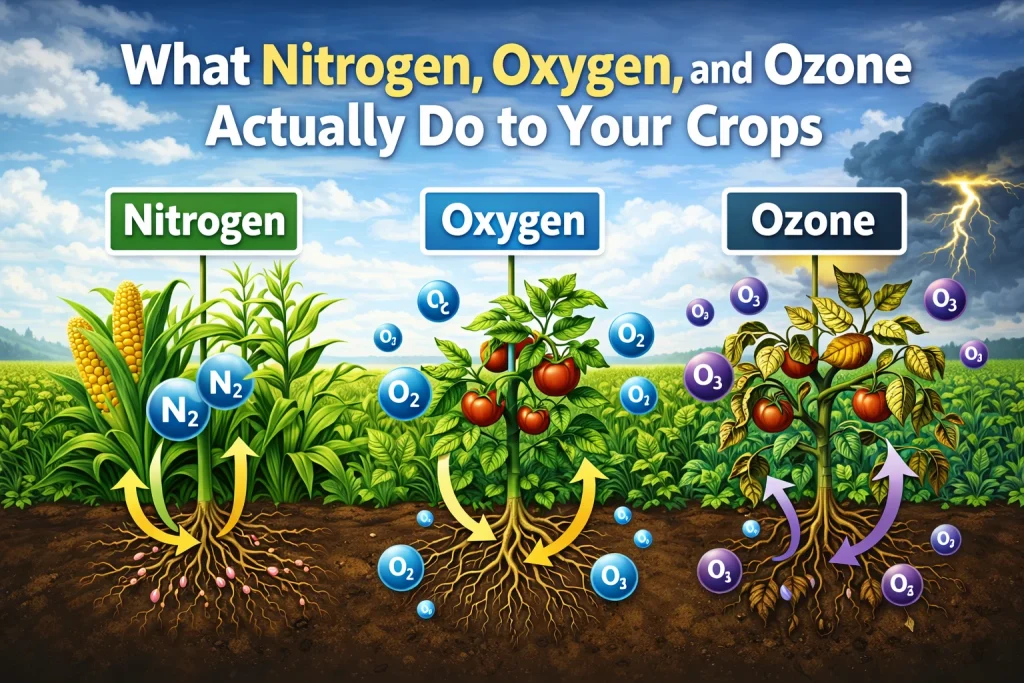
It is easy to overlook the problems caused by too much nitrogen until they manifest as crop failures. In agriculture, nitrogen management is directly related to lodging, which occurs when heavy-headed grain crops topple over before harvest due to soft, lush vegetative growth. Due to the higher concentration of amino acids in the tissues of plants with high nitrogen, aphids and other sap-sucking insects are attracted to them. Many of the pest pressure farmers deal with are downstream results of the instinct to add more nitrogen, according to experienced agronomists.
Despite its more subdued story, oxygen is just as vital to plant roots, especially in the soil. Roots do not produce photosynthesis. Sugars are broken down by aerobic processes in order to create the ATP energy that drives the uptake of nutrients and water. Whenever soil gets wet, whether because of excessive rainfall, inadequate drainage, or over-irrigation, the air spaces between soil particles fill with water. As a result, the oxygen concentration in the root zone decreases rapidly. Oxygen deprivation causes root cells to die within hours in certain species. Plant collapse, browning roots, and wilting in spite of wet soil can be mistaken for illness or drought stress, delaying the appropriate response. Compacted soils cause the same issue more slowly by gradually reducing the pore space roots need to access oxygen over weeks and seasons rather than days. By improving soil structure through tillage management and cover crops, and by avoiding trafficking on wet ground, we can manage this one requirement-maintaining oxygen availability where roots are growing.
In this image, ozone is the third gas that plays a subtle role on farms. In regular gas exchanges, ground-level ozone enters plant leaves through the stomata, not the stratospheric layer that protects us from pollution. Scientists call this “burning from within” because it directly oxidizes cellular tissue, resulting in either bronzing and early leaf death or stippling, which are microscopic black or brown dots on the leaf surface. Rice, wheat, and soybean yield losses are estimated to be between 5 and 15% under current ambient ozone concentrations; soybeans may be among the most severely affected. According to research published in journals monitoring crop productivity, ozone may be suppressing soybean yields by more than twelve percent globally based on stomatal uptake models. In this figure, ozone is ranked among the most significant unmanaged agricultural stressors that are currently in operation, mostly hidden from view.
As it turns out, these three gases are more closely related than they appear at first glance. Nitrogen fertilizers, livestock operations, and soil emissions following fertilizer applications are some of the sources of nitrogen oxides that combine with sunlight to form ground-level ozone. As farmers use nitrogen inputs to increase yields, atmospheric chemistry contributes to the production of ozone, which suppresses those same yields in sensitive crops downwind, creating a feedback loop that is not fully understood outside the research community. Ozone-related yield losses may offset the productivity gains from increased nitrogen use in some areas. It would be difficult to do the math if that were the case. Although the direction of the effect is undisputed, the magnitude at the field level remains a mystery. In order to address both issues at the same time, nitrogen management must take into account the right rate, timing, placement, and source of nitrogen. That could be one of the most significant agricultural discoveries of the next ten years if it receives the attention it deserves.