
The wood in the back of most gardens has been waiting for a purpose for longer than anyone can remember. A couple of 2x4s from a decking project. The salvaged door was replaced, but it never quite reached the skip. Someone upgraded to double glazing and couldn’t bear to discard some old windows that were leaning against the fence. It appears as if the garden is assembling the components of something and is just waiting for the owner to notice it.
Christian, an architect, noticed something during lockdown. As part of his time and little else, he built a greenhouse against the fence of his London garden using a heavy Georgian door from a relative’s construction project, windows gathered from friends clearing out, and timber that had been lying around for years. A sheet of translucent polycarbonate roofing was all he purchased. In the end, he produced a 1 x 2 m building that seemed funny to his fellow architects. There was no concern on his part. Tomatoes were produced. Overwintering was done with dahlias. The task was completed.
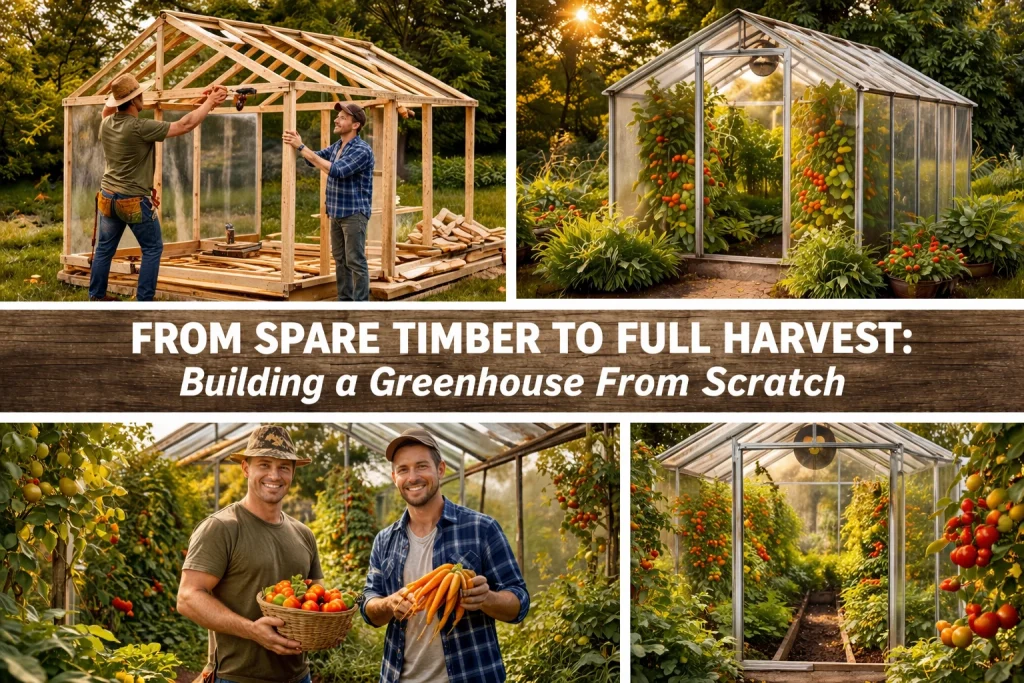
It is often overlooked when discussing prefabricated greenhouse kits and aluminum framing systems that a greenhouse only needs a sturdy frame and a clear covering. It’s really simple to understand the principles. Level foundations prevent rot and keep the base off the ground. There is a pitched roof that sheds water instead of collecting it, diagonal corner braces to prevent racking in the wind, and a rectangular timber frame with vertical studs about two feet apart. Following that, a covering material that is screwed or stapled firmly enough to prevent wind from lifting it. The entire structure can be summed up in that way.
Before any wood is cut, the choice of site is more important than most novice builders realize. In the northern hemisphere, the greenhouse should be south-facing, away from trees that provide afternoon shade, and ideally protected from the predominant winds without being completely enclosed in order to receive at least six hours of direct sunlight each day. As the sun angle decreases and nearby buildings or vegetation cast longer shadows, a spot that appears fine in the summer may appear noticeably shaded in the winter. It is not overly cautious to walk the site at different times of day and in different seasons, if possible. Simply put, it makes sense.
There is often unnecessary anxiety associated with the foundation question for first-time builders. All three options work well for a small timber greenhouse: a frame of pressure-treated timber skids sitting directly on level ground, a gravel bed that drains freely and resists frost heave, or concrete blocks at the corners. By measuring diagonals and adjusting until they match, and by using a spirit level rather than by eye, it is important that the corners are square and the base is level. The out-of-square base causes problems throughout the entire frame, resulting in difficult-to-seal gaps and slightly slanted walls.
If they are rot-resistant and structurally sound, reclaimed 2x4s make an excellent frame. When softwood is left outdoors unprotected for more than a season, the ends and surface may begin to deteriorate; those portions can be trimmed off and the remaining portion used; however, all reclaimed timber should be treated with a wood preservative prior to being incorporated into the building. The gable roof is much more practical and easier to construct than a flat roof, which collects water and eventually collapses. Where the rafters meet the wall plate, they must have a notch, known as a bird’s mouth joint. This simple saw cut will prevent the rafter from sliding under load once you understand the geometry.
Most people have a choice of covering materials. Six-mil UV-resistant greenhouse plastic is cheap, reasonably durable, and easy to install when stretched tight against the frame and clamped in place with staples or timber battens. In spite of the fact that twin-wall polycarbonate is more expensive, it provides significantly better insulation. The difference in overnight temperature retention is substantial enough to justify the additional expense for greenhouse users who intend to use their greenhouse throughout the winter. The timber framing can also be crafted around the window’s dimensions rather than cut to a predetermined specification, as Christian did. The result is a structure with authentic character and no glazing costs, even though some design flexibility is required.
I especially enjoy standing inside something that didn’t exist a weekend ago, made almost entirely of materials that would otherwise have ended up in a landfill or stored indefinitely, as the light shines through the polycarbonate and falls across the shelves after a project like this has been completed. It is possible to spend significantly more money and end up with something that performs worse with a flat-packed kit because it cannot account for the precise dimensions of a wall or the precise angle of morning sun in a particular garden. In spite of its flaws and occasional eccentricities, the handmade version fits the intended space. It usually counts for more than it seems.