When you pull back the cover of your mini greenhouse in late January, expecting progress, and find a tray of seedlings that have turned pale and stretched sideways, looking for light that doesn’t exist, it can be particularly disheartening. Stems are as thin as a thread. There are tiny leaves that appear somewhat desperate. This was not disclosed to you. In other words, no one clarified that the dark rather than the cold was the real issue.
Winter light is not limited to fewer hours in the northern hemisphere. If you’re lucky, it lasts for seven or eight hours because it’s less intense, arrives at a low angle, and is often obscured by clouds for days at a time. Unlike a larger building with white walls, a mini greenhouse exacerbates the problem rather than solving it; the glazing material reduces transmission to some extent, and the small interior volume prevents significant light bounce. For seedlings, who are at their most light-hungry stage, this quickly adds up. Due to this, the plant burns its stored energy in an attempt to reach a light source it cannot reach. Etiolation is the technical term for what most gardeners call leggy growth.
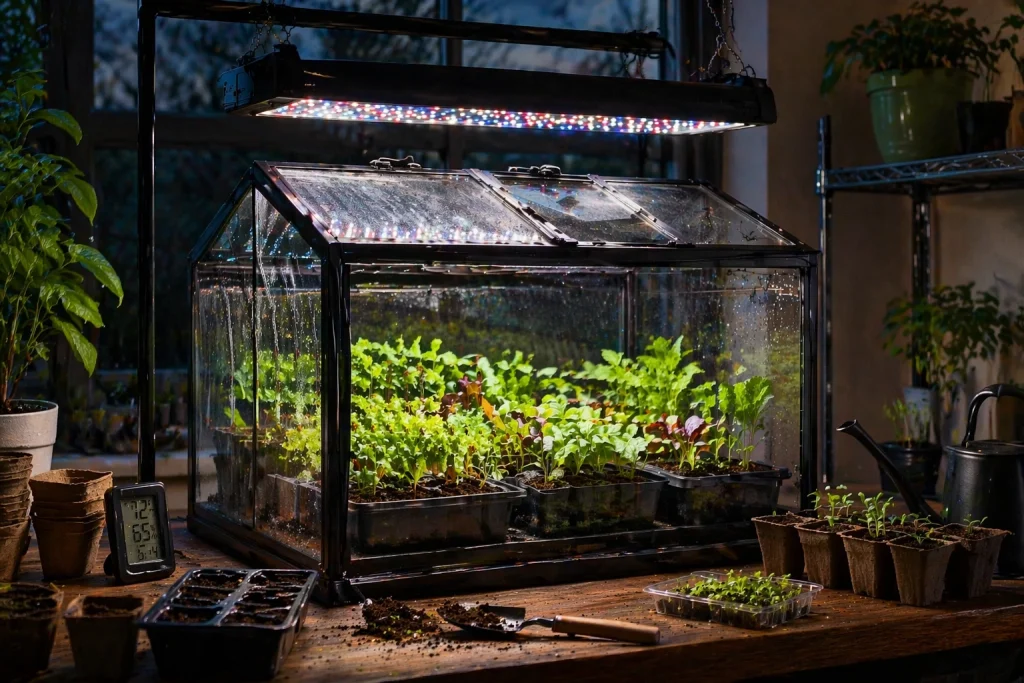
When you know what’s really wrong, the solution is relatively straightforward. LED grow lights with full spectrum white light that are positioned two to six inches above the trays and are set to run for fourteen to sixteen hours each day. Seedlings require blue-spectrum wavelengths between 5000K and 6500K for compact, robust vegetative growth, so color temperature is more important than most packaging implies. Warmer lights, which are sold for ambience rather than growth, often encourage weak, stretched stems caused by inadequate natural light. It’s important to understand this distinction before making any purchases since improperly mounted LED strips can still produce unsatisfactory results.
Choosing fixtures for a small greenhouse is primarily a practical decision. With multi-tier shelving units, linkable LED bar lights-the kind that clip together and run off a single plug-work well because they enable one bar per shelf level without requiring additional cables. T5 LED shop lights are another excellent choice, especially the two-foot sizes that fit neatly above a typical seedling tray without overhanging. When discussing what works versus what just appears promising on a product listing, more experienced seed starters often mention Barrina and Sansi. Neither is expensive. Lighting fixtures do not need to be specialized horticultural equipment as long as they are bright, have the right spectrum, and are close enough to the plants to provide significant intensity.
Distance is probably the most frequently overlooked detail. At the seedling stage, it is nearly always incorrect to hang lights high to cover a larger area. Light intensity decreases dramatically with distance, so at eight inches, a light that is perfectly adequate at three inches may be less than half of what it was at three inches. In order to maintain seedling light intensity, keep the light fixtures two to six inches from the foliage and move the fixtures upward as the plants grow using chains, S-hooks, or even zip ties. An automatic timer on the plug eliminates human error; the schedule remains constant regardless of how busy the day is.
In a cold mini greenhouse, lighting is not the only solution. A winter seedling’s germination is also controlled by soil temperature, which cannot be fully captured by air temperature. In order for pepper seeds to germinate, soil must consistently be between 65 and 80 degrees Fahrenheit. If the outside temperature drops, a lit mini greenhouse might not be able to sustain that range at root level, causing the seeds to sit there without sprouting. A seedling heat mat is positioned directly underneath the trays to address this issue; it maintains soil temperature in the germination zone regardless of the surrounding air’s conditions, and by combining bottom heat with overhead light, plants are actually able to grow even during the coldest weeks of the year.
In his seed-starting method, a Rhode Island grower used a three-shelf mini greenhouse with LED grow lights over each shelf and a heat mat on the bottom. It cost him about $120 and allowed him to start peppers in mid-January, tomatoes and eggplants a few weeks later, and have transplant-ready plants well ahead of his neighbors. It is a simple system. It’s not ostentatious, it’s not exclusive. As a result, it is effective because it considers both factors at once: soil warmth below and light duration and intensity above. January is unknown to the plant.
Many winter seed-starting failures are attributed to the misconception that greenhouses automatically supply plants with what they need. Refuge is provided by it. It has a certain warmth to it. In December and January, it cannot produce daylight. For this purpose, the lights are used. When the soil is kept warm and the setup is correct, even the darkest months of the year can become productive growing months.