
The concept of regrowing vegetables from kitchen scraps became incredibly romanticized and twisted between the first viral avocado-pit video and the tenth TikTok that promised a lifetime of free lemons. “Garbage gardening” online lacks genuine follow-through and is replete with time lapses and soft lighting. You never see the carrot stub that was left in a dish of water for three weeks and did not produce anything worth eating.
Certain aspects of reality are more fascinating and practical than others. Several vegetables make the effort worthwhile—plants that produce actual, edible food from leftovers you would otherwise toss. While some people on YouTube claim otherwise, there are others who will only produce a little green fuzz. Knowing the difference is all that matters practically.
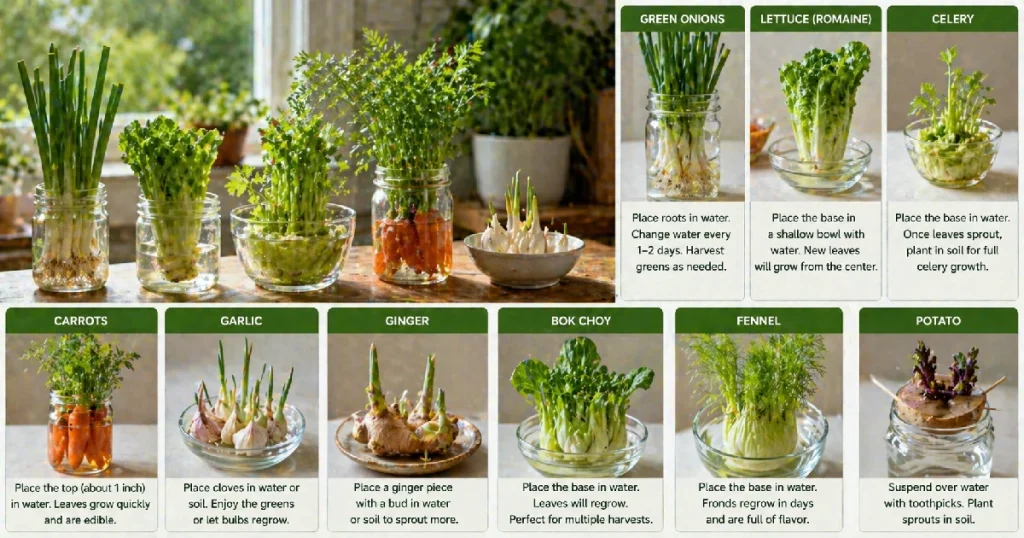
Let’s start with potatoes, since they are the best justification for this entire endeavor. A sprouted potato in the back of a dark pantry is a failure. No, it isn’t. A sprout is a tiny, somewhat pale growth that emerges from the eyes, and it marks the beginning of a new plant. It is important that each potato piece has at least one eye before cutting it into sections and letting it dry and scab over. Planting a freshly cut tuber directly into wet soil can cause it to rot before sprouting, so that step is more important than most guides suggest. Plant the cut surfaces eye-side up after the last frost in the ground or in a deep container filled with well-draining soil. Within a few months, each section can yield five to eight new potatoes. A true return on what was essentially nothing.
Alternatively, green onions are quick, incredibly simple, and still underappreciated. After using the green tops in whatever you’re cooking, drop the white root end into a glass of water. Within a few days, new green shoots appear from the center. Changing the water every few days and keeping the glass somewhere reasonably bright will give you fresh onion greens for weeks. Either place the white base straight into a pot of soil and allow it to grow robustly, or cycle the same scraps through water indefinitely until the flavor fades away. The total effort required is about four minutes in either case.
You should grow basil again if you work with it in the kitchen at all. A stem that hasn’t been chilled is crucial because cold storage weakens the cell structure and makes rooting much more difficult. In ten to fourteen days, a four-inch cutting submerged in water-away from direct sunlight, but somewhere reasonably bright-will show roots. Once the roots are about an inch long, the cutting becomes a fully independent plant. Essentially, it is a clone that functions consistently. One bunch of supermarket basil can grow into three or four new plants by summer if handled properly.
Ginger is one of those crops whose payoff is truly worth the wait, but it requires a bit more setup and patience. The knobbly, jointed hand in the grocery store is the plant’s underground portion, and each nodule can produce new growth if it has a greenish tip. Ginger is a tropical plant, so it requires warmth to sprout. A heat mat beneath the container is a must if you’re doing this in a temperate climate. Regular moisture and warmth will eventually cause the eyes to produce thin green shoots. A small portion of the rhizome can be removed as needed, covered, and the plant can survive in a container for years.
The math justifies garlic’s slower speed. You should save one clove from each organic bulb, as conventionally grown garlic is sometimes treated to prevent sprouting. In the fall, plant the clove tapered-end about four inches deep, and by the next summer, it will have grown into a whole new bulb. Nine months seems like a long time. Additionally, it sounds like perseverance that results in real food rather than merely a hopeful experiment on a windowsill.
There is a slight difference between sweet potatoes and regular potatoes. Instead of harvesting sweet potatoes from scraps grown indoors, you will produce slips, which are tiny sprouts that grow from suspended tubers in water and are planted out in the garden after the frost has passed. There is a two-step process that requires a reasonably long warm season and an outdoor growing area. It’s still worthwhile if the circumstances are right.
| Resource / authority | Gardenary — kitchen garden education platform founded by Nicole Burke |
| Best veggie to regrow from scraps | Potatoes — each sprouted eye produces a new plant yielding 5–8 tubers |
| Top 6 worth regrowing | Potatoes, basil, ginger, green onions, sweet potatoes, garlic |
| Not worth regrowing | Romaine lettuce, celery, carrots, beets, fruit trees (from seed) |
| Fastest to regrow | Green onions — new growth visible within 1–2 days in water |
| Slowest / longest payoff | Garlic — planted in fall, harvested after 6–9 months |
| Common misconception | Carrots and beets cannot regrow their edible root from scraps — only leafy tops |
| Reference website | gardenary.com — kitchen garden guides and plant encyclopaedia |
Vegetables that aren’t worth your time and effort are often unable to produce the portion you really want. A carrot stub submerged in water will produce feathery, rather lovely green tops, but no orange root will appear. Beets are also affected by this. The leaves of Romaine lettuce grow back from the base, but they are bitter, and the plant goes to seed much faster than most people expect. Only a few tiny leaves will sprout from the heart of celery. These aren’t lies, exactly. When grown from scraps, they simply hit a biological wall, saving weeks of misplaced optimism on the kitchen counter.
It’s really reassuring to watch someone confidently drop a sprouted garlic clove into a pot of soil. It’s not a trend or a lifestyle statement, but rather a small, useful act that turns food into compost. That’s garbage gardening, not endless free lemons. These are just a few things that work.
Olivia Murphy is a Senior Editor at Mini Greenhouse Kits and a fervent supporter of small-space and urban gardening. Alyssa, who is currently majoring in both literature and biology at Michigan State University, infuses her writing about city gardening and small-space growing with a unique blend of scientific curiosity and storytelling instinct. Her love of literature influences how she tells the stories behind the plants, and her background in biology gives her content a grounded, research-informed edge. When she’s not working on her next gardening piece, you can find her curled up with a good magazine or watching a movie that she’s been meaning to watch for weeks. She writes with passion at minigreenhousekits.com.