
There is a certain kind of silence created by a well-kept compost bin. There is microbial and worm activity there, turning the coffee grounds and carrot peels from last week into something that smells like a forest floor. From the outside, it doesn’t seem like much. The core process of a closed-loop garden is taking place: waste from the kitchen is being returned to the soil as fertilizer, completing a cycle that does not require any purchases, synthetic materials, or nearly anything to be thrown away.
Zero-waste gardens are not new. Subsistence farmers managed land for centuries before synthetic fertilizers arrived in the twentieth century, making it seem optional. Nowadays, people are consciously reverting to these principles and rebuilding closed systems in urban allotments and suburban backyards, realizing that the productivity they thought needed bags of fertilizer from a garden center is actually mainly achieved by composting. It is possible that the mainstream gardening industry has not fully disclosed how much outside input a healthy garden actually requires.
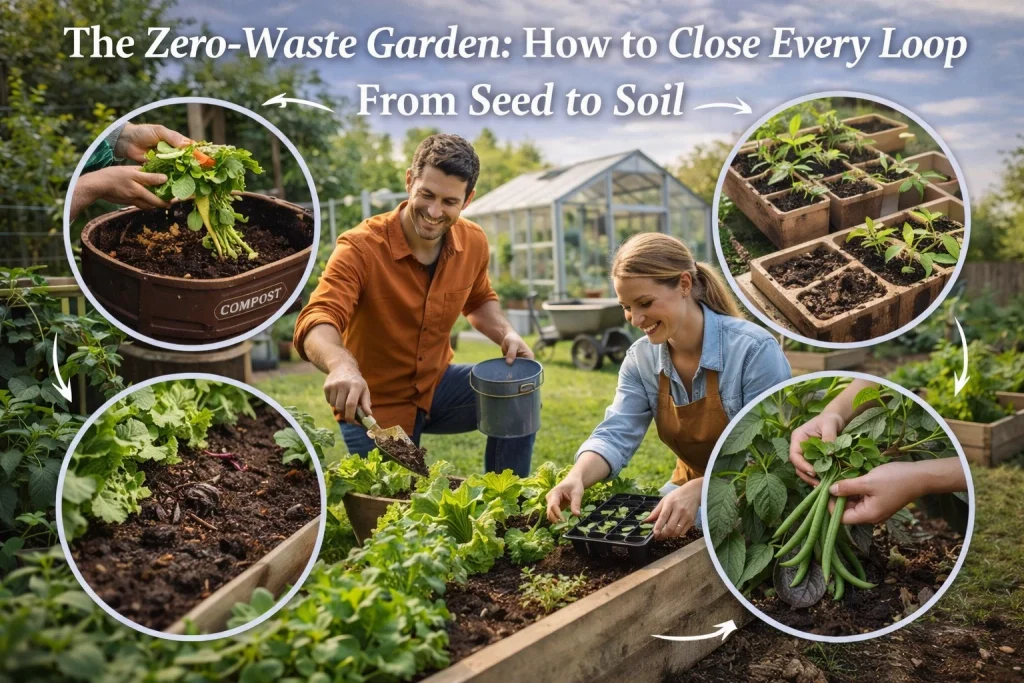
In most closed-loop gardens, seeds are the first point of conflict with traditional methods. In the conventional method, fresh seed packets are purchased each spring, along with plastic pots and seed trays. No loops are closed by these. By pressing a basic metal tool into a compost-rich mixture, soil blocking creates free-standing cubes of growing medium that require no containers at all. They have tighter, more robust roots than plants grown in pots since their roots strike the air at the block’s edges and self-prune. Toilet paper rolls, egg cartons, and newspaper folded into tiny tubes can be planted directly into the ground at practically no cost and will decompose harmlessly. As an added benefit, saving seeds from the best-performing tomatoes or peppers from a previous year closes a loop that most gardeners leave open indefinitely, reducing reliance on commercial seed suppliers and allowing one to gradually select cultivars that thrive in the local climate.
When it comes to soil fertility, the closed-loop philosophy becomes truly intriguing, and the composting discussion is more complex than the typical bin at the bottom of the garden. In contrast to producing what seasoned growers refer to as “black gold” in erratic batches, a three-bin system – one receiving fresh kitchen and garden waste, one actively composting, and one holding finished materials – produces it consistently and manageably. Vermicomposting uses red wigglers to process vegetable scraps in a contained bin. It produces castings that are measurably richer in plant-available nutrients than most finished composts. In about two weeks, a Bokashi fermentation system breaks down dairy and cooked food waste that traditional composting is unable to handle. Instead of sitting exposed in a heap, the resulting material is buried directly into soil beds to feed soil microbes.
No-dig methods connect these fertility inputs underground in order to preserve what is already functioning underground. As a result of turning soil, which has been conventional wisdom for generations, earthworms are destroyed, fungal networks are upset, and carbon-rich organic matter is exposed to the air, where it oxidizes and escapes as CO2. When compost is placed on the soil’s surface, organisms already present can draw nutrients downward at their own pace. Perhaps the fact that it sounds almost passive is why it has taken so long to catch on with gardeners who are accustomed to equating effort with results. According to practitioners of the Dowding method, made popular in the UK by growers such as Charles Dowding, the soil performs better when it is allowed to take care of itself.
Water loops are the most obvious leaks in gardens. A rain barrel placed beneath a downspout collects water that would otherwise run off a roof and end up in the drainage system in addition to being free. Due to its lack of dissolved salts and chlorine, this water supply is actually better for plants. In ancient Persia and pre-Columbian America, ceramic pots released water gradually through their unglazed walls directly into the root zone, losing nearly nothing to evaporation. It is not difficult to use either technology. Both have been accessible for thousands of years. This rediscovery of these techniques reveals something significant about how detached modern gardening has become from the logic of the natural systems it has always been a part of.
Companion planting and cover crops can close loops that aren’t always apparent. Clover and rye are sown between harvests to fix nitrogen from the atmosphere and maintain soil structure, replenishing soil fertility lost by crops without the need for fertilizers. If grown in a corner of the garden and pruned regularly, comfrey accumulates potassium and other trace minerals in its leaves, which, once chopped and dropped around fruit trees or vegetable beds, release nutrients. Pruning the plant a few times a year is all that is required to maintain this fertilizing system. Basil near tomatoes discourages pests. Nasturtiums serve as trap crops that keep aphids from attacking more valuable plants. By incorporating these connections into the design of the garden, less strain is placed on any one component and system stability is progressively increased.
Garden loops take more than a season to close. When the garden is able to produce more of its own needs than it consumes from the outside world, it substitutes internal inputs for external inputs, such as purchased seeds for saved ones, synthetic fertilizer for compost, plastic pots for newspaper, and municipal water for rainwater. It requires observation and some trial and error, and the results compound in ways that are difficult to predict at first. When the path is pursued sufficiently, the reasoning behind it becomes less like a different approach to gardening and more like the only one that makes sense.