Slowly deteriorating greenhouse plants are especially frustrating. You appear to have done everything correctly: you watered the structure frequently, kept it closed to prevent cold, and positioned the entire setup in a sunny area. Yellow leaves are still appearing on the leaves. Stems are flexible. A slight musty smell is present. The problem is most likely that doing everything correctly in a small greenhouse looks very different from what intuition suggests, and every error is magnified in an enclosed space that isn’t present in an open garden.
Overwatering is the most common cause of mini greenhouse failures. In these structures, it is the most common cause of plant death, characterized by soil that never truly dries out, stems that feel soft or collapse slightly under pressure, and yellowing from the base upwards. Gardeners who have grown outdoors all their lives understand the importance of watering on a schedule. No matter what the habit is – Monday, Wednesday, Friday, etc. In a closed greenhouse, however, evaporation is drastically slowed, and that schedule almost always provides too much moisture. Most people do not realize how easy it is to press a finger into compost. When the top two centimeters feel dry, use water. If not, wait. For many struggling growers, switching from schedule-based to soil-based watering is the answer.
Overwatering causes the most damage, followed by ventilation. Fungal diseases thrive in sealed spaces with high humidity, anything over 80% for prolonged periods of time. Botrytis, powdery mildew, and damping off are not unlucky. The results of humid, stagnant air are predictable. A musty smell greets you upon opening the door, light green algae grows on interior surfaces, and condensation drips from the glazing panels in the morning. To solve the problem, the vents should be opened early in the morning, preferably before 9 or 10 a.m., when temperatures rise above 27°C. If the greenhouse is situated against a fence or protected from the wind, a tiny oscillating fan, even one powered by solar power, can significantly improve air flow. It is possible that inadequate ventilation causes more greenhouse plant deaths than any other pest or disease, even though the symptoms are frequently misinterpreted.
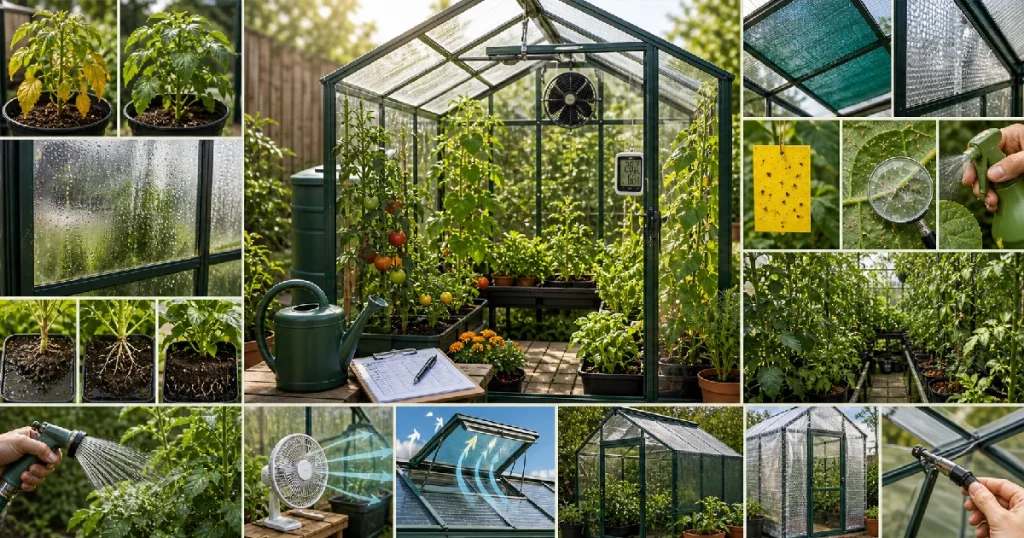
Especially for glass and polycarbonate mini greenhouses placed on patios or adjacent to garden walls, temperature fluctuations are an underappreciated but extremely dangerous problem. During a sunny spring morning, these buildings heat up quickly, and once the sun sets, they cool down immediately. During the summer, this results in wilting, scorched leaves, and stunted growth. The result is water-soaked stems by morning and blackened foliage in the winter. Shade cloth applied to outside panels reduces interior heat without compromising light in the summer. In colder months, sealed gaps around doors and bubble insulation lining the walls maintain warmth throughout the night. Auto vent openers, which react mechanically to heat without requiring any electricity, are well worth the small cost because they eliminate the need to monitor and adjust throughout the day.
It is important to take more care of pests than new greenhouse owners usually do. In theory, it seems counterintuitive: isn’t the purpose of a greenhouse to keep pests out? Aphids, spider mites, and whiteflies are attracted to warm, protected environments, and once inside, they multiply without natural predators. Thanks to sticky yellow traps placed near the roof, infestations are detected early, often before the plants themselves show signs of damage. A powerful water jet from a hose eliminates most light infestations. The most well-known ones are handled by neem oil. The bigger habit, however, is sanitation. The routine maintenance involves removing dead or dying plant material, cleaning pots with diluted bleach solution at the beginning of each season, and keeping the interior neat enough to prevent breeding grounds and hiding places.
| Problem | Symptoms | Cause | Fix |
| Overwatering | Soil never dries out, soft/collapsing stems, yellowing from base upwards | Evaporation is drastically slowed in closed greenhouses, schedule-based watering provides too much moisture | Switch from schedule-based to soil-based watering — water only when top 2cm feel dry |
| Poor Ventilation | Musty smell, green algae on interior surfaces, condensation on glazing panels | Humid stagnant air above 80% humidity promotes fungal diseases like botrytis, powdery mildew, damping off | Open vents before 9–10am, use a small oscillating fan, consider solar-powered ventilation |
| Temperature Fluctuations | Wilting, scorched leaves, stunted growth in summer; water-soaked stems, blackened foliage in winter | Glass and polycarbonate structures heat and cool rapidly | Apply shade cloth in summer, seal gaps and add bubble insulation in winter, install auto vent openers |
| Pests | Plant damage often visible before infestation is noticed | Warm protected environments attract aphids, spider mites, and whiteflies which multiply without natural predators | Use sticky yellow traps early, water jet for light infestations, neem oil for serious cases, maintain sanitation |
| Overcrowding | Nonexistent airflow, declining yields, weak lanky stems reaching for light | Too many plants placed too closely together | Allow 45cm between tomatoes, 60cm between cucumbers; remove excess plants as they grow |
Overcrowding usually manifests later in the season, following an optimistic spring planting. It’s hard to ignore how quickly a greenhouse that appeared large in March becomes unmanageable by June. Airflow becomes almost nonexistent, yields decline, and weak, lanky stems reach upward for light in plants that are closely spaced. In general, cucumbers require 60 centimeters between plants, while tomatoes require 45 centimeters. These numbers seem generous when the plants are small, but suddenly they aren’t. In addition, crowding makes it more difficult to identify problems early on, which exacerbates all of the other problems.
The majority of mini greenhouse issues are environmental rather than botanical. Plants themselves can flourish in most cases. In enclosed systems, they are defeated by a combination of seemingly reasonable conditions, such as keeping the structure closed for warmth, watering frequently, and filling every available space. A simple, inexpensive thermometer and hygrometer can tell you more about the condition of a building than any amount of visual inspection. When temperature, humidity, and airflow are accurately measured, guesswork is eliminated, which is where most damage occurs.
Olivia Murphy is a Senior Editor at Mini Greenhouse Kits and a fervent supporter of small-space and urban gardening. Alyssa, who is currently majoring in both literature and biology at Michigan State University, infuses her writing about city gardening and small-space growing with a unique blend of scientific curiosity and storytelling instinct. Her love of literature influences how she tells the stories behind the plants, and her background in biology gives her content a grounded, research-informed edge. When she’s not working on her next gardening piece, you can find her curled up with a good magazine or watching a movie that she’s been meaning to watch for weeks. She writes with passion at minigreenhousekits.com.