
Because of a certain type of stubbornness, someone in Colorado or Michigan may decide to grow bananas at home. Don’t buy them. They should be grown. Growing tropical fruit in a backyard greenhouse during the winter in an unsuitable climate. The fact is that it works. People are doing it. A bunch of homegrown bananas hanging in a structure you probably built yourself seems genuinely unlikely, but the learning curve is steep and sometimes humbling.
Most people make the mistake of choosing the incorrect variety as their first decision. With banana plants growing up to 20 to 30 feet tall, a small backyard greenhouse will run out of ceiling space before it has even begun. Dwarf Cavendish and Super Dwarf Cavendish varieties, which reach heights between four and seven feet, are ideal for the majority of home setups. Blue Java bananas, also called ice cream bananas, thrive in colder climates and are said to have a vanilla flavor. The yellow Cavendish bananas found in grocery stores are actually rhizomes rather than seeds. The tiny black dots on a store-bought banana are immature and will not develop. Start with a pup, which is a sucker that has been split off from its parent.
After the variety issue is resolved, the real work begins: creating a tropical setting within a glass or polycarbonate building. Cold is not a friend of bananas. Below about 60°F, growth essentially ceases. Even for a short period of time, if the temperature drops below freezing, the plant will suffer greatly. Daytime temperatures should be between 75 and 85°F and nighttime temperatures should be above 60°F. It seems reasonable until January arrives and the heater has to work harder. Many greenhouse setups fail to achieve 50 to 70 percent humidity, and this is where a lot of greenhouses fail. The leaves begin to brown at the edges when the hygrometer reads in the 30s, heating systems dry out the air, and pests are blamed for the problem. Even a simple humidifier placed near the plant can make a significant difference throughout the winter.
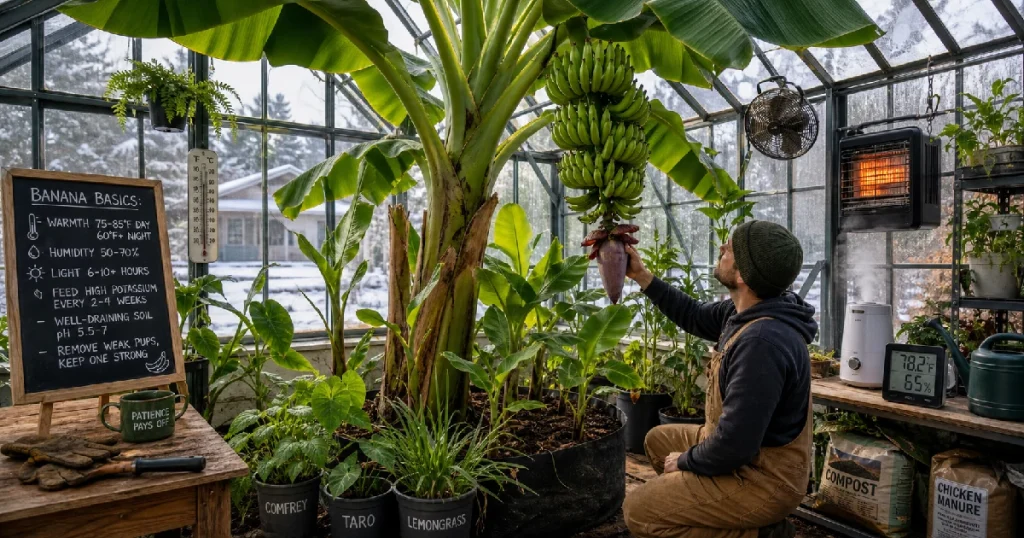
There is a light third leg on this stool. Direct sunlight should be gotten six to eight hours a day, but ten hours is best. During the summer, a south-facing greenhouse can handle this on its own. Particularly in northern latitudes, additional grow lights can make the difference between a plant merely surviving and one that is actually growing. Those who give up on greenhouse bananas in the middle of winter may be unknowingly underlighting them.
Feeding becomes almost comically difficult. During the growing season, banana plants consume a lot of energy. A high-potassium fertilizer, such as a 10-10-10 or 8-10-8 formula, is applied every two to four weeks during spring and summer to keep the plant active. To grow healthy vegetables, the soil must have a pH between 5.5 and 7, be dark and rich, and drain well while retaining moisture. The roots benefit from a lot of compost, ideally a 50/50 mixture with high-quality loamy soil. Chicken manure is a viable option considering bananas’ high potassium and nitrogen needs. Some growers use a permaculture technique called a banana circle to improve soil health naturally by planting companion plants like comfrey, taro, and lemongrass. A pleasant form of agricultural symbiosis, comfrey accumulates minerals and feeds banana plants from below.
The structure of a banana plant is another thing that most newcomers don’t fully understand before they arrive. It’s not just one tree. The rhizome looks like a mat with pups and suckers protruding from it. Before dying, every stem bears fruit exactly once. The succession plan calls for removing weaker pups while allowing one strong pup to grow into the next main stem in order to prevent the mother plant from splitting her energy seventeen ways. Fruiting declines if the mat is not controlled, and it becomes crowded and disorganized. Growing bananas seems to surprise people more than any other aspect since the plant is constantly dying and starting over.
| Aspect | Details |
| Best Varieties | Dwarf Cavendish, Super Dwarf Cavendish (4–7 feet); Blue Java (ice cream banana, vanilla flavor, cold-tolerant) |
| What to Avoid | Full-size varieties growing 20–30 feet — will outgrow any backyard greenhouse |
| How to Start | Begin with a pup (sucker split from parent plant), not seeds or store-bought bananas |
| Minimum Temperature | 60°F — growth ceases below this; freezing temperatures cause serious damage |
| Ideal Temperature Range | 75–85°F daytime, above 60°F nighttime |
| Humidity Requirement | 50–70% — heating systems dry out air, causing leaf browning often misdiagnosed as pests |
| Light Requirement | 6–8 hours minimum, 10 hours ideal; grow lights recommended in northern latitudes during winter |
| Fertilizer | High-potassium formula (10-10-10 or 8-10-8) every 2–4 weeks in spring and summer |
| Soil Requirements | pH 5.5–7, dark and rich, well-draining but moisture-retaining; 50/50 compost and loamy soil mix |
| Companion Planting Option | Banana circle technique using comfrey, taro, and lemongrass to naturally improve soil health |
| Plant Structure | Rhizome mat with pups and suckers; each stem fruits once then dies — succession management is essential |
| Pest Management | Water jet for light infestations, neem oil for serious cases; real cause is usually environmental (humidity, drafts, root rot) |
| Time to Fruit | 9–18 months from planting under good conditions, longer if conditions are unfavorable |
| Biggest Challenge | Patience — maintaining precise temperature, humidity, and feeding schedules for over a year before any harvest |
While pests can be controlled, they still need to be dealt with. In situations with inadequate airflow, aphids and spider mites frequently appear. A powerful water jet from a hose is used to treat light infestations. Neem oil can be used for more serious cases. The real pest problem in a backyard greenhouse is usually environmental factors like a draft from a gap in the structure, uneven humidity, or wet soil that causes root rot. It is these silent killers that cause pest damage and mislead growers in their diagnosis.
Patience is the hardest part. Planting to fruit can take nine to eighteen months, or longer under unfavorable conditions. You can’t avoid feeling the wait when you’re actively controlling temperatures, humidity, and feeding schedules for a plant that won’t reward you until fall. Those who have brought green bunches inside to ripen on the counter after pulling them from a backyard structure seem to agree that the ridiculousness is fully worth it.
Alyssa Bennet is a Senior Editor at Mini Greenhouse Kits and a passionate advocate for urban gardening and small-space growing. Currently pursuing her major in Arts at the University of California, Alyssa brings a distinctly creative eye to the world of city gardening – blending artistic sensibility with a genuine love for green living. She writes regularly at minigreenhousekits.com, and when she’s not crafting her next gardening piece, you’ll find her with a paintbrush in hand, watching sports, or exploring the city with friends.