
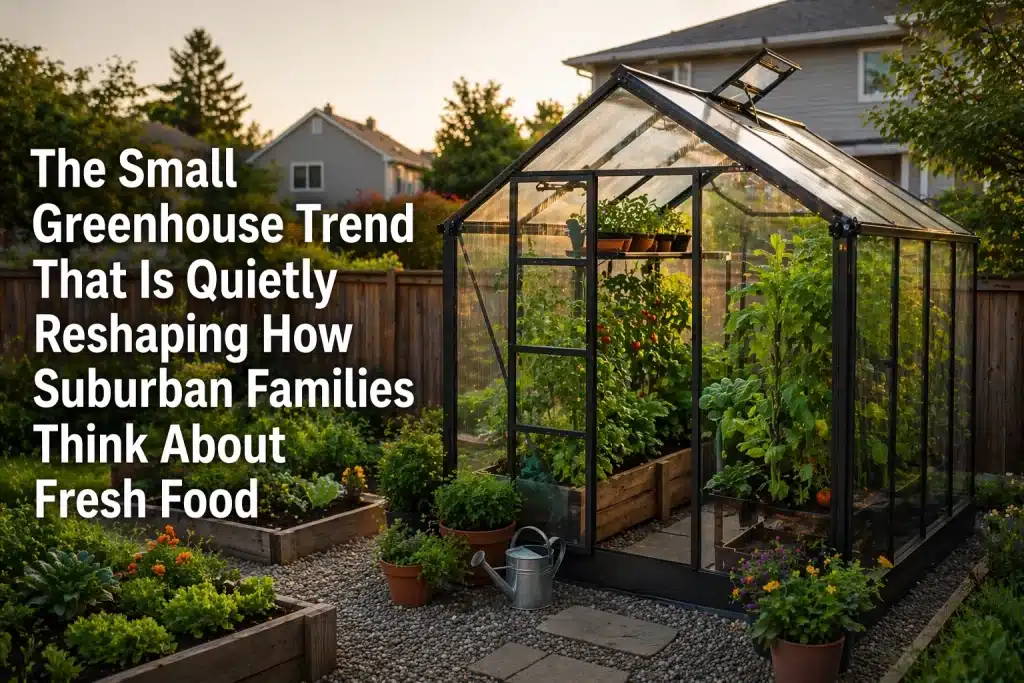
In almost any mid-sized American city, you’re likely to see something new tucked next to a fence or anchored to a back patio if you walk through a residential neighborhood on a weekend morning—in the outer ring suburbs, where the yards are decent and the driveways hold minivans. It’s a tiny greenhouse. Panels made of aluminum and polycarbonate, or perhaps a frame made of cedar. The length is ten feet and the width is eight feet. Quietly intent, modest, and neat. Through the fogged glass, you could see a tomato plant climbing toward the ridge, lettuce, and herbs. It’s not a hobby. It’s more like a choice.
Many backyards are experiencing this, and the reasons have less to do with a passion for gardening and more to do with a slow-growing concern about food prices and sources. In recent years, suburban families have viewed their backyards as resources rather than lawns to maintain, especially since grocery prices began to rise steadily. This change can now be seen in the tiny greenhouse. This is not a farm. This is not a homestead. Making something tangible is just a deliberate, useful step.
The trend might have eventually emerged regardless of any specific economic pressures. When the outside world seems unstable, Americans have historically turned to home cultivation. Victory gardens during wartime, back-to-land movements of the 1970s, and raised-bed revivals after the 2008 recession are just a few examples. Each of those moments reflected a desire to have some control over what ended up on the table. In many families, the current greenhouse movement continues that impulse with better materials and much greater ambition.
Seasonal vegetable plots cannot compete with the year-round capacity of the small greenhouse. A cold frame can extend the growing season by a few weeks. In a proper greenhouse, even if it is unheated and dependent on passive solar heating, the calculation is completely different. Salad greens are harvested through January in climates that would otherwise lose growing capacity from November to March, tomato seedlings are planted in February, and warm-season crops take over in March. It is still possible to go to the grocery store. Even if the change is only slight, it changes people’s perception of food in ways that go beyond financial savings.
It seems to me that harvesting something an hour before eating it recalibrates expectations in a way that is difficult to explain to someone who hasn’t done it. From a California farm to a distribution center, a refrigerated truck, a store shelf, and a home refrigerator, fresh lettuce tastes different. Freshness is a valid nutritional argument since some vitamins deteriorate rapidly after harvest, but the process is also important. The vegetables grown in the greenhouse are often consumed by children who help maintain it. Parents report this pattern frequently enough to be noteworthy, although it’s not a guarantee.
Buildings themselves have advanced significantly. Historically, a residential greenhouse kit was either a pop-up frame with a zip-up door, which was more of a season-extender than a real growing area, or a custom installation requiring expert assistance and a large sum of money. The middle ground has been largely filled in. There are now readily available eight-by-ten to eight-by-12 cedar and aluminum kits designed to withstand wind and snow loads in a way that previous consumer structures could not, and can be installed without a contractor. Watering systems with timers, LED grow lights with timers, and temperature sensors that alert a smartphone when the greenhouse’s conditions deviate from ideal are examples of smart technology used in greenhouses. Some families consider these additions essential, while others do not. People who aren’t engineers or professional growers can now access these options more easily.
Space constraints are frequently discussed and deserve candid discussion. An eight-by-eight greenhouse in a suburban backyard won’t eliminate grocery shopping. It’s not realistic to expect that. Salad greens, herbs, early spring crops, and summer staples can be consistently produced with vertical growing systems, tiered shelving, and succession planting. Considering the rising cost of produce, that output is significant for a family of four who prepares meals at home regularly. It does not replace the store. With it, it bargains.
It is less clear where this goes at scale. Smart greenhouses have drawn the attention of urban planners and food security researchers because they see the potential of distributed, neighborhood-level production — clusters of backyard and balcony greenhouses that could contribute to local food resilience in ways that individual efforts cannot. The idea is intriguing, but it encounters the well-known problem of home food production: it tends to concentrate among households with the time, space, and resources to do it. Fresh food is rarely grown by families with the greatest need for dependable, reasonably priced food. Whether small greenhouses will remain a middle-class lifestyle choice or evolve into something more inclusive and widespread remains to be seen.
While you watch the buildings rise in backyards that used to contain nothing but lawn furniture and gas grills, it’s difficult to ignore the sense that something real is changing, neighborhood by neighborhood, one cedar-framed building at a time.