You can find flat-packed mini greenhouses leaning against the wall in any garden center in the spring, marked with bold prices and promising year-round growing. Most of them have similar features, such as a metal frame, a transparent cover, a zipper, or a latch. Your mini greenhouse will function as a true growing environment or as an expensive plastic tent depending on the material of those panels. Packaging rarely makes this clear.
Two options are available. Single-skin polycarbonate, which is a single layer of plastic and can be flat or corrugated, and double-wall polycarbonate, which is two sheets joined by internal ribs and has an air channel in between. That air channel is the entire game, no matter how subtle it may sound. It’s what keeps a seedling tray alive at two in the morning in March and what turns it into a hard frost victim. This is what distinguishes a structure that retains heat from one that loses it.
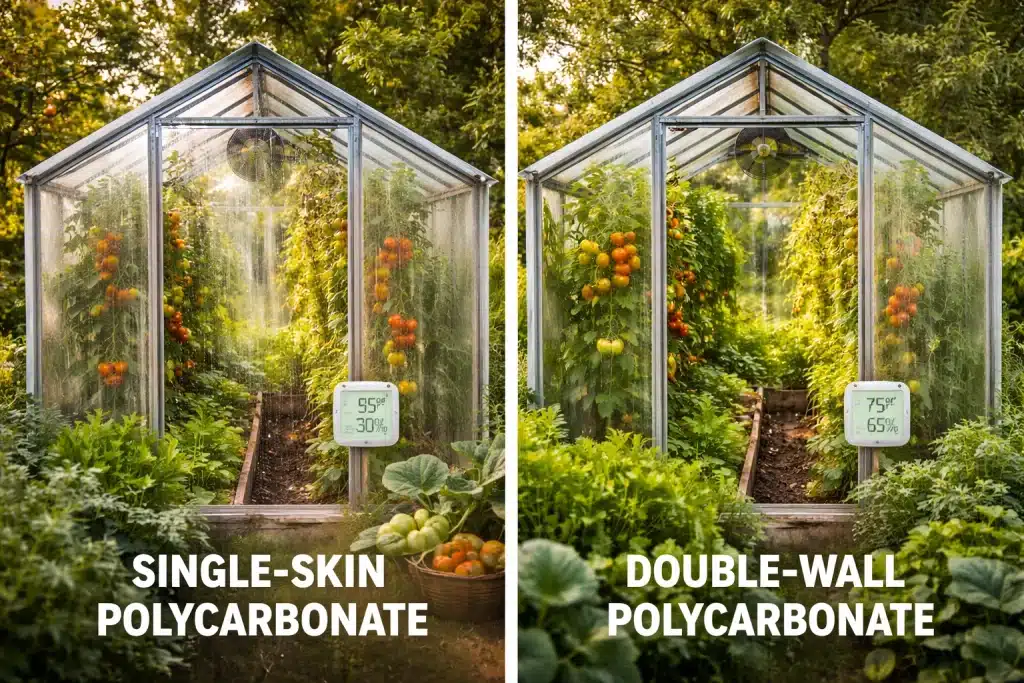
Single-skin panels excel in one particular area: light. During short winter days, a single transparent sheet can transmit over 90% of incoming light, which is extremely useful if you’re growing in a low-light area. There is also a case for greenhouses in mild climates, where temperatures don’t fluctuate much and they only need to be used during the summer. A mini greenhouse, however, can quickly turn that benefit into a liability. Before making any purchase, consider this point. A small enclosed space has very little thermal mass. Temperature changes cannot be absorbed by soil, water, or other materials. When the sun shines on a clear April morning, the temperature inside a single-skin mini greenhouse can reach plant-killing levels in less than an hour. After dark, it drops just as quickly when a cold front moves in. The material that lets in the most light is also the one that provides the least resistance to external weather conditions.
To solve this problem, double-wall polycarbonate uses simple physics. In the intense midday sun and on chilly nights, the air trapped between the two sheets slows heat transfer in both directions. Compared to single-pane glass, which already performs better thermally than single-skin polycarbonate, the reduction in heat loss is estimated at 40% to 65%. That figure is significant for anyone who has tried to keep a seedling tray alive during an unforeseen late-spring cold snap and failed. It’s also important to note that the diffused light from twin-wall panels tends to be kinder to plants; it is less intense and more evenly distributed, so it can’t scorch sensitive foliage if direct sunlight hits them at an incorrect angle from clear single-skin panels.
Double-wall material still has a compelling structural case, despite being less dramatic. Twin-wall panels are rigid, unlike single-skin panels, especially corrugated panels, which can flex under wind pressure and gradually distort with time. Mini greenhouses placed in exposed garden locations-against a wall, on a patio, or anywhere without a substantial natural windbreak-will put their glazing materials to the test. Commercial greenhouse operations, architectural skylights, and industrial roofing, where structural performance is more important than cost per square foot, utilize double-wall panels because their ribbed internal structure disperses impact and pressure.
Twin-wall panels might not be necessary for all gardeners. A small greenhouse may be sufficient for someone who grows in a consistently mild coastal climate and uses it only to extend summer crops by a few weeks. Consumers are unaware of their category until they have already made the purchase and witnessed a cold night ruin a month’s work. There’s a tendency for greenhouse owners to underestimate how unstable temperatures can become inside small structures once they learn this lesson.
If you plan to plant seeds in late winter, overwinter delicate perennials, or grow through spring and autumn without additional heating, double-wall polycarbonate is not a luxury upgrade. Structures must perform the functions for which they were purchased. It is often not significant at the mini greenhouse scale, but when you compare the cost of replacement plants, wasted compost, and a season’s delay, the price difference between the two materials looks significant. Panels make decisions. The rest is incidental.