A large garden center’s outdoor area will exhibit the same ritual every Saturday morning. A trolley was piled high with plastic bags filled with rich, dark, nutrient-rich compost. People load three or four at a time, sometimes more, with the quiet assurance of someone acting responsibly and sensibly. The gardening appears to be excellent. There is a sense of knowledge in it. A surprising number of seasoned growers believe it’s a waste of money as well.
57% of gardeners in the UK are unaware of the contents of the bags they purchase, according to research by the Royal Horticultural Society. The number includes most of the people who load those Saturday morning trolleys. As you learn what commercial bagged compost actually contains, the ignorance begins to seem less like negligence and more like a reasonable response to an industry that hasn’t been particularly forthcoming. There is no standard for labeling. The contents of some bags are obvious. There are others who say nothing at all. A bag can claim to be organic even if it contains a significant amount of peat because “organic” simply means that it contains organic matter, not that it was produced according to any ethical or ecological standards.
It is often the same conclusion that gardeners who have spent decades creating productive plots reach despite coming from different angles. Bags were no longer purchased by them. Since they’ve discovered that what comes out of those bags rarely compares to what they can produce themselves, the gap has grown significantly over time, not because they are purists or contrarians.
Why it’s important to know what’s inside the bag
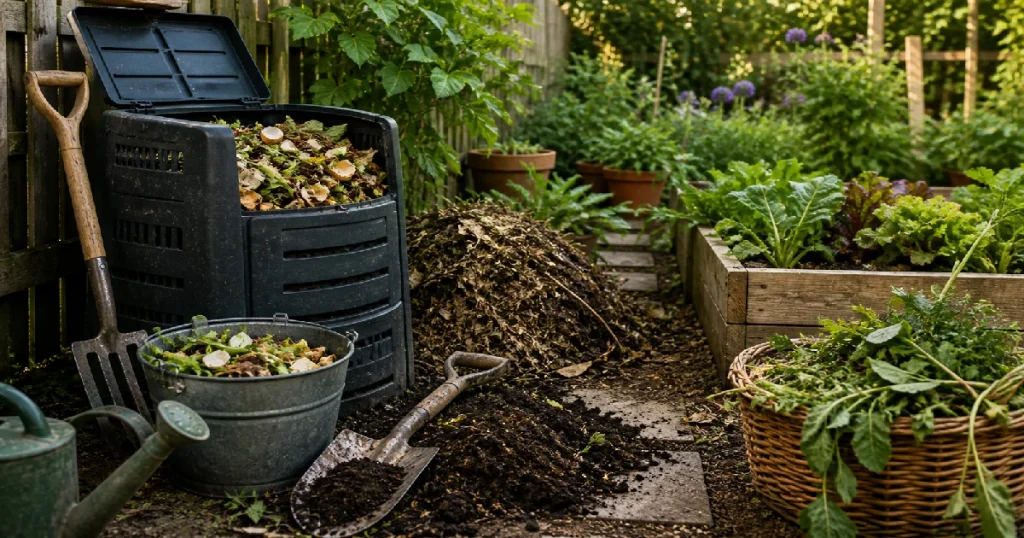
Composted material is alive, as opposed to material that has been processed in a factory. With shredded cardboard, garden clippings, kitchen scraps, and the occasional bucket of spent soil, a well-kept heap or bin establishes a microbial community that is suited to the garden’s needs. Organic matter is broken down by local, adapted organisms in a backyard compost bin. Most commercial products are pasteurized or heat-treated, which kills pathogens but also eliminates the beneficial biology that serious gardeners believe is the whole point. Biochemically, what’s in the bag is not quite dead, but it is less alive than the alternative.
Next, we have the contaminants. Often, commercial composts made from municipal green waste-the kind gathered in council bins from gardens where selective weedkillers were used on lawns-contain persistent herbicides, especially aminopyralids. As a result, these substances can seriously harm tomatoes, beans, and other vulnerable vegetables, survive the composting process, and remain active in the finished compost. The past ten years have seen enough documented cases to make seasoned vegetable growers cautious of bagged products with untraceable supply chains. The presence of microplastics in soil improvers that have been subjected to industrial processes is a more recent concern. In front of a shelf of brightly packaged bags, you can’t help but feel uneasy knowing that any of them could contain six potentially dangerous ingredients.
Most gardeners don’t understand environmental math
Besides quality issues, there is a simple environmental case that deserves more attention. Peat still dominates the market for bagged compost. An industrial extraction pass removes about two hundred millimeters of peat at a time from bogs where it forms at a rate of about one millimeter per year. That is not a renewable resource by any meaningful definition. Home gardeners mine 70% of the peat mined in the UK and Ireland, which is more than commercial horticulture, the industry that receives the most criticism. Every three bags purchased at a garden center for ten dollars is included in that calculation.
There is a simple alternative that doesn’t require specialized knowledge or a lot of space. If a compost bin is placed in a shaded corner of a garden and fed with roughly equal amounts of green and brown material (such as grass clippings, vegetable peelings, and annual weeds), it will produce a rich, dark, crumbling material in a few months if it is turned periodically. The RHS describes it as smelling and looking like damp woodland. People without outdoor space can compost worms in a small kitchen bin in a fraction of the time. By simply burying kitchen scraps in the ground, trench composting completely avoids the heap and nourishes the soil.
Observing more experienced gardeners at work, it appears that the move away from purchasing bags has been more of a gradual realization than a conscious decision. I am disappointed with the items I purchased. It is surprising to see the handmade items. Eventually, the trip to the garden center begins to seem like a slightly more expensive way to do something worse.
As a Senior Editor at Mini Greenhouse Kits, Hannah Kinsley is a passionate supporter of small-space gardening and urban gardening. Hannah, who is currently majoring in Environmental Policy through the University of Michigan’s Environmental Studies program, infuses her writing with a solid academic foundation and a sincere enthusiasm for the environment. You can find her playing soccer or exploring the city’s green areas with friends when she’s not researching the newest trends in city gardening or creating content for minigreenhousekits.com.