
There’s a certain kind of disappointment when you walk out to the front border in late March or early April, expecting the familiar bloom of tulips or daffodils, and instead find a patch of bare soil. You planted the bulbs. Water was given to them. You marked the location with a stake so you would know where to look. Nothing has changed. A patch of floppy green leaves that don’t bloom at all is more annoying than complete absence. The causes of this affliction are more varied than most people realize, and they affect both novices and seasoned gardeners alike.
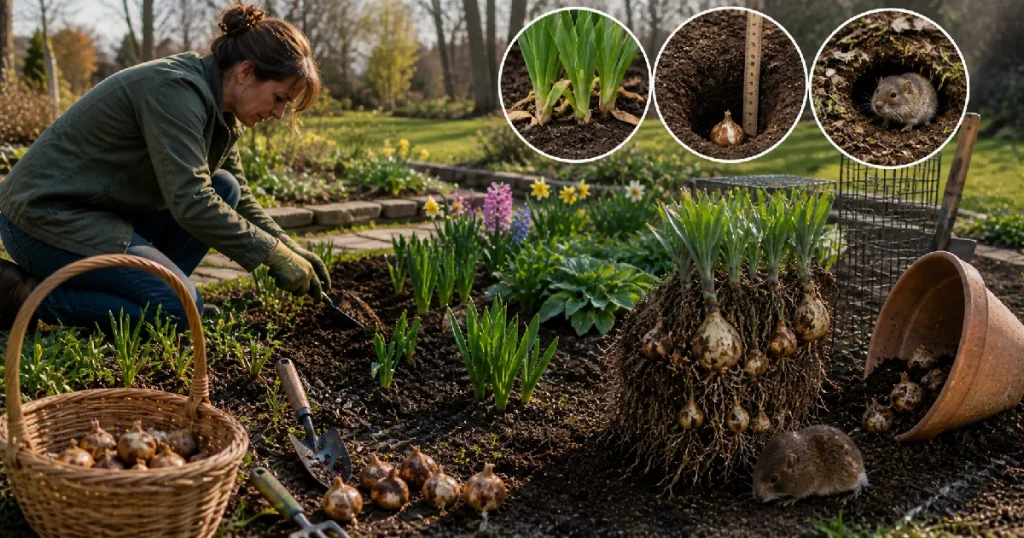
In the weeks following flower fade, the most frequent offender is what a gardener can consistently control. Trimming back disorganized, yellowing foliage after peak flowering and tidying up spent blooms are very appealing. There is a mess in the borders. From the street, neighbors can see the brown, drooping leaves. Having to clean everything up makes sense. You can also ensure your bulbs don’t return the following year by doing this. Those dying leaves are photosynthesizing and returning energy to the bulb in order to build carbohydrate reserves for the following spring. The bulb will be effectively starved if you cut them off too soon. A Michigan State University Extension study recommends leaving leaves until they have completely yellowed and withered, usually six to eight weeks after flowering. For six days only. When they appear messy, they shouldn’t be used. As soon as they are truly finished.
It falls in late spring, when everything else in the garden is bursting into bloom and the dying foliage seems out of place. In reality, this is one of those gardening fundamentals that seems easy but requires a great deal of discipline. One method is to interplant bulbs with annuals or perennials that will fill in and cover the foliage as it dies back. When the bulbs have finished their work, hostas grow up through the spent leaves and cover the mess with their large, eye-catching foliage. Even though they are less noticeable, the leaves continue to function.
Most gardeners overlook soil, depth, and site issues
Bulb failures are largely caused by site selection, which extends beyond foliage management. People often plant first and diagnose later in this area. It is especially harmful when there is inadequate drainage. Winter and early spring bulbs left in wet, soggy soil will rot, and by the time a gardener notices a problem, the bulb has already died. In areas that are consistently soggy, it is honestly recommended to relocate the bulbs completely. Grit or coarse sand can be added to lightly damp soil to improve drainage. A clay-heavy border that drains poorly and stays cold and wet well into April makes it difficult to grow tulips, which are native to rocky slopes and gravelly soil of Central Asia. Spring bulbs are mostly grown in climates with dry summers.
Another factor that is easy to make mistakes with and can have unexpected long-term effects is planting depth. In general, bulbs should be planted three to four times deeper than their height. Tulip bulbs that are two inches tall should be planted six inches below the surface, for example. Shallow planting of daffodils promotes the development of non-flowering offsets rather than blooming bulbs, as well as exposing the bulb to temperature changes. It might not be able to propel growth to the surface if it is too deep. Especially problematic is the possibility of postponing the effects of improper depth. It is possible for a bulb planted too deep to flower successfully in the first year using its initial energy reserves, but then to produce gradually weaker growth in subsequent years as smaller offset bulbs, lacking those energy reserves, reach the light and fail.
Insufficient sunlight exacerbates these problems. The leaves of spring bulbs require direct sunlight to perform their photosynthetic functions. As deciduous trees become leafless during bulb flowering, bulbs under deciduous trees may suffer later in the spring when the tree canopy fills in and shades the foliage before the bulb has finished transferring energy. Direct sunlight is required by most species for at least six hours per day. It is worthwhile to observe a possible planting location throughout the entire spring season, not just during the weeks when the bulbs are visible.
In the case of simple aging, pests, or overcrowding
At first, gardeners don’t always consider the natural lifecycle of bulb plantings. Because tulips are descended from species that are native to harsher climates, they tend to decline after a few years in typical garden conditions, regardless of how well they are cared for. Offsets are smaller daughter bulbs that eventually overtake and compete with the parent bulb. The visible result is a clump with abundant leaves but fewer flowers after three to five years. It is best to dig the clump in late summer after the foliage has completely died back, separate the bulbs, discard any that are soft or undersized, and replant the healthy bulbs at the appropriate intervals.
| Topic category | Hardy spring bulb cultivation — tulips, daffodils, hyacinths, crocus |
| Top cause of failure | Premature foliage removal — cutting leaves before they yellow prevents bulb from recharging |
| Foliage rule | Leave leaves for 6–8 weeks post-flowering until fully yellowed and withered |
| Ideal planting depth | 3–4× the bulb height; tulips/daffodils/hyacinths: 5–8 inches; crocus/snowdrops: 3–4 inches |
| Ideal planting time | When soil temp is 40–50°F at night; above 60°F risks rot, below 40°F stunts development |
| Sunlight requirement | Minimum 6 hours of direct sun; shade prevents energy storage for next season |
| Overcrowding cycle | Divide clumps every 3–5 years in late summer once foliage dies back |
| Animal-resistant bulbs | Daffodils (all parts toxic), alliums (strong scent deters wildlife) |
| Fertilizer guidance | Low-nitrogen, high-potassium feed (e.g., liquid tomato feed) when shoots first emerge |
There are some disappearances that gardeners attribute to other causes that can be explained by animal damage. Recently planted bulbs are often eaten by voles, chipmunks, and squirrels, and their tunneling can disrupt the soil structure. Moles consume earthworms and insects, while voles eat plant roots and bulbs directly. Mole tunnels are sometimes blamed for bulb disappearances caused by voles. In this case, daffodils and alliums have a practical advantage: most animals are poisoned by all parts of daffodils, and rodents and deer are consistently discouraged by the pungent smell of alliums. Planting naturally resistant bulbs with more susceptible species is a sensible long-term solution when pest pressure persists.
My observations of gardeners working through these factors every spring give me the impression that bulb growing requires more perseverance and care than most other tasks in the garden. Unless you implement the fixes months in advance, you cannot know whether they have been successful, and failures are often invisible—occurring underground, in the winter, for reasons that won’t become apparent until March. The delay between action and result makes the entire endeavor somewhat humble. Finding out why the bulbs vanished is at least the first step toward restoring them.
As a Senior Editor at Mini Greenhouse Kits, Hannah Kinsley is a passionate supporter of small-space gardening and urban gardening. Hannah, who is currently majoring in Environmental Policy through the University of Michigan’s Environmental Studies program, infuses her writing with a solid academic foundation and a sincere enthusiasm for the environment. You can find her playing soccer or exploring the city’s green areas with friends when she’s not researching the newest trends in city gardening or creating content for minigreenhousekits.com.