

Seeing a neighbor load black bin bags with fall foliage, carry them to the curb, and then drive to the garden center to buy fifteen pounds of “premium soil conditioner” seems a little absurd. There is a subtle irony here. Rain slowly falls on it as it sits on the sidewalk.
Even though serious gardeners have known about leaf mold for generations, it is still underutilized, possibly because it takes more time than money. Unlike traditional compost, which relies on bacteria to produce heat and a carefully balanced mixture of greens and browns, leaf mold relies mainly on fungi. Those tiny threads break down the fibrous structure of fallen leaves into a dark, crumbly, earthy-smelling substance that is called a free priceless soil conditioner by the Royal Horticultural Society. It is very useful to use the term “invaluable.”. The garden center might not be able to compete with it.
Although the technique itself is simple, the specifics are crucial. Every leaf serves a different purpose. Oak, beech, and hornbeam decompose beautifully and yield superior products. Thick, waxy leaves like those of sycamore, horse chestnut, and sweet chestnut must be shredded before they can persist for years. Evergreens like holly and laurel are too resistant to the fungal process to be useful in a hot compost pile. Furthermore, if you plan to use the final product near vegetables, you should consider the possibility that leaves collected from busy main roads may contain pollutant residues. Your own garden and quieter streets are better sources.

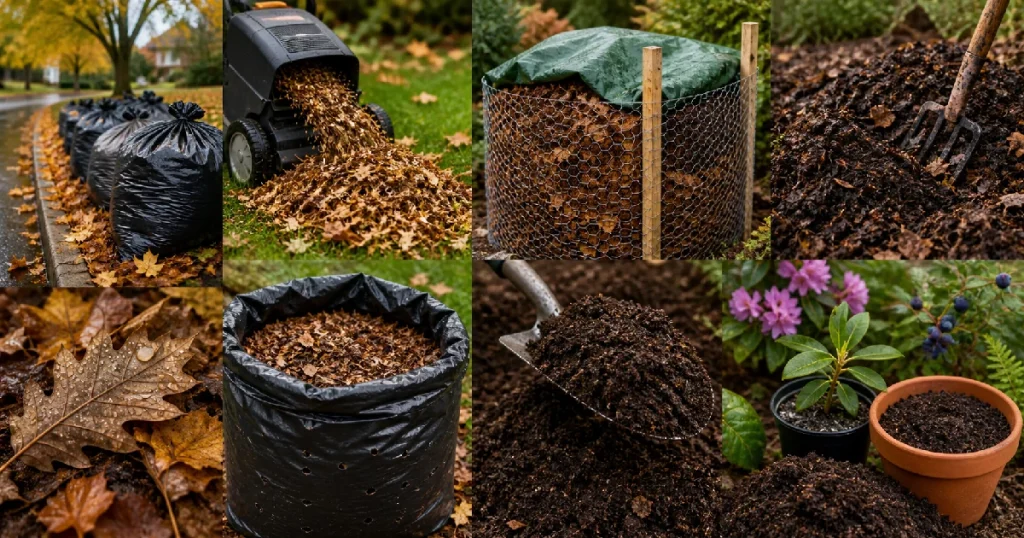
The most crucial step is shredding, which most people overlook. A leaf vacuum or lawnmower can significantly increase the surface area available to fungi, which can reduce the natural decomposition timeline to about twelve months. It’s the difference between creating the conditions for something to happen and just waiting for it to happen. As soon as the leaves are shred, they are placed either in a heavy-duty black bin bag with a dozen holes punched through the sides and bottom, or in a chicken wire cage between four wooden stakes. Fungi require moisture and heat, which black plastic retains. It is also beneficial to cover open piles with a tarp.
Moisture is probably the most overlooked element. Growers say the pile should feel damp, but not soggy, like a well-wrung sponge. Since leaves are hydrophobic when dry, they shed water instead of absorbing it, so a dry pile can remain inert for months before it begins to decompose properly. Check the pile periodically, especially during dry spells, and moisten the layers as you build them. Adding oxygen to the bags by turning them with a pitchfork every few weeks or shaking them vigorously keeps them going. The work isn’t difficult. Work pays, however.
After a year or so, the finished product is a coarse, dark brown substance that can be lightly dug into beds or used as mulch around trees and shrubs. The RHS recommends combining it with good soil, garden compost, and sharp sand to make a homemade potting mix after two years. When you smell that fresh, forest-floor scent from a finished bin of the stuff, it feels like something truly wonderful has been created from nothing. There is no cost associated with it. It rarely contains weed seeds, unlike many purchased composts. Furthermore, figures indicate that it can increase moisture-holding capacity by over fifty percent, comparable to anything sold commercially.
There is also a pine needle variation worth learning about. For mulching rhododendrons, azaleas, blueberries, and other ericaceous plants that suffer in alkaline soils, needles (which can take up to three years in some cases) produce a highly valuable acidic leaf mold. If stored separately, it becomes a fairly specialized product that is difficult to find otherwise. When you see this unfold over several seasons, you change your perception of autumn completely, seeing it as a free, slow delivery of something beneficial rather than a seasonal chore.
There is no guarantee that the leaf mold method will work for every gardener. You need space, patience, and the ability to think in terms of seasons rather than weekends. For those who devote themselves to it, the return is hard to dispute: a product that enhances soil structure, nurtures beneficial soil life, inhibits weed growth, holds onto moisture, costs nothing, and transforms waste into something useful. The garden centers may not be aware of how fierce the competition is. It doesn’t really matter what the fungi in the garden think.
As a Senior Editor at Mini Greenhouse Kits, Hannah Kinsley is a passionate supporter of small-space gardening and urban gardening. Hannah, who is currently majoring in Environmental Policy through the University of Michigan’s Environmental Studies program, infuses her writing with a solid academic foundation and a sincere enthusiasm for the environment. You can find her playing soccer or exploring the city’s green areas with friends when she’s not researching the newest trends in city gardening or creating content for minigreenhousekits.com.