

In January, the first bucket spread across the bare soil of the vegetable beds in a grey, powdery drift that the wind quickly picked up and redistributed. Standing there in a coat with a face mask pulled up, gloves on, eyes narrowed against the dust, I felt a little ridiculous tipping fireplace waste into garden beds and calling it soil amendment. Farmers have been doing this for thousands of years, before anyone could reach for a bag of balanced fertilizer. It had to be something.
Wood ash is a well-known ingredient. As well as potassium, phosphorus, magnesium, and a variety of trace elements that plants require in trace amounts, certain hardwoods also contain calcium, which can make up as much as 20% of their weight. Ash is sometimes used as a complete fertilizer when it’s actually a targeted supplement because it doesn’t contain nitrogen. Soil alkalinity is its most important impact. As wood ash dissolves more easily in water than lime, it raises pH more rapidly. It is useful if the soil is severely acidic and needs to be corrected before planting season. Adding ash to a soil with a pH that is already neutral or almost neutral is not a solution, but rather the beginning of a long-term problem.
This experiment used vegetable beds with a pH of 6.2, which was in the range where wood ash would probably be beneficial rather than harmful. An at-home test confirmed this. Gather ash from the wood-burning stove in the winter and early spring, apply small amounts to the beds, and compare the results with previous seasons. Instead of being applied repeatedly, the rate remained close to the suggested maximum, which is approximately a five-gallon bucket spread over 1,000 square feet. In late winter, the ash was added to the soil, raked lightly into it, and allowed to settle with the rain.

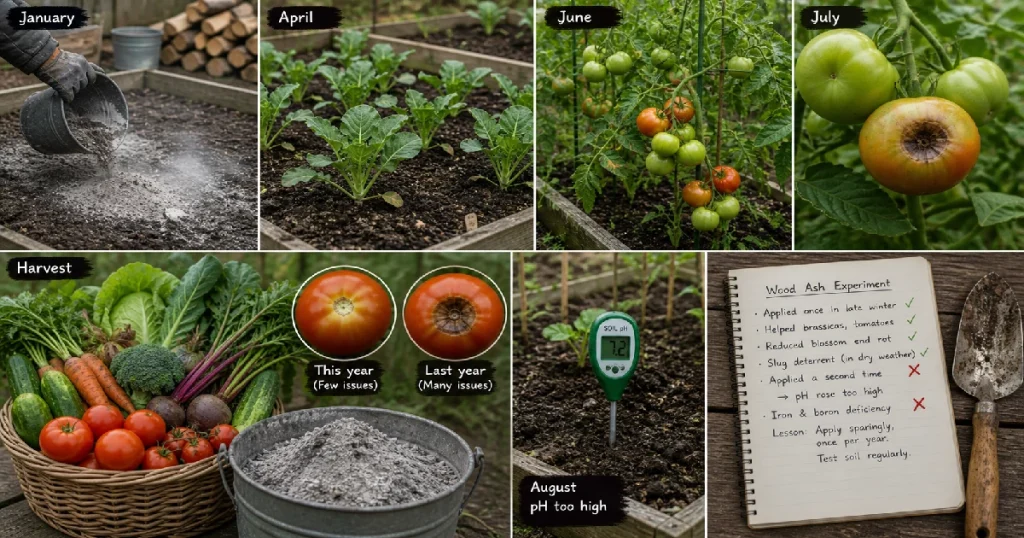
By April, the brassica beds had changed significantly. In mid-spring, broccoli seedlings transplanted had established quickly, without the sulky two-week adjustment period previously typical, and the soil had a slightly looser texture where clay had been most uncooperative. Whether it was the ash or just a better spring is hard to say. Unlike controlled garden experiments, this was not a controlled experiment. There was a garden there. Brassica roots have been shown to benefit from wood ash’s calcium content, and the timing of the improvement was too good to ignore.
Tomato beds were the most obvious success. Symptoms of calcium deficiency in tomatoes include blossom end rot, a dark, sunken patch on the base of developing fruit. Earlier seasons, it had been a persistent problem. Because of the ash being worked into the soil prior to planting and a more cautious watering schedule, only two or three fruits developed blossom end rot this year, as opposed to fifteen or twenty the previous year. Potassium from the ash likely played a role in fruit development as well, even though it is more difficult to see directly than blossom end rot.
The slug deterrent effect was real, despite its limited scope. When the weather was dry, slugs reluctantly crossed the gritty, caustic barrier of ash that formed around seedling bases. In wet weather, it dissolved within an hour. In order to be effective as a pest control method, it needs dry conditions and continuous renewal in the early spring when slug pressure is highest and rainfall is lowest. It is practically worthless by June. Knowing this is important before expecting too much from it.
This was an ad hoc decision that wasn’t part of the original plan, motivated by the hope that if some was good, a little more might be even better. There was a flaw in that reasoning. Symptoms of iron and boron deficiency appeared in late summer on plants that appeared healthy in June, including pale, slightly yellowed new growth. A soil test showed that the pH in those areas had risen above 7.0. At that point, phosphorus and other micronutrients become unavailable to roots regardless of their physical presence. Overcorrection was made to the ash.
| Category | Details |
| Subject | Using Wood Ash in Garden Beds — Benefits, Risks & Practical Guidance |
| Key Nutrients | Calcium (~20%), Potassium (~3–5%), Magnesium, Phosphorus, and trace elements |
| Primary Effect on Soil | Raises pH — acts similarly to lime but faster-acting and more soluble |
| Ideal Soil pH for Use | Effective on acidic soils below pH 6.5; avoid applying to pH 7.0 or above |
| Safe Application Rate | 10–20 lbs per 1,000 sq ft per year (roughly one five-gallon bucket) |
| Best Timing | Late winter/autumn — allows compounds to settle before spring planting |
| Plants That Benefit | Tomatoes, peppers, brassicas, fruit trees, most vegetables in acidic soil |
| Plants to Avoid | Blueberries, raspberries, azaleas, rhododendrons, potatoes |
| Key Risk | Over-application causes pH above 7.0 — locks out phosphorus, iron, boron, manganese |
| Pest Deterrent | Dry ash deters slugs and snails when applied around plant bases |
| What to Avoid | Ash from treated, painted, or pressure-treated wood; coal; charcoal briquettes |
I can’t help but think back on that second application and feel the unique annoyance of an avoidable mistake. Wood ash should be applied once a year, sparingly, and accompanied by soil tests to monitor the situation. Ash’s fast-acting solubility, which makes it useful, also makes it easy to overshoot. In a garden with acidic soil, wood ash is truly beneficial when applied sparingly in late winter and allowed to work slowly. It replaces the issues it resolved when applied twice or liberally, or when applied to soil that didn’t need it.
As a Senior Editor at Mini Greenhouse Kits, Hannah Kinsley is a passionate supporter of small-space gardening and urban gardening. Hannah, who is currently majoring in Environmental Policy through the University of Michigan’s Environmental Studies program, infuses her writing with a solid academic foundation and a sincere enthusiasm for the environment. You can find her playing soccer or exploring the city’s green areas with friends when she’s not researching the newest trends in city gardening or creating content for minigreenhousekits.com.