
A dead oak stands at the far end of a rural Connecticut garden, its upper branches bare against the sky and its bark peeling in long strips. The owners have been discussing its removal for the past two years. Due to the low estimate, it is still standing. Meanwhile, something else is happening. Two downy woodpeckers have dug a tiny hole near the base of the crown. A screech owl was observed roosting there last November. In short, deliberate bursts, the woodpeckers return to the insect-pocked trunk. There is no longer any life in the tree. Obviously, it is also doing something.
The urge to cut down a dead tree immediately makes sense. Trees that are dead are a sign of failure; they need to be fixed, they are a nuisance, and they are liabilities. Due to this, the tree services recommend prompt removal, which is both financially advantageous for their business model and reasonable in some cases. It is less often discussed that a standing dead tree can be one of the most environmentally beneficial elements in a garden if it does not pose a structural danger to buildings or power lines. Foresters and wildlife biologists call it a snag. During its slow decomposition, a single dead trunk can support dozens of species and serve as a nesting site, a feeding station, and eventually as a soil amendment. The term may sound clinical, but the reality it describes is truly rich.
By drilling holes of different diameters into dead wood, you can transform a standing snag into a native bee hotel. In neat suburban landscapes, solitary bees are increasingly unable to find nesting cavities, which they need for nesting. There are no bees here. They do not form colonies and do not sting violently. In addition to pollinating gardens effectively and silently, they need a place to lay their eggs. A dead trunk provides the ideal material. The holes fill up over the summer. Next spring, the next generation emerges. Almost no setup costs are involved in this closed loop system.
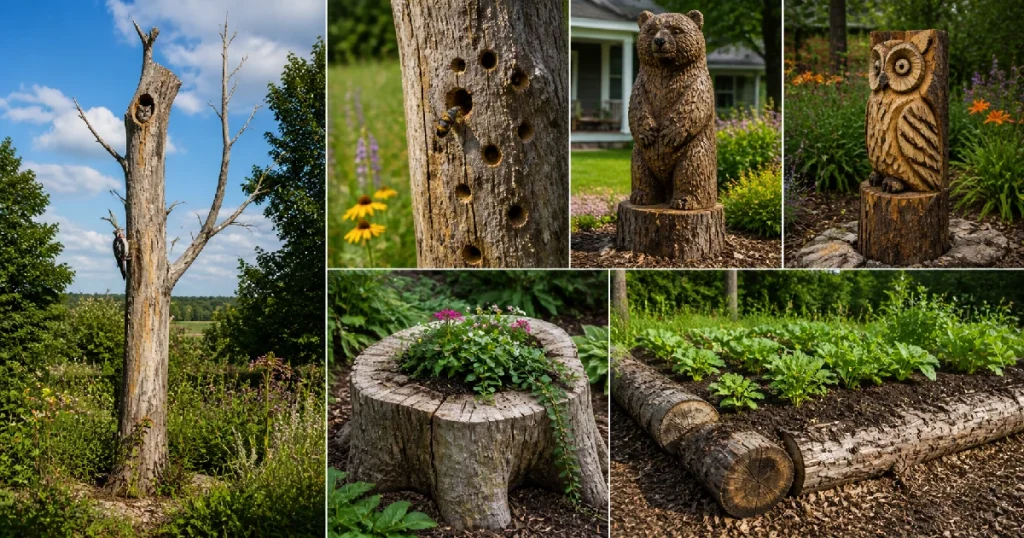
Gardeners who are unable or unwilling to leave a dead tree standing due to safety concerns, HOA regulations, or purely aesthetic reasons may find the alternatives more appealing than they think. A chainsaw artist working on a referral can transform a dead trunk into something visually appealing, such as an owl, a bear, a totem, or an abstract shape. It is not a specialized approach. Throughout the American Northeast and Pacific Northwest, carved tree sculptures have become a common sight in residential landscapes, transforming what was once a removal issue into a conversation piece that lasts ten years or more before weathering to an acceptable ruin, depending on the artist and the wood. Even though the price varies greatly, it is often less expensive and much more interesting than full removal.
Once the tree has been cut down, the stump can be used for a variety of purposes. When hollowed out, filled with high-quality potting mix, and planted with sedums, trailing flowers, or even a small kitchen herb like thyme, what was once a removal remnant becomes a planter with true character. Its uneven edges, dark interior, and organic shape make it unlike any manufactured container. In comparison with purchased planters, watching a well-planted stump planter through a season gives the impression that it belongs in the garden. There is a history to the content. It was something before it was this.
The more ambitious option is hugelkultur, which is an elevated bed built over buried logs. As the wood breaks down underground, it releases nutrients, holds onto moisture, and creates the kind of loose, biologically active soil structure that conventional amendments can’t. There is some work involved in digging, laying the logs, and covering them with topsoil and compost. After a few years, however, the resulting beds are often remarkably productive, drawing energy from decaying wood in an almost alchemical manner. The tree that provided shade for decades eventually feeds your garden.
There are legitimate situations where removal makes sense, and these situations should be taken seriously. Trees that have died from diseases, such as oak wilt, Dutch elm, or emerald ash borer, pose a threat to nearby trees and should be removed immediately. An arborist must examine a trunk that is leaning toward a structure before anything else. Ash trees, for instance, lose the structural integrity that allows them to stand safely for years, and once they die, they become unpredictable and brittle. Postponement is not justified by these reasons. Rather than reflexively removing them, they are arguments for honest evaluation.
The notion that a dead tree needs to be removed as soon as possible should be challenged. It could be something quite different: an opportunity that, depending on how it’s managed, can outlive and outperform many of the things planted to replace it based on ecological, garden design, and basic observation.
As a Senior Editor at Mini Greenhouse Kits, Hannah Kinsley is a passionate supporter of small-space gardening and urban gardening. Hannah, who is currently majoring in Environmental Policy through the University of Michigan’s Environmental Studies program, infuses her writing with a solid academic foundation and a sincere enthusiasm for the environment. You can find her playing soccer or exploring the city’s green areas with friends when she’s not researching the newest trends in city gardening or creating content for minigreenhousekits.com.