
A certain moment occurs when an interior designer enters a garden for the first time with a brief in hand. They look around, squint a little, and begin discussing flow, palette, and focal points for a few minutes. Vocabulary is transferred. There is no doubt that the assurance is genuine. After the third discussion about plant selection, something begins to fall apart.
Combining these two fields has real appeal. Many homeowners have always considered gardens as afterthoughts, areas that receive whatever is left over after a house is built. Traditional gardening advice often lacks spatial intelligence, which can be provided by interior designers, who are trained to consider how rooms feel rather than just how they look. The question is how much of that intelligence will endure soil, shade, and a British winter.
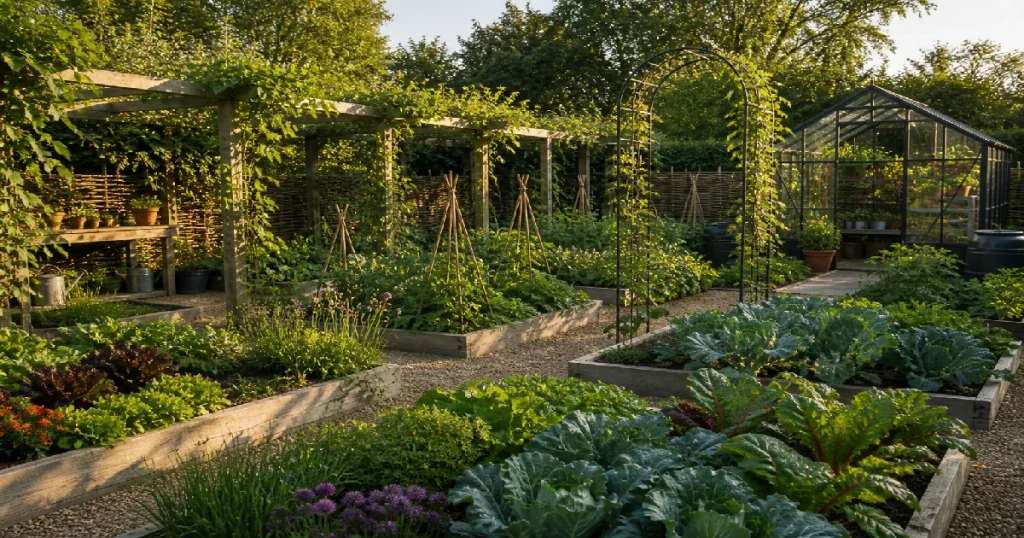
Designers and garden experts consistently describe it as doing a lot. Usually, the issues appear later and in predictable ways. Interior designers excel at laying the foundation for a garden before a single plant is planted. Many amateur gardeners ignore the concept of treating the outdoor area as a room composed of three distinct layers: walls, flooring, and overhead structures like pergolas and tree canopies. Many suburban gardens suffer from this omission: a fence, a level patio, and nothing in between to direct the viewer’s attention. Designers fix that almost instinctively.
An indoor-outdoor reasoning that is robust
Color is another area where the interior designer’s intuition usually works well. When compared to the usual collection of whatever looked good at the garden center that spring, choosing a carefully selected, restrained palette-three tones at most, one neutral anchor, one supporting shade, and one accent-creates a calmer, more cohesive environment. A sculpture, a water feature, or a single striking plant at the end of a sight line are examples of focal points that designers consider differently from horticulturists. The method comes directly from interior design, and it is nearly identical.
Lighting is perhaps the best direct transfer. Any interior designer will tell you that layering ambient, task, and accent light is equally effective outside. An area that functions at dusk in a new way is subtly transformative, and a garden lit in three layers extends its usable hours well into the evening. Most people choose inexpensive solar units that fail within a season, according to designers who have done this work. One of the more seamless transitions between the two domains is to use warm white LEDs powered by the mains.
When there is a difference between indoor and outdoor spaces
It is usually time and scale that cause problems when they do arise. Designers are trained in rooms measured in meters, with walls remaining in place and furniture chosen to fit precisely. Different functions are performed in gardens. According to garden designers James Alexander-Sinclair and Joe Swift, too many small items create visual noise, making a space seem smaller than it actually is, so what appears to be a generous planting arrangement on paper becomes fussy and cluttered when installed. The interior instinct to add detail and variety, which is effective inside, often fails outside, where the scale dictates restraint and boldness. A small garden is enhanced by ten delicate specimens carefully placed around a large plant with structural foliage.
Time is the more difficult issue. Interior designers work with items that don’t spread into adjacent rooms, and a sofa doesn’t keep growing. That’s what plants do. A mistake is selecting a plant based on its current appearance without considering its size, spread, and behavior in three or five years. In the third season, a scheme that looks great in photos can become a tangled mess. Horticulturists must have a thorough understanding of soil composition, drainage, and whether a particular area receives six or two hours of sunlight. When designers cross over, one of the most common mistakes they make is to place plants for color contrast rather than for their actual growing conditions.
Experienced observers conclude that collaboration is the most effective way to conduct the experiment, rather than that it fails. Lighting, furniture, color scheme, and spatial logic are handled by the interior designer. Horticulturists take care of soil, plants, and what will still look good in 2029. In their own right, neither has the full picture. When you create a garden that feels truly right-coherent, livable, and still lovely after a few seasons-both types of thinking are involved.
| Core design principle | Define three architectural layers — boundaries, ground surface, overhead — before selecting any plants or decorative items |
| Recommended color palette | Maximum three coordinating tones for outdoor spaces; one neutral anchor, one supporting tone, one accent |
| Biggest furniture mistake | Investing in quality landscaping then adding cheap plastic furniture — undermines the entire design (James Alexander-Sinclair & Joe Swift) |
| Scale rule for small gardens | One or two large bold plants create more calm and structure than many small ones; pergolas should span 240–360 cm to feel proportionate |
| Common hardscaping error | Over-paving at the expense of planting; aim for roughly 50/50 hard-to-soft ratio in smaller gardens |
| Plant selection pitfall | Choosing plants for how they look today, not in 3–5 years; buying only flowering plants ignores year-round seasonal structure |
| Lighting approach | Layer ambient, task, and accent lighting; LED mains-powered over cheap solar for reliability; all bulbs matched to “warm white” |
Olivia Murphy is a Senior Editor at Mini Greenhouse Kits and a fervent supporter of small-space and urban gardening. Alyssa, who is currently majoring in both literature and biology at Michigan State University, infuses her writing about city gardening and small-space growing with a unique blend of scientific curiosity and storytelling instinct. Her love of literature influences how she tells the stories behind the plants, and her background in biology gives her content a grounded, research-informed edge. When she’s not working on her next gardening piece, you can find her curled up with a good magazine or watching a movie that she’s been meaning to watch for weeks. She writes with passion at minigreenhousekits.com.