

This particular moment is familiar to most gardeners. As you drive home from the garden center with a car full of individual plants, you arrange them in the border, take a step back, and sense that something isn’t quite right. There are all the colors present. There is no problem with the plants. Nevertheless, the entire scene seems agitated and even contentious, as if the garden is at odds with itself. This sensation is not caused by a lack of taste. There is no system in place.
Color behaves differently in a garden. Depending on the time of day, the season, and the type of light, it varies. If a pairing shines at dusk, it will appear flat by noon, and if it shines in deep shade, it will appear ostentatious in direct sunlight. Most garden writers don’t acknowledge that there are combinations that consistently withstand all of those conditions, but they exist, and once you find them, they become your permanent tool kit.
A combination of white and green is the most reliable starting point, but it’s also the least utilized. Rather than a hesitant, default option, make an active decision. In bright midday sun, white flowers hold their own without washing out because they reflect light in a way no other color can, lifting shaded corners from gloom otherwise. Any type of garden would benefit from white salvia behind a low border of variegated hostas or cream hydrangeas with dark green fern fronds. In between the bright spots, the green does half the work by providing a variety of tones, from lime to deep pine. This combination appears frequently in gardens that appear harmonious throughout the year.

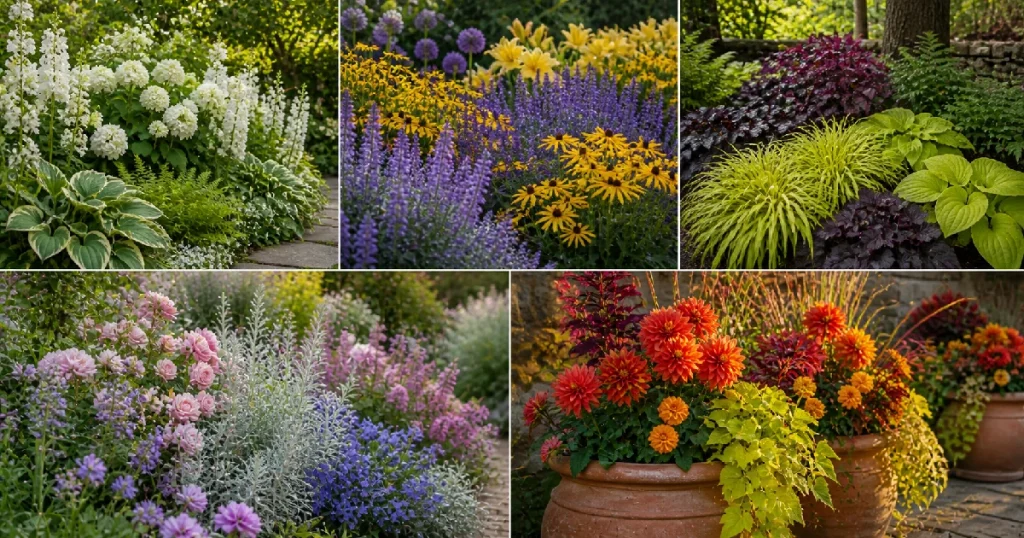
Purple and yellow are opposite colors on the color wheel, so theoretically they should be in conflict. In practice, the pairing is nearly infallible. In contrast, yellow keeps purple from getting gloomy, while purple calms yellow’s energy. When planted in a sunny border with catmint along the front and yellow rudbeckias or daylilies behind, they create a vibrant border that lasts from late spring through early autumn. As a side effect, the combination tends to attract pollinators with the unwavering focus of a strategically placed advertisement.
Shade gardening is most effective when lime green is combined with burgundy or extremely dark purple foliage. There is a color logic to shade gardening. Where lighter colors might just vanish in low light, this combination adds depth. Since the dark tones absorb what little light there is, the lime green pops with an intensity that would not be possible in full sun. There is something purposeful and even theatrical about heuchera varieties in plum and near-black planted with golden Japanese forest grass or a hosta with chartreuse leaves, something shade gardens often lack.
Unlike the previous combinations, the romantic palette of pinks, silvers, and soft blues is heavily dependent on seasonal timing. In late spring and again in September, the light quality softens and the palette’s gentleness reads as elegance rather than absence. It is silver-grey foliage — artemisia is the dependable workhorse here — that serves as a bridge between pinks and blues in a way neither white nor green can. This prevents the blue from becoming chilly and softens the sentimentality of the pinks. English garden designers have used this color scheme for more than a century, and they continue to do so because it is effective.
| Category | Details |
| Subject | Colour Combinations for Year-Round Garden Design |
| Core Principle | Use the colour wheel — complementary, analogous, and monochromatic schemes |
| Most Reliable Trio | White, Blue/Purple, and Green — works in sun and shade |
| High-Contrast Pairing | Purple and Yellow — complementary colours that energise each other |
| Best for Shade | Burgundy/Dark Purple with Lime Green — creates depth in low light |
| Romantic Palette | Pinks, Silvers, and Soft Blues — classic English cottage feel |
| Bold Summer Combo | Red, Orange, and Chartreuse — best in full, hot sun |
| Year-Round Anchor | Evergreen foliage, coloured bark, and structural plants for winter interest |
| Common Mistake | Choosing plants individually rather than designing colour combinations in advance |
| Key Design Tip | Repeat colour groupings throughout beds — prevents a patchy, chaotic look |
Summertime gardeners seeking movement and heat will enjoy the combination of red, orange, and chartreuse green. Rather than spreading throughout an entire garden, which can become tiresome, it is best used in containers or a specific border area. Marigolds, dahlias, and a trailing chartreuse coleus planted at the edge of a terracotta pot catch the afternoon light with an almost aggressive quality. In the cool morning light, the same combination is warmer, less demanding, and more approachable.
Identifying the principle behind each of these combinations is worthwhile. Green is never neutral. In the dead of winter, when the flowers are gone and the only thing preventing the garden from looking deserted is its structure, the foliage still adds to the design. During the months when nothing is blooming, ornamental grasses that go dormant, gold-leafed shrubs and burgundy heuchera provide color, which sets apart a planned garden from one just planted. The right color combinations require more than just peak summer. On a cloudy November afternoon, the garden appears to be nothing or everything.
Olivia Murphy is a Senior Editor at Mini Greenhouse Kits and a fervent supporter of small-space and urban gardening. Alyssa, who is currently majoring in both literature and biology at Michigan State University, infuses her writing about city gardening and small-space growing with a unique blend of scientific curiosity and storytelling instinct. Her love of literature influences how she tells the stories behind the plants, and her background in biology gives her content a grounded, research-informed edge. When she’s not working on her next gardening piece, you can find her curled up with a good magazine or watching a movie that she’s been meaning to watch for weeks. She writes with passion at minigreenhousekits.com.