

If you stroll through any garden center on a Saturday morning in April, you’ll notice something. The packaging of almost everything promises convenience. It is infallible. It’s not a big deal. Don’t worry about it after you plant it. Among the products that promise to simplify gardening are pre-mixed soil, self-watering pots, and slow-release pellets that promise to nourish plants for six months. In spite of this, millions of gardeners are still fatigued by their outdoor areas by the end of June.
Low-maintenance gardens have a reputation problem. There are those who claim it doesn’t exist at all, that all gardens need constant care, and that it’s a nice fiction to promote the opposite. Other people treat it as an achievable goal while quietly underestimating what it takes to get there. There is something to be said for each side. There is a garden that requires very little maintenance. In spite of this, it is neither discovered by chance nor produced by buying the right products. Often, the most important design choices are those that seem counterintuitive at first.

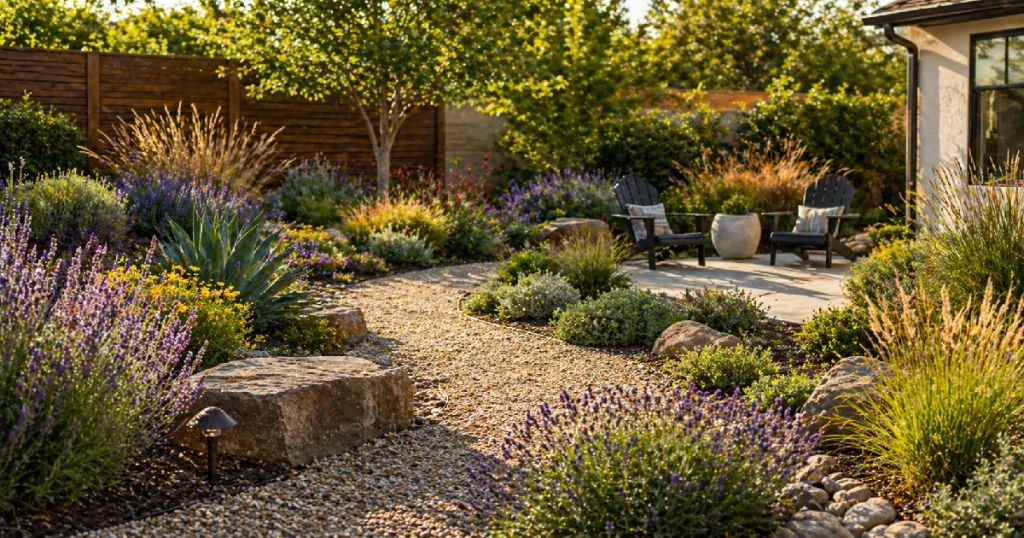
The conversation usually begins on the lawn. A well-kept lawn has long been seen as a sign of domestic respectability, effort, and order in any garden. In small gardens without children, removing the lawn completely is often the lower-maintenance option, according to the RHS, an organization not prone to controversial positions. For a small patch of grass, mowing, edging, feeding, aerating, and reseeding are all necessary. When graveled areas, permeable paving, or broad planting borders are replaced, a surprising amount of that ongoing work disappears. Although it’s an odd trade psychologically, gardeners who make it usually don’t return.
In terms of plant selection, most low-maintenance strategies either succeed or quietly fail. In practice, the RHS’s “right plant, right place” concept can be difficult to consistently implement. This is especially true for gardeners who choose plants based on how they look in catalogs rather than how they will perform in their particular conditions. Lavander will struggle to survive in heavy clay soil and will need assistance. The same lavender is practically self-sufficient in sunny, free-draining soil. There is no change in the plant. It is a completely different result. Instead of seasonal bedding plants, hardy shrubs and evergreen perennials eliminate the need for frequent replanting, minimize weed growth, and maintain the garden’s structured appearance throughout the winter.
It is a method that novice gardeners often underuse, but seasoned gardeners mention almost casually, as if it is common knowledge. Aside from slowing moisture evaporation from the soil’s surface and suppressing weeds, covering bare soil between plants with bark chips, gravel, or composted material also improves soil structure over time as organic mulch decomposes. To complete the initial application, it takes an afternoon. During the following months, weeding is significantly reduced. In early spring, observing a recently mulched border gives the impression that the season may be manageable.
| Category | Details |
| Topic | Low-Maintenance Garden Design: Principles, Myths, and Real Strategies |
| Key Authority | Royal Horticultural Society (RHS), United Kingdom |
| Founded | 1804 — one of the world’s leading gardening authorities |
| Core Principles | Right plant, right place; mulching; hardscaping; evergreen structure |
| Common Misconceptions | Gravel gardens need no upkeep; small lawns are easier than borders; “no-maintenance” exists |
| Best Plant Choices | Hardy shrubs, evergreen groundcovers, AGM-certified perennials, self-clinging climbers |
| Key Labor-Savers | Mulching, large pots, ditching the lawn, no-dig methods |
| Ideal For | Time-poor gardeners, elderly growers, urban and small-space gardens |
| Reference | RHS – 10 Ways to Have a Low Maintenance Garden |
The size of the pot is another detail that draws attention. It makes sense to use smaller containers in small gardens, especially on balconies and patios, since they are more proportionate, easier to move, and less intimidating. In the summer, however, small pots dry out more quickly than large ones, requiring daily watering and ongoing observation. Investing in raised planters or grouping plants in large containers significantly reduces maintenance requirements. Perennials that are drought-tolerant can go several days without watering once they are established. A group of small pots with annual bedding may need twice-daily care in July.
In reality, low-maintenance gardens require significant initial investment in planning, soil preparation, plant selection, and sometimes hardscaping. In the first few years, it is possible to produce something that truly runs close to itself, but doing so requires careful consideration. The gardening industry’s version, centered on products and quick fixes, often hides this. In reality, what works is mulched borders, sensible hardscaping, structural planting, and letting go of the idea that the garden must always be immaculate. The last piece of advice is perhaps the most underappreciated. Even gardens with a few minor flaws, such as self-seeding, naturally spreading ground cover, and some leaves left where they fall, are not neglected. The garden is self-sufficient.
As a Senior Editor at Mini Greenhouse Kits, Hannah Kinsley is a passionate supporter of small-space gardening and urban gardening. Hannah, who is currently majoring in Environmental Policy through the University of Michigan’s Environmental Studies program, infuses her writing with a solid academic foundation and a sincere enthusiasm for the environment. You can find her playing soccer or exploring the city’s green areas with friends when she’s not researching the newest trends in city gardening or creating content for minigreenhousekits.com.