
A NASA research facility was working on a problem unrelated to lettuce in the 1990s. They had to figure out how to grow food in space without soil, gravity, or margin for error. They developed a method that misted plant roots with nutrient solution at specific intervals while suspending them in the open air. It took years for aeroponics to penetrate the commercial farming sector, even though space gave it legitimacy. It is currently at one end of a legitimate debate about which soilless system produces food more quickly and whether that is the right question to ask.
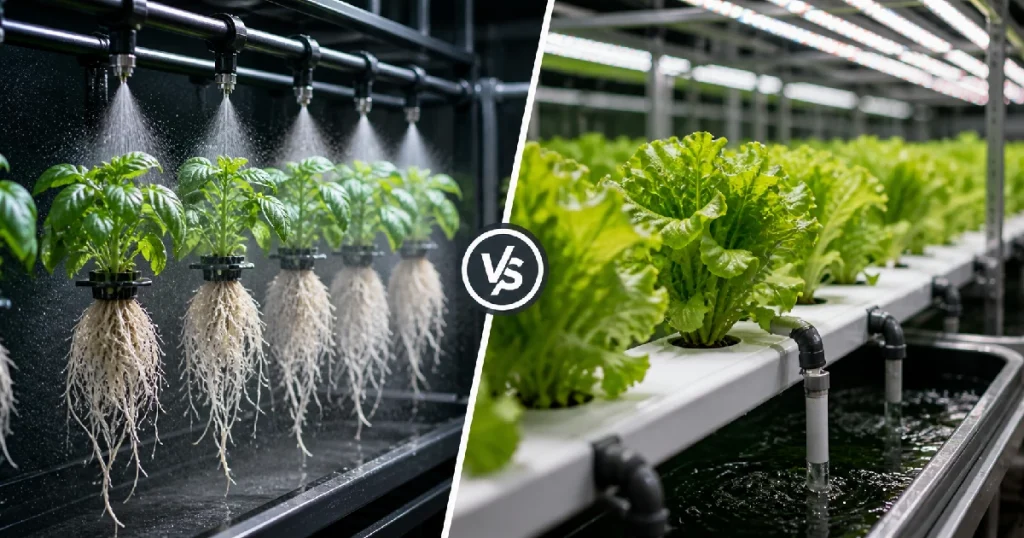
When it comes to speed, aeroponics wins. In studies comparing the two techniques, aeroponic plants grow 10 to 45 percent faster than hydroponic plants, and 30 to 50 percent faster than soil plants. In an aeroponic system, roots receive both nutrients and oxygen in nearly perfect proportions. As roots hang freely in the air between misting cycles, oxygen is directly absorbed. The high-pressure nozzles deliver a precise micro-dose of nutrient solution directly to the root surface every 30 to 60 seconds. Nothing is diluted by standing water. Nothing is hindered by the growing medium. When it comes to plant feeding, the delivery is straightforward.
Hydroponics involves immersing roots in nutrient-enriched water solutions or exposing them to them regularly. Roots in contact with water have less direct access to oxygen than roots suspended in the air, regardless of the configuration – deep water culture, nutrient film technique, or ebb and flow. By compensating with air stones or timing drainage cycles, most hydroponic systems effectively prevent root rot. Aeroponics, however, virtually ignores a fundamental biological reality. Aeroponic lettuce grows in a well-managed commercial facility at an astounding rate; crops that require four weeks in soil are harvested in less than three, cycle after cycle, with an almost mechanical consistency.
Hydroponics regains its position
However, both commercial growers and hobbyists quickly learn to respect the vulnerability that comes with speed. Aeroponic systems do not have a buffer. When a pump fails in a hydroponic system, the reservoir keeps the roots hydrated for hours. Before any plants perish, you have enough time to identify the problem, find a replacement part, and fix it. Whenever a pump fails in an aeroponic system, the exposed roots begin to dry out almost immediately. An environment that is warm can cause significant stress in a matter of hours. After a short period of time, irreversible damage occurs. Without a backup power source and a reliable monitoring system, operating an aeroponic system is more reckless than optimistic.
Another problem is the nozzles. Aeroponics’ fine-bore misting heads can get clogged when minerals accumulate in the nutrient solution. pH and nutrient concentrations must be calibrated more precisely than in comparable hydroponic systems, and routine cleaning is essential. Because nutrients are delivered in such tiny doses at such short intervals, any imbalance has a greater impact than in a system with a larger nutrient reservoir. Growers with monitoring infrastructure can easily handle this. For someone setting up their first soilless system on a kitchen counter or shelf in a spare room, it’s a significant additional burden that hydroponics doesn’t impose.
Practical conclusions for different types of growers
Commercial vertical farming has grown rapidly over the past ten years, with most ambitious operators starting with hydroponics and eventually moving to aeroponics. Taking on the complexity and operational requirements of aeroponic systems is highly incentivized for large-scale facilities that grow microgreens and mixed salad leaves for urban restaurant supply, where cycle speed directly affects revenue. When compounded over twelve or fifteen crop cycles per year, the growth rate differential results in a significant output advantage.
Home growers have a different calculus. It is possible to grow herbs on a kitchen counter or a small assortment of greens on a balcony shelf using a hydroponic system without the infrastructure and ongoing care of aeroponics, which allows for faster growth than soil, no pest pressure, controlled nutrition, and year-round production. It’s still unclear whether the speed difference between the two approaches is significant at the scale of a personal harvest. A hydroponic system that operates continuously for two years performs better than an aeroponic system that experiences two pump failures and a nozzle clog in its first season. Most growers who choose the slower method don’t consider reliability a consolation prize. That’s the whole point.
Alyssa Bennet is a Senior Editor at Mini Greenhouse Kits and a passionate advocate for urban gardening and small-space growing. Currently pursuing her major in Arts at the University of California, Alyssa brings a distinctly creative eye to the world of city gardening – blending artistic sensibility with a genuine love for green living. She writes regularly at minigreenhousekits.com, and when she’s not crafting her next gardening piece, you’ll find her with a paintbrush in hand, watching sports, or exploring the city with friends.