

We who live for the soil feel a certain electricity every April when the ground breathes again. That first morning when you drink coffee on the back porch looking at the damp earth makes the coffee taste better. It feels as if the world is finally coming back to life when you see green spikes pushing through the mulch. Last year, however, that feeling vanished when I saw my golden retriever digging with a frantic kind of joy. The previous autumn, I had buried my prized bulbs here. It dawned on me then that I had spent years worrying about the wrong things when the real danger was hidden beneath three inches of dirt. Tulips toxic to dogs weren’t just theoretical warnings on plastic tags. Instead, it was a nightmare that could ruin a Saturday morning.
These plants symbolize hope, which is why we buy them. It’s time for a burst of saturated color after a long, gray winter. We don’t usually think about the bulb’s chemical composition or how allergenic lactones are more concentrated as you go deeper into the plant. A dog does not see a bulb as a future flower. This is a ball. There is buried treasure here. There is something to taste and explore about it. As I watched my dog sniff the air, I felt a pit in my stomach that had nothing to do with the beauty of the season. A hobby can quickly become a source of anxiety. Suddenly, your backyard becomes a minefield of potential disasters instead of a sanctuary.
There is something serene and polished about gardening. Photos show pristine borders and happy pets lying on the grass. A frantic call to the vet or the struggle to pry a half-chewed bulb from a stubborn mouth are never shown. Knowing you planted something dangerous right where your best friend spends her afternoons brings a special kind of guilt. Every decision you make at the nursery is questioned. The labels seem so small, and the warnings seem like an afterthought compared to the bright pictures of blooms.

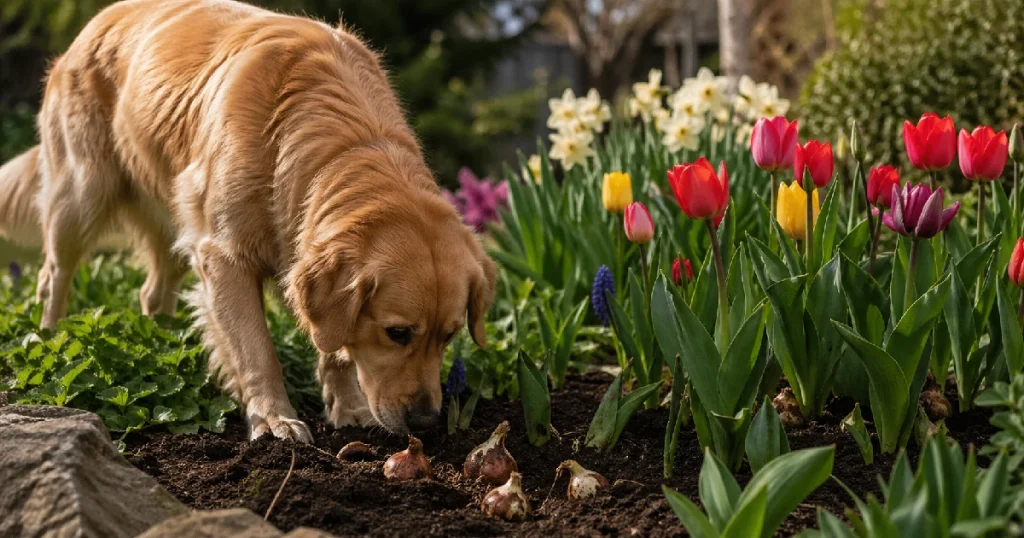
Plants toxic to dogs make the beauty of the season fade away
On that afternoon, I sat on the mudroom floor watching for any signs of distress. The vet was on speed dial, and I had a stack of half-read articles about what to do. Garden centers lead you to believe that the world is much safer than it actually is. When you walk through those aisles, everything seems innocent. The list of plants toxic to dogs is long and includes almost every spring favorite. It’s not just the tulips. In March and April, emergency veterinarians are kept busy by the very things that signal the end of winter.
When I looked out the window at my flower bed, I felt betrayed. Choosing colors and considering bloom times took a lot of time. The biology of the thing never occurred to me. Gardening is like curating a gallery, where we are the curators. In spite of this, we often forget that we share the world with creatures that experience the world through their mouths. I noticed a difference in the soil that day. The feeling was heavy. My neighbors who had similar setups made me wonder if they knew. It made me wonder if everyone was just moving through their lives with these hidden risks.
The tension between creating something beautiful and keeping it safe is strange. Certain perennials provide height and drama, but they cause cardiac issues or severe gastric distress. You become cynical about the industry as a result. The English garden was never meant to be a playground for curious terriers, as they sold us the dream of it. Wilder, less-curated spaces where risks are more evident or plants are less pampered and processed made sense to me.
Where does a curated yard end and a dog-poisoning daffodil begin?
As I dug deeper into my research, I began to lose interest in the traditional spring palette. My entire landscape plan is doomed if daffodils are poisonous to dogs because I found myself staring at a clump of yellow trumpets in the corner of the yard. The answer is a resounding yes. The crystals in those bulbs are even more irritating than those in tulips. Having the most iconic flowers of the season pose the greatest threat seems cruel. We celebrate the arrival of these plants while our pets walk through a pharmacy of natural toxins.
My friend shrugged and said her dogs don’t care about flowers. Anecdotal confidence like that can be dangerous. All it takes is one boring afternoon or one particularly fragrant bit of mulch to change everything. I used to think my dog was too well-behaved to eat plants. However, behavior has nothing to do with instinct. Alkaloids and calcium oxalate crystals are unknown to dogs. We project our own understanding of the world onto them and are shocked when they act like animals. They know that the earth is soft and something smells interesting.
As I learned more, I realized that even safe things aren’t. The answer to the question of whether daylilies are toxic to dogs is that they are mainly a concern for cats, but if enough of them are consumed, they can still cause stomach trouble. As a result, work becomes a constant state of vigilantism, which takes the joy out of it. While pulling weeds, you wonder if the weed is actually safer than the flower you planted. There is a complete reversal of the garden hierarchy. Things that grow naturally seem less dangerous than the expensive imports we coddle and fertilize.
There is no right or wrong way to do this. If you fence everything off, your yard will look like a construction site. Planting only safe plants will limit your options to a handful of boring greens. It’s either you live with the risk or you change your entire philosophy of what a garden is. Because native plants are often grown along with local wildlife, they often don’t have the same concentrated punch as some of the show bulbs that are bred for show.
Whenever I see a picture of a dog sitting in a field of flowers, I think of that day in April. Through the screen, I want to warn them to be careful. I would like to tell them about lactones, crystals, and bulbs that resemble toys. Usually, I don’t. They don’t want to hear that their beautiful moment was a gamble. Because reality is messy and requires us to change our habits, we prefer the aesthetic over reality.
There is still a garden and I still plant things, but how I do it has changed. I no longer buy bulk bags of tulips. My goal is to find things that don’t require me to hold my breath every time the dog walks outside. I stopped trying to make the yard look like a magazine cover. I started letting it be a place where we could all exist without having to go to the clinic. Peace of mind is more valuable than any flower, even if it isn’t as flashy and there are fewer iconic spring colors.
Nature isn’t there for our convenience. It has its own logic and defenses. We cross lines that we do not fully understand when we bring these plants into our homes. We mix the wild with the tame and hope for the best. The happiest things happen, and sometimes we find ourselves standing in the dirt at six in the morning. Hopefully, a small brown bulb has not caused any permanent damage. Currently, uncertainty is part of the process. It makes the successes feel more meaningful and the failures feel more profound. The landscape is not under your control. Just another creature trying to survive in a world that was never meant to be safe.
From a distance, I can appreciate the color of the tulips in my neighbors’ yards. There is something appealing about that perfect red and how it catches the light. For me, they will always represent that moment of panic. They remind us that beauty often comes at a price. For those of us who share our lives with dogs, that price is sometimes too high. Despite my anxieties, the season continues to move forward. Rain falls, the sun rises, and things in the ground do what they have been programmed to do for thousands of years. Adaptation is necessary. It’s up to us to decide what’s more important: the bloom or the heartbeat.
Evolution is a quiet process. Instead of looking for the biggest flowers, you look for the safest ones. Ferns and moss and things that don’t hide toxins in their roots bring joy to you. As you grow, you learn to love the garden for what it is rather than what you want it to be. Sometimes, when you see your dog sleeping under a perfectly harmless maple tree, you realize you made the right choice. Catalogs can keep the tulips. It’s time for me to grow something much more significant.
As a Senior Editor at Mini Greenhouse Kits, Hannah Kinsley is a passionate supporter of small-space gardening and urban gardening. Hannah, who is currently majoring in Environmental Policy through the University of Michigan’s Environmental Studies program, infuses her writing with a solid academic foundation and a sincere enthusiasm for the environment. You can find her playing soccer or exploring the city’s green areas with friends when she’s not researching the newest trends in city gardening or creating content for minigreenhousekits.com.