

A certain type of gardener disappears for two weeks every August, returns to find their patch baked by an unrelenting sun, and dismisses it because their plants are unchanged. There is no wilting. There are no crispy edges. There is no peaceful cemetery of good intentions. Most of us must learn the hard way over time that the right plants don’t require as much attention as we think.
In recent years, drought-tolerant perennials have gained popularity due to factors such as rising water prices, unpredictable summers, and a growing disinterest in gardening as a full-time job. It has long been recognized by landscape designers and horticulturists in arid regions that stress-tolerant plants not only thrive in harsh conditions, but also look better. Overfed, overwatered, or overtended plants may become weak and floppy. They tend to become more compact, structured, and, to be honest, more beautiful when left mostly on their own.
The most underappreciated plant in this category is yarrow. Its feathery foliage and flat-topped flower clusters in shades of gold, pink, and white have adorned gardens in zones 3 through 11. It keeps coming up for a reason. Despite heat, cold, humidity, clay soil, sandy soil, and prolonged dry spells, it endures with cheerful indifference. You will get a second flush if you deadhead it occasionally. It will return a little happier and wider the following spring if you ignore it completely. In addition, it attracts pollinators, so you benefit ecologically without having to do much.

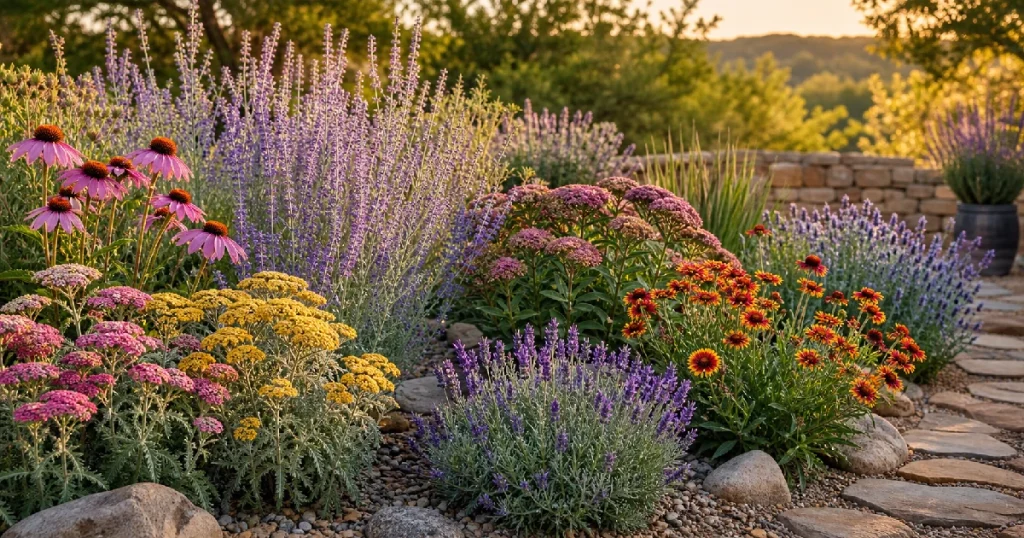
Similar functions are performed by the purple coneflower, Echinacea, which is indigenous to the prairies of North America. These plants have developed deep taproots because they evolved in environments with extreme summer heat and erratic rainfall. The roots store enough moisture to sustain the plant for weeks without rain, and they anchor it securely so that droughts won’t harm it. Throughout the winter, goldfinches and sparrows eat coneflower seedheads, which are left standing. Even when dormant, they earn their position.
At first glance, Russian sage appears to be delicate – those long, airy spikes of blue-purple flowers, those silver-grey leaves catching the light in a way that seems almost too delicate for harsh conditions – which is why it often confuses people at the garden center. In a sunny border, it’s one of the most hardy plants. Most garden beds appear opulent by comparison with the soil that it was cultivated in. Central Asian steppes are its native habitat. Poor drainage will kill it. If there is too much nitrogen, it will become floppy and formless. It seeks full sun, good drainage, and the ability to do most of its own work. When those conditions are met, it blooms from midsummer well into fall.
Stonecrop, also known as sedum, provides consistent late-season color when everything else in the garden is fading, unlike most drought-tolerant plants. In late summer and fall, upright varieties, like ‘Autumn Joy,’ produce clusters of flat-headed flowers that deepen to copper and rust in the fall, then remain attractive seed structures all winter long. Because succulent leaves store water so efficiently, they can withstand weeks without rain without showing any signs of distress. Drainage is one thing they request. Wet soil will cause the crown to rot faster than dry soil.
The catmint plant deserves more recognition than it usually receives. From late spring to fall, it produces clouds of blue-purple flowers that withstand heat, drought, and partial shade. Deer are also repelled by its fragrant foliage. Shear it back after it blooms, and it will quickly recover, yielding a second wave of flowers into September. If you combine it with yarrow or Russian sage, it will basically take care of itself for years. Catmint thrives because most gardeners don’t pay much attention to it.
It defies common sense that Gaillardia, the blanket flower, thrives in poor soil instead of rich, amended garden beds. Overfeeding will cause the stems to grow tall, loose, and topple over. Providing full sun and well-drained soil, it produces those fiery red and yellow daisy flowers from early summer until the first frost. When established in a dry, sunny spot, it tends to endure year after year without much care even though it is a short-lived perennial in most climates (treating it as a biennial and allowing it to self-seed is a useful strategy).
Even though lavender is perhaps the most well-known member of this group, well-meaning gardeners still mistreat it by overwatering and planting it in clay. In hillsides baked by summer sun, its Mediterranean roots developed in rocky soils with little rainfall and quickly draining soils. When those conditions are replicated, such as full sun, sharply drained soil, and gravel mulch to keep the crown dry, lavender practically takes care of itself. A slight shear after flowering keeps it compact and fruitful for many years. It will sulk silently before rotting if you ignore it. There is nothing tough about the plant. As a plant, it simply wants to be treated as such.
To create a drought-tolerant garden from scratch, here are some helpful tips. To establish the root system of these plants, frequent watering is necessary during the first growing season, since they are only drought-tolerant once established. Gravel mulch works best for plants in this category because it keeps crowns dry and reflects heat without holding onto moisture that could rot them. It is easy to destroy a hardy perennial by overfertilizing it; lean soil gives these plants their characteristic compact growth. The majority of them need full sun for at least six hours a day. As soon as they are placed in shade, they weaken, stretch, and lose the structural qualities that initially made them worth planting.
The most productive plots are rarely those with the most intensive management when observing gardens during a challenging summer. In most cases, they belong to gardeners who chose plants appropriate for their current circumstances rather than those they wished they had and neglected them. It appears more deliberate than a high-maintenance garden battling its environment, paradoxically. There is a lesson in that. The most resilient gardens are not those that are climate-resistant. Initially, they selected the best team.
As a Senior Editor at Mini Greenhouse Kits, Hannah Kinsley is a passionate supporter of small-space gardening and urban gardening. Hannah, who is currently majoring in Environmental Policy through the University of Michigan’s Environmental Studies program, infuses her writing with a solid academic foundation and a sincere enthusiasm for the environment. You can find her playing soccer or exploring the city’s green areas with friends when she’s not researching the newest trends in city gardening or creating content for minigreenhousekits.com.