

Take a handful of soil from a well-maintained garden and you’ll notice something right away. An earthy, almost sweet scent is caused by a substance called geosmin, which is created by bacteria that are biologically active in soil. Furthermore, it feels right: it’s dark, a little wet, and it breaks apart in the hand without solidifying into a sticky mass or dissipating into dry dust. In about thirty seconds, most skilled gardeners can reasonably assess the soil’s health without a single piece of equipment. That instinct isn’t magic. A home gardener can obtain most of the information they need through pattern recognition based on observation.
Commercial soil testing kit manufacturers would rather you were unaware of this. If a gardener attempts to understand why a vegetable bed is underperforming or why certain plants continue to struggle despite reasonable care, a clear glass jar, a bottle of white vinegar, and a careful examination of which weeds are growing where can provide surprising comprehensive information. There is no fraud in the kits; they measure what they claim to measure. It is not as complicated as the packaging suggests when it comes to soil science at home.
A straight-sided glass jar, water, dish soap, and patience are all you need for the jar test. Fill the jar about a third full with soil from about six inches down, then add the soap to help separate the particles, and shake vigorously for three minutes. Put it down and observe it after that. Sand sinks to the bottom in the first minute due to its weight. After a few hours, silt settles in the middle layer. Clay floats for up to 24 hours before settling. Based on the proportions of those three layers, you can determine what type of soil you have. Generally, vegetables and garden plants thrive in a loam composed of 40 percent sand, 40 percent silt, and 20 percent clay. Compaction and poor drainage are signs of heavy clay, which has a thick top layer that takes the longest to settle. Usually, sand indicates the opposite: nutrients and water are drained away more quickly than roots can absorb.

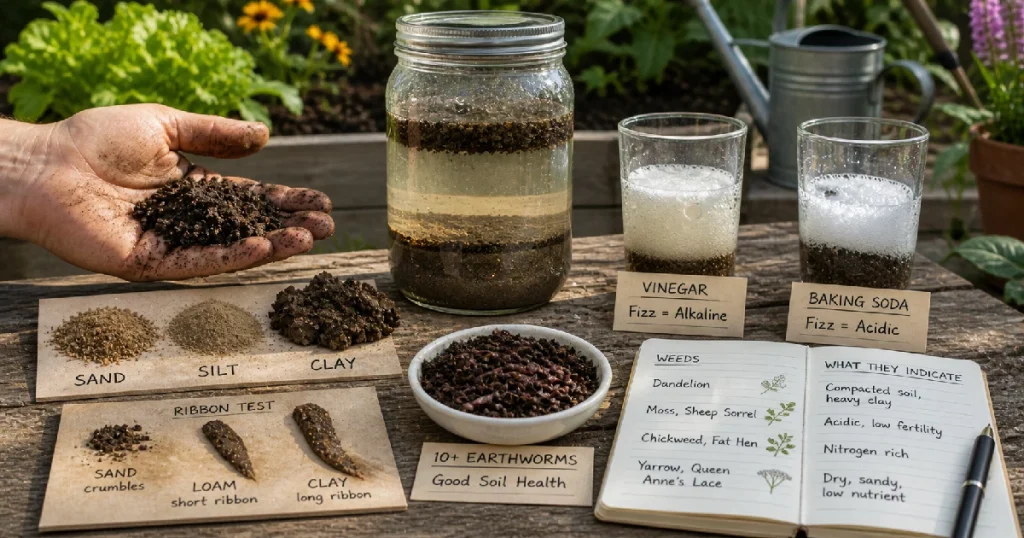
The ribbon test allows you to read the same information more quickly. The soil should be moistened until it resembles putty, formed into a ball, and squeezed out between your thumb and forefinger. Sand crumbles before ribbons form. Loamy soil produces a short ribbon less than an inch long before it breaks. When you’re hoping for loam, clay soil rolls out into a long, smooth ribbon longer than two inches. To complete the two-minute test, you only need your hands.
In the kitchen, you will find everything you need to test pH. Watch for fizzing as you pour half a cup of white vinegar into a bowl with two tablespoons of soil. The vinegar’s acid reacts with the earth’s alkaline compounds to create carbon dioxide bubbles, which indicate alkaline soil. No response? Consider going in the opposite direction. After moistening a soil sample with distilled water, add half a cup of baking soda. Fizzing now indicates acidic soil. If neither test shows any reaction, your soil is neutral, where most plants thrive. Compared to a pH meter, the fizz test is a blunt tool, but it can tell you whether you need to add lime or sulfur, whether blueberries will thrive, and whether brassicas will thrive. The purchase of a thirty-dollar pH kit might have been saved with a half-cup of vinegar, though it’s uncomfortable to consider that in the middle of the process.
One of the most reliable indicators of soil health is earthworms, which are inexpensive to count. A cubic foot of soil, or about a twelve-inch cube, should be dug up, broken up, and counted. Ten or more earthworms indicate a biologically active soil with a respectable organic matter content and a sound structure. The soil needs organic matter, such as compost, aged manure, and leaf mold on a warm spring morning when the soil surface is wet and worm activity is high. Due to their honesty, earthworms do not require calibration.
| Category | Details |
| Subject | Reading and Testing Garden Soil Without Commercial Kits |
| Core Principle | Healthy soil is dark, crumbly, earthy-smelling, and biologically active |
| Texture Test Method | The Jar Test — sand, silt, and clay settle in layers within 24 hours |
| Ideal Soil Composition | 40% sand, 40% silt, 20% clay (loam) |
| pH Test Method | Vinegar (alkaline) and Baking Soda (acidic) — fizzing indicates reaction |
| Optimal Garden pH | 5.5 to 7.0 for most vegetables and flowering plants |
| Soil Health Indicator | Earthworm Count — 10+ worms per cubic foot signals healthy, active soil |
| Weed Indicators | Dandelions = compacted clay; Moss = acidic; Chickweed = nitrogen-rich; Yarrow = dry/sandy |
| Visual Warning Signs | Grey/pale colour = low organic matter; Puddles forming = poor drainage/compaction |
| When to Test | Spring or autumn — autumn preferred, allowing time to amend before planting |
| Professional Option | County extension office soil tests — usually free or low-cost, results in 1–3 weeks |
Weeds growing in a bed are often ignored as soil indicators. The deep taproots and tolerant constitutions of dandelions, plantains, and knotweed enable them to push through compacted, heavy clay. Moss and sheep’s sorrel grow in acidic, low-fertility soil. In addition to being ideal for chickweed and fat hens, nitrogen-rich soil can also be an indication of overfertilization or an imbalance between nitrogen and other nutrients. Yarrow and Queen Anne’s Lac colonize dry, sandy, low-nutrient soil. Farmers and market gardeners have been using it as a diagnostic tool for centuries, and it is still accurate enough to be useful.
Be clear about the boundaries of DIY observation. Jar tests, ribbon tests, vinegar tests, and earthworm counts can be used to determine texture, approximate pH, and biological activity. They cannot identify soil-borne pathogens or heavy metal contamination, nor can they provide you with precise potassium, phosphorus, or nitrogen levels. It is well worth the small cost of a professional soil test from a county extension office when establishing a new growing area or troubleshooting persistent, unexplained failures. The results, which include specific amendment recommendations, cannot be matched by fizzing vinegar. The soil itself communicates everything that is important to most home gardeners. Knowing when to ask is the key.
Alyssa Bennet is a Senior Editor at Mini Greenhouse Kits and a passionate advocate for urban gardening and small-space growing. Currently pursuing her major in Arts at the University of California, Alyssa brings a distinctly creative eye to the world of city gardening – blending artistic sensibility with a genuine love for green living. She writes regularly at minigreenhousekits.com, and when she’s not crafting her next gardening piece, you’ll find her with a paintbrush in hand, watching sports, or exploring the city with friends.