

The early spring brings a certain kind of optimism, the kind that prompts people to fill six terracotta pots at the garden center with whatever seeds seem promising. The corn crop. There are pumpkins. Maybe a large zucchini plant. A few weeks later, the same individual stands over a tangle of yellowing vines that spill over the railing, wondering what went wrong.
It is effective to garden in containers. The method is genuinely and productive, but it only works if you understand this fundamental principle: not all plants were made for buckets. Variety choice makes all the difference between a pot full of lush cherry tomatoes in July and a pot full of dejected, stunted vines. Sadly, seed packets rarely explain this adequately.

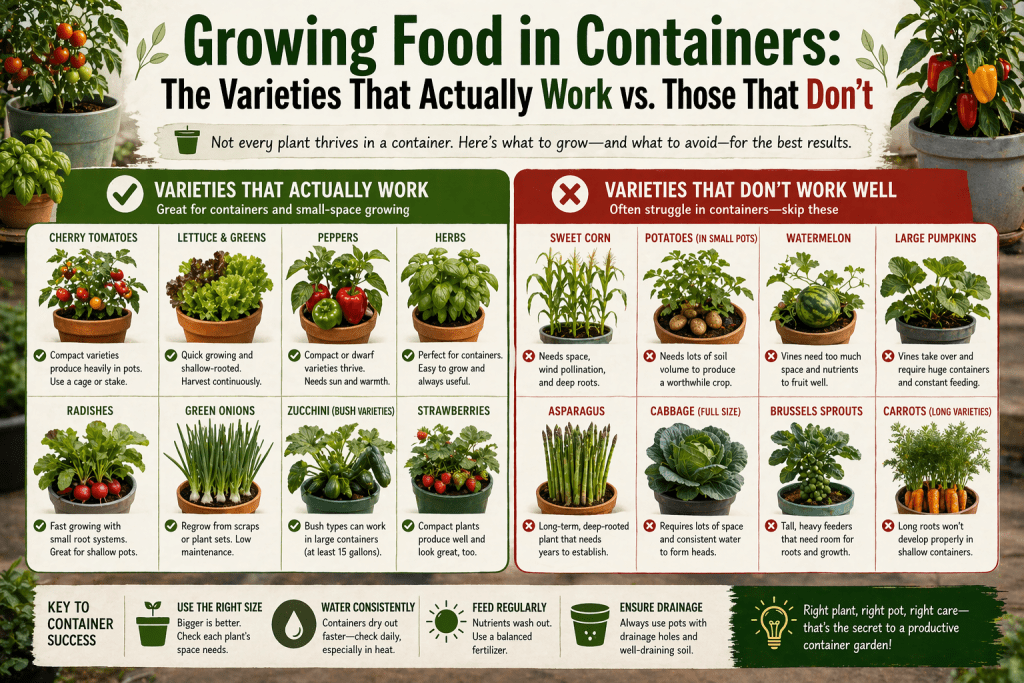
Plants that grow well in containers share a few characteristics. There are usually small varieties referred to as “bush,” “patio,” or “dwarf” in seed catalogs. Instead of growing until frost kills them, they eventually stop growing taller because their roots are shallower or their growth habits are defined. Determined tomatoes are a classic example. A variety such as “Tumbler” or “Patio Princess” grows to a set size, sets fruit, and remains manageable in a 5-gallon pot. Alternatively, an indeterminate variety simply keeps growing, requiring ever-larger cages and ever-richer soil as it matures. When it overwhelms everything around it, it produces fruit that is later and smaller than it would be in the ground.
Peppers are among the best container crops, but most people are unaware of this fact. Growing them in a 3-gallon pot feels like plenty of space, they love heat, and they can withstand slightly drier conditions between waterings. On a sunny patio, “Cayenne” or “Sweet Golden Baby Belle” will produce consistently throughout the season. Furthermore, herbs such as basil, thyme, and rosemary thrive in the naturally dry, well-drained conditions that pots provide. Every Italian apartment balcony seems to have a terracotta pot of herbs baking in the afternoon sun.
Lettuce, for example, is one of the most forgiving greens. They grow quickly, have shallow roots, and are suitable for window boxes and hanging baskets. Tom Thumb lettuce grows only four or five inches wide at maturity, making it ideal for small spaces. A radish, which is often planted as an afterthought, can grow in as little as three weeks and requires very little depth. Most container success stories follow the same logic: rapid production, compact habits, and smaller roots.
Next, we have the other category. Corn is probably the most common error. In order to ensure proper pollination, it must be planted in dense blocks and grows to heights that make a potted plant look ridiculous. It’s difficult to ignore the pattern when people share their balcony corn experiments online: many tall, healthy stalks and almost no ears. Standard vine squash and pumpkins, which spread up to fifteen feet and occupy all available space, are also inappropriate. Because asparagus is a perennial with deep roots and a long establishment period, planting it in a container is essentially symbolic.
Artichokes occupy an intriguing middle ground. In spite of their ability to grow in pots, these perennials outgrow them quickly, produce little, and provide little return to the grower. Long-rooted carrots twist and fork in shallow or narrow containers, more like art projects than vegetables, and require a depth of 12 to 18 inches for standard varieties. Round varieties, such as “Paris Market” and “Tonga di Parigi,” completely avoid this problem and perform well when placed in a deep container.
A lot more consideration should be given to soil when discussing container gardening. Transferring garden soil directly from a bed to a pot quickly compacts and compacts it. When roots suffocate due to improper water drainage, disease develops. With soilless potting mixes composed of peat, coconut coir, perlite, and vermiculite, light and well-aerated conditions are maintained. Compost greatly increases nutrient content. During periods of extreme heat, a seasoned container gardener found that combining potting soil about half-and-half with garden dirt kept the roots cooler and prevented wilting. Beginner guides usually do not include such specific, hard-won information.
Watering is a battle many people lose in silence. In particular, fruiting plants require deep, steady moisture at their roots, and containers dry out more quickly than in-ground beds on hot days. Shallow, frequent watering produces weak, surface-grazing roots that cannot support heavy fruit set. Water the soil completely until it runs out, then let it dry a little before doing it again. Plants make their needs fairly clear, but calibration requires some observation.
| Category | Details |
| Topic | Container Vegetable Gardening |
| Best For | Balcony, patio, rooftop, and small-space growers |
| Top Performing Plants | Determinate tomatoes, peppers, lettuce, herbs, bush cucumbers, radishes |
| Plants to Avoid | Corn, vining squash, asparagus, artichokes, indeterminate tomatoes |
| Minimum Pot Size | 5 gallons for most fruiting vegetables |
| Soil Recommendation | Soilless potting mix (not garden soil) |
| Watering Frequency | Daily in summer; sometimes twice daily in heat |
| Fertilizing | Slow-release at planting + liquid feed twice monthly |
| Reference | The Old Farmer’s Almanac – Container Gardening |
Fertilization is more important in containers than anywhere else. When you water deeply, nutrients flow out of the potting mix along with the water. It is likely that a liquid feed will be needed every few weeks during the active growing and fruiting season, but a slow-release fertilizer at planting gives plants a head start. Fish emulsion, liquid seaweed, and compost tea are all beneficial. Pale leaves and sluggish growth are usually signs that they are low.
The mobility, cleanliness, and ability to move a pot two feet to the left when the light shifts in August of a well-planned container garden cannot be matched by an in-ground bed. Perhaps more people would follow the advice if it were more straightforward-start with cherry tomatoes, peppers, and lettuce; omit the corn; get a larger pot than you think you need; and water frequently. Although there is a learning curve, it is short.
As a Senior Editor at Mini Greenhouse Kits, Hannah Kinsley is a passionate supporter of small-space gardening and urban gardening. Hannah, who is currently majoring in Environmental Policy through the University of Michigan’s Environmental Studies program, infuses her writing with a solid academic foundation and a sincere enthusiasm for the environment. You can find her playing soccer or exploring the city’s green areas with friends when she’s not researching the newest trends in city gardening or creating content for minigreenhousekits.com.