

There is a specific kind of silence that only exists at six in the morning in a backyard that is still trying to decide if it wants to be a garden or a graveyard. I have spent a lot of those mornings standing barefoot on cold grass, staring at a patch of wilted kale and wondering why I keep doing this to myself. Gardening is a strange, beautiful, and often frustrating form of slow-motion gambling. You put a seed in the ground, you offer it water and hope, and then you wait to see if the universe decides to cooperate or if a rogue rabbit will end the experiment by Tuesday. Over the years, my approach has shifted from a desperate attempt to control nature to a quiet, somewhat messy collaboration with it. I have realized that the most useful gardening tips are rarely the ones found in a glossy manual about soil pH levels. They are the ones you learn after you accidentally kill your third hydrangea because you thought it liked the afternoon sun when it clearly, desperately did not.
We live in a world that moves too fast, and a garden is the ultimate antidote to that speed. It forces a rhythm on you that cannot be hacked or optimized. You cannot make a tomato ripen faster by shouting at it or by upgrading your software. This realization is where the real work begins. I remember the first time I tried to grow anything more ambitious than a plastic succulent. I bought all the expensive tools, the designer gloves, and the bags of sterilized potting mix that smelled like a chemistry lab. None of it mattered. My garden was a disaster because I was treating it like a project to be managed rather than a living thing to be observed. Experience has taught me that watching is just as important as weeding.

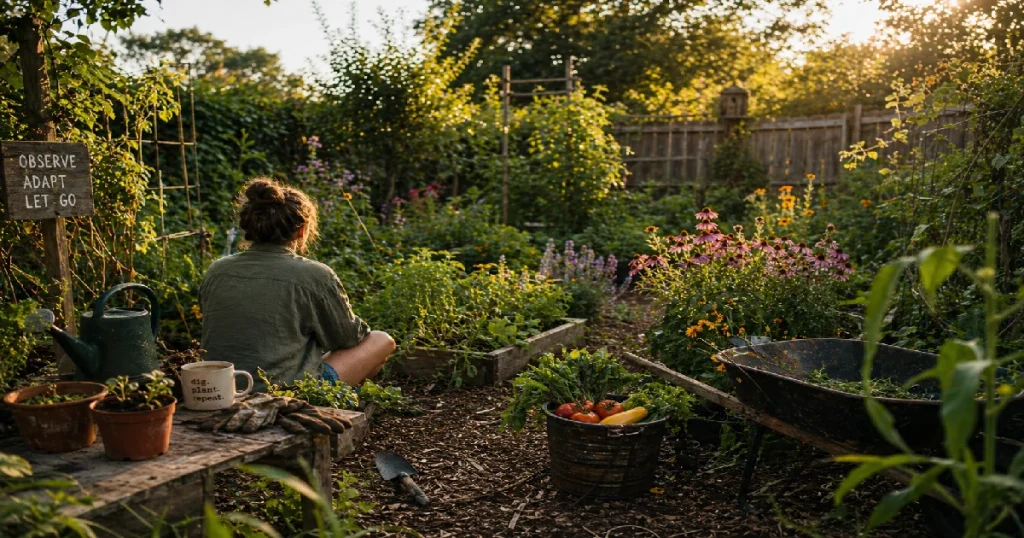
Why most beginner gardening tips fail to mention the chaos
When you start out, you are bombarded with advice that makes everything sound so linear. People tell you to plant in straight rows and follow the back of the seed packet like it is holy scripture. But the truth is that gardening tips for beginners should probably start with a warning about how much of this is actually about failure. My first real success came from a pile of compost I had forgotten about. A pumpkin vine just decided to emerge from the rot and take over half the driveway. It taught me more about what plants actually want than any book ever could. They want to be left alone just as much as they want to be cared for. We often over-parent our plants, drowning them in too much water or fussing with their roots until they give up out of sheer exhaustion.
The dirt itself is a storyteller. You learn to feel the difference between soil that is exhausted and soil that is humming with life. I have become the kind of person who sticks my hand into a flower bed just to feel the temperature of the earth. It is an intuitive process that takes time to develop. For those looking for beginner gardening tips that actually stick, I would say focus on your particular patch of earth before you buy a single seedling. Notice where the frost lingers longest in February. Pay attention to how the wind whips around the corner of your house. Every yard has its own microclimate, its own little pockets of drama and peace. If you ignore those nuances, you are fighting an uphill battle against the land itself, and the land always has more stamina than you do.
I have grown to love the imperfections. A garden that looks like a museum is usually a garden that is miserable to maintain. I like the weeds that have pretty blue flowers. I like the way the mint tries to stage a coup and occupy the entire herb garden. There is a certain honesty in the mess. It reflects the reality of life, which is rarely tidy and always a bit out of control. When we try to impose too much order, we lose the magic of the unexpected volunteer plant that arrives via a bird or the wind. Some of my favorite flowers are the ones I never actually planted.
Adapting to the concrete and the shift toward urban gardening tips
Not everyone has an acre of loam to play with. I spent five years trying to grow things on a third-floor balcony that faced north and caught about twenty minutes of direct light a day. That period of my life was a masterclass in compromise. Most urban gardening tips focus on vertical space or fancy hydroponics, but I found that it was mostly about understanding the heat. Concrete holds onto warmth in a way that soil doesn’t. My pots would bake in the mid-afternoon, turning into little ovens that scorched the roots of my basil. I had to learn the art of the heavy pot and the mulched surface, even in a container.
There is something defiant about growing food in a city. Tucking a few pepper plants between a brick wall and a fire escape feels like a small act of rebellion against the sterile environment of the street. It connects you to the seasons in a place where the seasons are often just something you see through a window or feel as a draft under the door. Spring gardening tips usually revolve around the excitement of the first thaw, but in the city, spring is more about the return of the light hitting the narrow alleyways. It is about dragging heavy bags of soil through a subway station or up three flights of stairs because you just can’t wait for the garden centers to start their delivery service.
I once knew a man who grew an entire forest of tomatoes in five-gallon buckets on a flat roof in Brooklyn. He didn’t have a hose; he carried every drop of water up a ladder. His plants were the healthiest I have ever seen. When I asked him how he did it, he just pointed to the plants and said they were grateful. It sounds sentimental, but there is a grain of truth in it. Plants in an urban setting are often under more stress from pollution and reflected light, so they require a different kind of vigilance. You become a guardian of a tiny, fragile ecosystem that shouldn’t exist but does because you willed it into being.
The transition into the warmer months always feels like a frantic race. My spring gardening tips are usually less about planting and more about cleanup. You spend weeks pulling back the dead stalks of last year and seeing what survived the frost. It is a time of reckoning. Some things don’t make it, and that loss is part of the cycle. I have learned not to mourn the plants that die in the winter. They make room for something new, for a different experiment. This year, I am leaning into the wildness. I am letting the clover take over the paths because the bees seem to prefer it to the mulch I usually lay down.
There is no such thing as a finished garden. It is a work in progress that ends only when you stop showing up. People often ask for gardening tips as if there is a secret formula that will guarantee a bounty of perfect roses or massive zucchinis. The only real secret is persistence. You have to be willing to get your knees dirty, to get sunburned, and to deal with the inevitable heartbreak of a late frost or a hungry groundhog. It is a hobby for the patient and the resilient.
I find myself thinking about the future of my small patch of earth more often these days. I wonder what it will look like in ten years if I keep letting the perennials roam where they want. Maybe it will become a jungle, or maybe it will revert to a meadow. Either way, the act of tending to it has changed me more than I have changed the dirt. I move a little slower now. I listen a little more. I don’t mind the stains on my jeans as much as I used to. There is a profound sense of peace that comes from knowing you are just one small part of a very large, very ancient process.
The sun is starting to dip below the neighbor’s roofline now, and the shadows are stretching out across the hostas. I should probably go inside and wash the mud off my hands, but the air smells like damp cedar and lavender, and it feels wrong to leave just yet. There is still a bit of weeding to be done, or maybe I’ll just sit here and watch the fireflies start to wake up. The garden will still be here tomorrow, doing its quiet work while I sleep, waiting for the next time I decide to come out and try to understand what it is trying to tell me.
As a Senior Editor at Mini Greenhouse Kits, Hannah Kinsley is a passionate supporter of small-space gardening and urban gardening. Hannah, who is currently majoring in Environmental Policy through the University of Michigan’s Environmental Studies program, infuses her writing with a solid academic foundation and a sincere enthusiasm for the environment. You can find her playing soccer or exploring the city’s green areas with friends when she’s not researching the newest trends in city gardening or creating content for minigreenhousekits.com.