

From a distance, a small yard in a suburb outside of Philadelphia looks like any other. The fence, the house, and the lawn are modest. When you get close, the fence virtually disappears and is replaced by a cascade of green. Pole beans twist up the netting. Bamboo poles support cherry tomatoes. As cucumber vines approach the top rail, they appear to be fleeing. A homeowner, who started all of this on a whim during a pandemic spring, harvests enough food to feed four people from late June through October. She did not add a single square foot of ground space. The only thing she could do was raise her gaze.
Instead of letting vegetables sprawl across the ground, people have grown them on trellises, arches, walls, and wire frames for centuries. Vertical vegetable gardening is this practice. Now, something seems different. More and more people are refusing to accept their smaller living spaces as a limitation, whether it’s thanks to urban homesteading or growing awareness of the true cost of food. Even five years ago, it seemed strange to see a living wall of herbs or a trellis filled with cucumbers.
The appeal is easy to understand. Vertical growing increases yield without expanding the footprint. This means that plants are more visible, more accessible, and -most importantly – easier to harvest. It becomes optional for gardeners to bend and kneel, the customary tax on their knees and backs. Additionally, there is a disease argument that receives little attention: leaves dry out more quickly after rain, air circulates more freely, and powdery mildew, which destroys so many crops during rainy seasons, struggles to establish itself when foliage is off the ground.

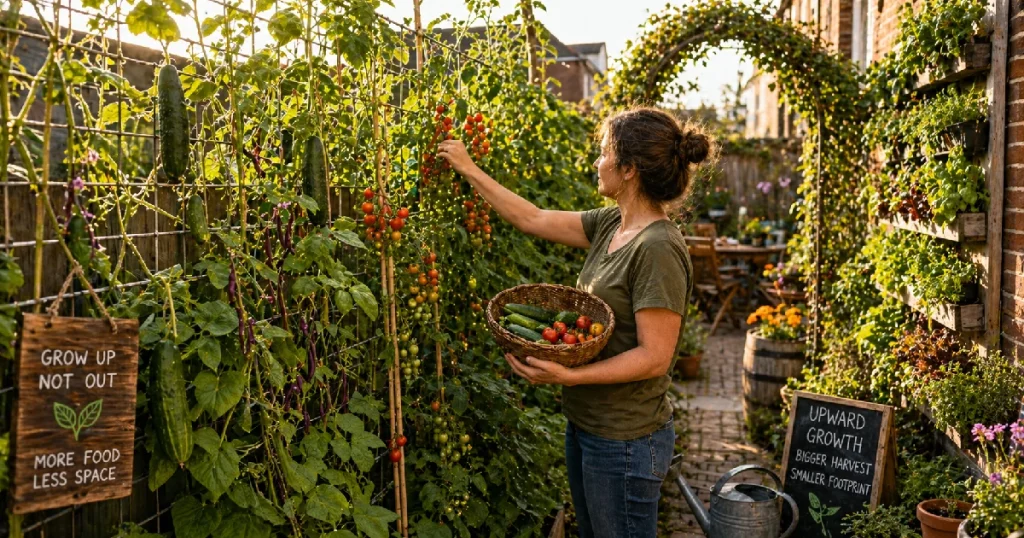
Plant selection is more important than most beginner guides emphasize. Trying to force a bush-like crop to climb a trellis is a lesson in frustration. A little encouragement and support will allow pole beans, climbing peas, vining cucumbers, indeterminate tomatoes, and rambling squash and zucchini varieties to soar to new heights without complaining. Sweet potatoes are usually considered ground crops, but they can be successfully redirected upward and sprawl enthusiastically. Once the fruit begins to grow, hammock-style fabric slings are required; otherwise, gravity will decide.
Structures range from sophisticated to improvised. Using galvanized steel uprights and heavy-gauge wire panels bent into a walkway is the strongest option. Walking beneath one in July when beans and cucumbers are suspended at shoulder height is truly theatrical. Bean teepees made from bamboo canes have a different kind of charm; they are straightforward, rustic, and look good in a kitchen garden before they grow anything. With trellises bolted to shed walls or fences, you can convert an otherwise useless vertical surface into useful space. Salad greens and herbs can be grown in old wooden pallets that have been sanded and upright with little work.
Watering catches deserve a mention. Vertical plantings, especially those mounted on walls, dry out more rapidly than in-ground beds. Because the wall casts a rain shadow, precipitation strikes the planter’s front while the back remains dry. Most of this can be resolved with a timer-equipped drip irrigation system, or for those who prefer to keep things simple, a daily hose check in the morning should suffice. Gardeners may be put off by the extra watering care, which seems like a trade-off worth considering before constructing a twenty-foot living wall.
Sunlight is another limit that is often overlooked. Vegetables require at least six hours of direct sunlight per day, and a wall that faces north or is shaded by a higher structure won’t provide this. The safest surfaces are those facing south or west. An added benefit is thermal mass: stone or brick walls absorb heat during the day and radiate it back at night, extending the growing season. Plants that grow in front of a dark brick wall in early spring often appear a week before those that grow in open spaces nearby.
If you live in the city and only have a balcony or a fire escape, your options are limited, but they are not nonexistent. Tower planters, which are columnar structures with planting pockets on the sides, work well for herbs, lettuces, and strawberries. Wall-mounted fabric pockets work well for crops with shallow roots. Wet soil is heavy, and balcony railings are rarely designed with kitchen gardens in mind. It is common for people to neglect checking load limits prior to installation until something goes wrong.
Indoor vertical gardens fall into a slightly different category. A row of mason jars or tiny pots clamped to a board and hung next to a bright kitchen window makes sense, even though it’s more of a herb station than a garden. Basil, chives, mint, and oregano thrive under those conditions, and chopping fresh herbs straight into a pot on the stove is a small domestic pleasure that makes a Tuesday night feel thoughtful rather than hurried. The equivalent of putting flowers on the table is putting flowers in the garden.
It’s important to remember that vertical vegetable gardening is not a miracle cure. Good soil or growing medium, steady moisture, and a willingness to discover which crops cooperate are all necessary. Squash that becomes so heavy that it bends a bamboo pole in half or cucumber that loses its grip and falls from a second-story trellis provide quick educations. Actually, everything in a garden does. Vertical growth imparts these lessons at eye level, making observation and, ultimately, correction easier.
As a Senior Editor at Mini Greenhouse Kits, Hannah Kinsley is a passionate supporter of small-space gardening and urban gardening. Hannah, who is currently majoring in Environmental Policy through the University of Michigan’s Environmental Studies program, infuses her writing with a solid academic foundation and a sincere enthusiasm for the environment. You can find her playing soccer or exploring the city’s green areas with friends when she’s not researching the newest trends in city gardening or creating content for minigreenhousekits.com.